





Butterscotch Amber Beads
Butterscotch amber beads bring warm, opaque tones to the neck, offering wearers rich historical character from the Edwardian era through the mid-twentieth century.
Butterscotch Amber Beads
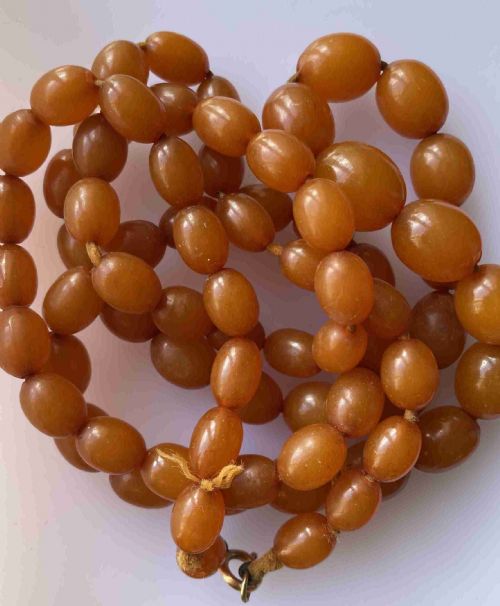
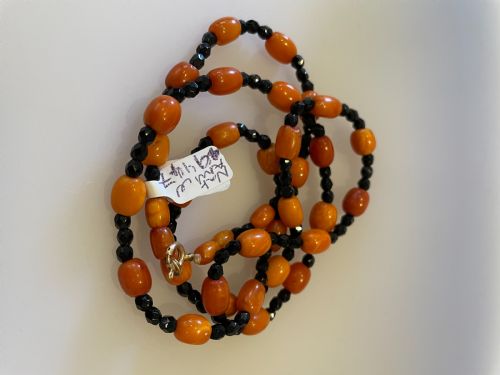
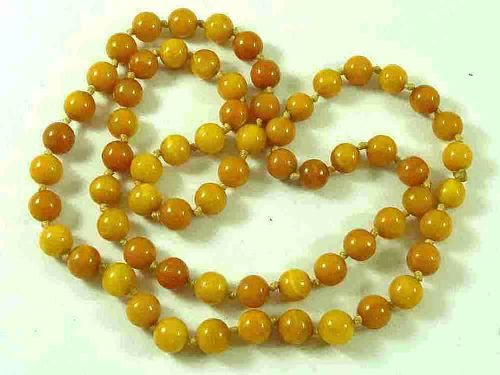
When you search for butterscotch amber beads, you encounter necklaces and jewellery sets spanning the Edwardian period, the 1930s, and the 1950s. These pieces include graduated bead necklaces featuring large barrel shapes and raw polish finishes.
You are most likely to meet 1930s creations on this page, often described as Baltic amber or phenolic resin alternatives. These items showcase styles ranging from Art Deco and Baltic Folk to Ethnic and Bohemian designs.
The assortment contains both genuine fossilised tree resin and early synthetics like Bakelite. Such pieces range from sterling silver mounted sets to simple threaded strands.
How they were made
Maker construction relies on natural and synthetic materials threaded securely together, sometimes paired with metal components and sterling silver clasps. Traditional examples utilise organic Baltic amber shaped into graduated barrel forms.
Alternative items incorporate Bakelite and phenolic resin moulded to replicate the dense, cloudy opacity of genuine resin. Artisans finished these ornaments with threaded cords and secure barrel clasps.
Butterscotch Amber Beads Retail Price Guide 2026
Typical asking prices for butterscotch amber beads among the pieces listed under this phrase on Sellingantiques today, from the lower quarter to the upper quarter. They describe what is for sale here now, not the wider market.
Some necklaces reach past thirty inches in length, ensuring plenty of golden resin to swing while you walk.
What varies in quality
Quality differences depend upon the consistency of the opaque colouration and the regularity of bead graduation. Uniformity in size across long lengths distinguishes superior strands from mixed lots.
The integration of precious metal mounts and the inclusion of original barrel clasps elevate individual pieces. Material purity also divides natural fossilised resin from synthetic substitutes.
The Butterscotch Amber Beads Glossary
- Graduated beads
- Beads arranged by size along a strand so that the largest rest at the centre front and taper towards the clasp. This traditional layout draws the eye downwards.
- Barrel clasp
- A small, cylindrical fastening mechanism that screws together securely. You find this specific hardware frequently on period necklaces.
- Phenolic resin
- An early synthetic material used to replicate the appearance of organic resin. It mimics the density and yellow-brown hue of older specimens.
- Baltic amber
- Fossilised tree resin originating from the region around the Baltic Sea. It serves as the primary organic material for these historic ornaments.
Butterscotch Amber Beads: Frequently Asked Questions
How do I wear these necklaces?
These necklaces suit both casual and formal attire, hanging comfortably around the collarbone or lower depending on the length of the strand.
Heavier graduated versions make strong focal points when paired with simple necklines.
What periods do these pieces span?
The available selection covers items from the Edwardian period through the 1930s up to the 1950s.
Art Deco and folk styles dominate the nineteen-thirties examples.
Are all these beads genuine amber?
The material varies across the listings to include both natural Baltic amber and early plastics like Bakelite.
Phenolic resin was frequently utilised during the twentieth century to achieve similar opaque golden tones.
How are the strands fastened?
Many items utilise traditional screw-in barrel clasps designed to blend seamlessly with the end beads.
Other examples incorporate metal findings or sterling silver mountings.