




Vintage Amber Bead Necklace
A vintage amber bead necklace brings a warm, organic glow to the neckline, prized for its deep honey tones and tactile history.
Vintage Amber Bead Necklace
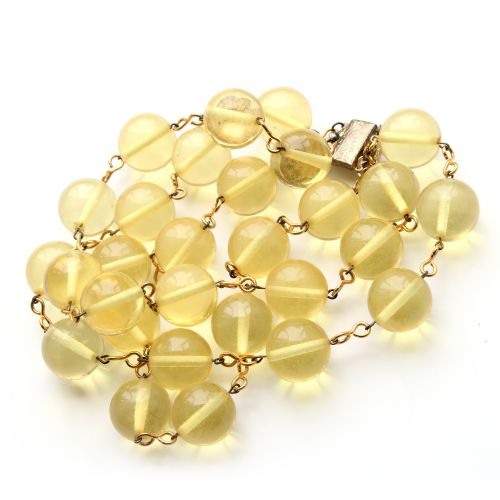
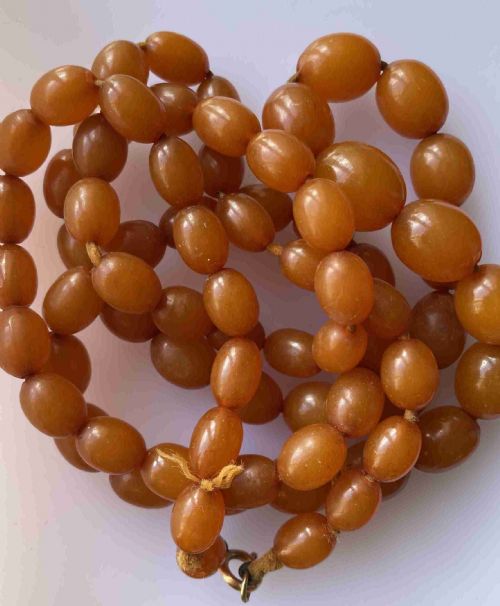
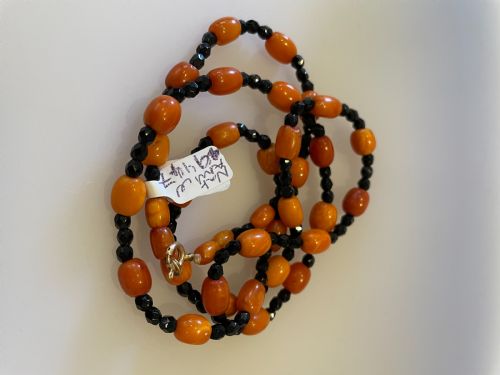
A vintage amber bead necklace brings together fossilised tree resin fashioned into smooth, polished spheres or organic shapes. When searching for a vintage amber bead necklace, buyers encounter pieces spanning from the Edwardian era through the nineteen-thirties and nineteen-fifties.
The most common examples on this page feature butterscotch, egg yolk and honey hues, often strung with graduated beads. These range from short Edwardian lengths to longer thirty-three-inch strands recorded in the archives.
Some variants incorporate alternative mid-century plastics like Bakelite and Lucite alongside genuine Baltic amber or sterling silver settings. Each piece carries the distinct weight and warmth characteristic of its specific period of manufacture.
How they were made
Makers shaped natural Baltic amber and early plastics like Bakelite and Lucite by hand or machine into spherical, barrel and raw organic bead forms. Artisans then drilled each component individually to thread them securely onto cord, thread or metal findings.
Clasps and settings frequently utilised sterling silver or chrome to complement the warm tones of the amber and phenolic resin. Graduated strands required careful sorting by size, ensuring a smooth transition from smaller terminal beads to larger centre pieces.
Some amber beads retain ancient trapped insects, offering a microscopic prehistoric snapshot beneath your collarbone.
What varies in quality
Quality in a vintage amber bead necklace rests upon the depth and consistency of the material's colour, ranging from pale butterscotch to rich translucent honey. Superior examples display desirable natural inclusions and marbling rather than flat, uniform opacity.
Graduation symmetry and bead uniformity dictate the visual rhythm of the strand, while secure stringing and original barrel clasps preserve structural integrity. The presence of matched sets, such as accompanying earrings, elevates the desirability of the piece.
Paris House London
The Vintage Amber Bead Necklace Glossary
- Baltic amber
- Fossilised tree resin originating from the Baltic region, valued for its clarity, warm palette and natural inclusions. It serves as the primary organic material found across many listed necklaces.
- Bakelite
- An early form of phenolic resin developed in the early twentieth century, utilised in various vintage jewellery pieces for its dense weight and rich colour range. It appears frequently alongside genuine amber in twentieth-century designs.
- Graduated beads
- A stringing technique where beads decrease progressively in size from the centre front towards the clasp. This method ensures a balanced drape around the wearer's neck.
- Lucite
- A transparent thermoplastic material introduced in the mid-twentieth century, employed by designers to create colourful statement bead necklaces. It offers a lighter alternative to heavier resins and natural stone.
Vintage Amber Bead Necklace: Frequently Asked Questions
How do I clean vintage amber?
Clean vintage amber gently using a soft, damp cloth without harsh chemical detergents or ultrasonic jewellery cleaners. Pat the beads dry immediately with a lint-free cloth to preserve the surface polish.
Avoid exposing the resin to alcohol, perfume or hairspray, as these substances can dull the natural finish over time. Store the necklace separately in a soft pouch to prevent scratching from harder metals.
Are these necklaces made of real amber?
The listings include both genuine Baltic amber and early synthetic alternatives such as Bakelite, Lucite and phenolic resin. Each material possesses distinct weight and tactile warmth that separates it from modern glass or plastic.
Checking the titles and descriptions will confirm whether a specific piece uses natural fossilised resin or alternative mid-century materials. Both categories hold distinct collector interest and historical value.
How should I store my necklace?
Store your bead necklace flat in a dedicated fabric-lined box or a soft cloth pouch to protect the thread and surface. Keeping it away from direct sunlight and extreme temperature fluctuations prevents the amber or resin from drying out.
Ensure the strand is not tightly coiled or compressed beneath other heavy items, which can strain the original stringing material over prolonged periods.
What length are these necklaces?
Lengths vary considerably across the collection, ranging from shorter Edwardian collar styles to long strands measuring over thirty inches. Longer versions offer versatility for doubling up or wearing as a continuous opera-length piece.
Specific dimensions, including bead counts and total weight in grams, are detailed in individual item listings to help you choose the right fit.