


Art Deco Bead Necklace
An art deco bead necklace brings together geometric design and distinctive materials from the early twentieth century.
Art Deco Bead Necklace
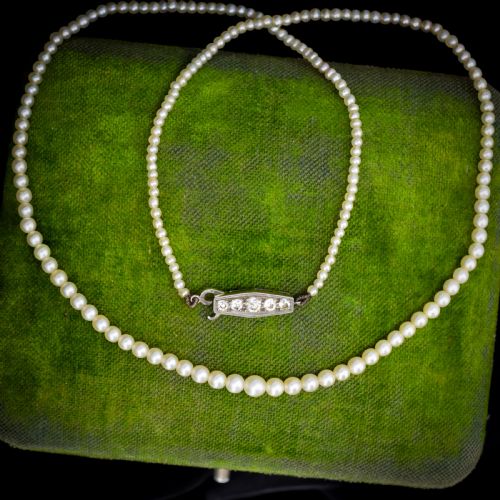
An art deco bead necklace encompasses pieces fashioned during the 1920s, 1930s, and subsequent decades, displaying the characteristic geometric and modernist lines of the period. Buyers exploring this selection encounter strands featuring materials ranging from early plastics to fine gemstones.
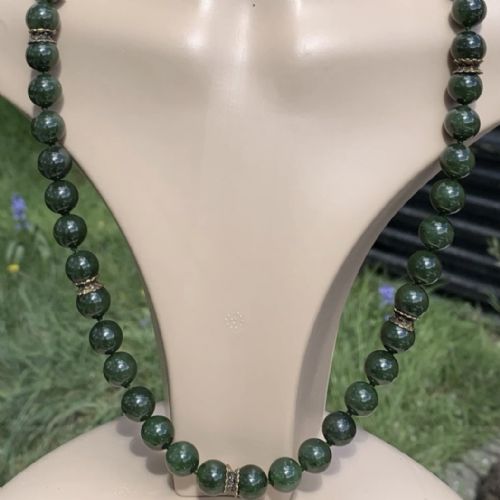
The assortment includes examples featuring bakelite, amber, rock crystal, jade, pearl, and glass beads, often paired with silver, chrome, or gold clasps. Graduated bead formations and distinct colour palettes dominate the pieces currently and previously recorded in the inventory.
Many items reflect the specific design ethos of the interwar years, utilising chrome alongside green glass, or pairing phenolic resin with metallic accents. These necklaces serve as wearable examples of twentieth-century design evolution.
Materials and construction
Maker techniques involve stringing individual beads - whether carved from natural Baltic amber, moulded from bakelite, or faceted from rock crystal and green glass - onto durable cords. Metal components such as silver and chrome form the clasps and spacers that secure the strands.
Clasps frequently incorporate finer details, including diamond chips, platinum settings, or 18ct white and yellow gold work. Gemstones like emerald, tourmaline, and nephrite jade are shaped and polished to complement the primary bead material.
One cheerful piece pairs bright green glass with industrial chrome, proving that modernist glamour could be achieved without precious stones.
Distinguishing quality in the pieces
Quality rests upon the uniformity of bead graduation, the precision of faceting in materials like rock crystal, and the selection of primary substances such as natural amber versus moulded phenolic resin. Superior examples display consistent symmetry and careful matching across every bead in the strand.
The refinement of the clasp mechanism and the integration of precious metals or gemstones elevate certain pieces above standard production. The presence of precious stones like diamonds or emeralds in the fastening points indicates higher tier craftsmanship.
The Art Deco Bead Necklace Glossary
- Bakelite
- An early form of synthetic phenolic resin widely utilised for moulded beads during the 1930s. It develops a distinct warmth and patina over time.
- Graduated
- Describing a strand where beads increase in size progressively toward the centre. This arrangement draws the eye along the curvature of the necklace.
- Rock crystal
- Colourless transparent quartz carved and faceted into beads. It offers a bright, clear alternative to glass.
- Nephrite jade
- A dense mineral carved into smooth beads for ornamental wear. Its deep green tones feature prominently in antique Asian-influenced designs.
- Spacer
- A small decorative element placed between larger beads to separate them. Spacers add length and visual rhythm to a strand.
Art Deco Bead Necklace: Frequently Asked Questions
How should I care for my art deco bead necklace?
Store each necklace flat in a lined box to prevent tension on the stringing cord and protect softer materials from scratching against one another.
Clean organic materials like amber and pearl with a soft, dry cloth rather than chemical dips or ultrasonic cleaners.
What materials were commonly used in these necklaces?
Makers utilised a wide range of substances including synthetic resins like bakelite and phenolic resin, organic materials such as amber, pearl, coral, and jade, alongside minerals like rock crystal, opal, and tourmaline.
Metal components typically consist of silver, chrome, platinum, or gold, occasionally accented with small diamonds or paste stones.
How can I tell if a bakelite bead necklace is authentic?
Authentic bakelite from the interwar period exhibits specific weight, warmth to the touch, and subtle surface ageing consistent with decades of handling.
Many examples feature characteristic colour variations such as butterscotch or cherry tones that developed as the material aged.
Are these necklaces adjustable in length?
Most antique strands retain their original fixed length, which is determined by the cord and the specific number of graduated beads.
Extender chains are uncommon on authentic period pieces, though a specialist can occasionally adjust the length by altering the stringing.