

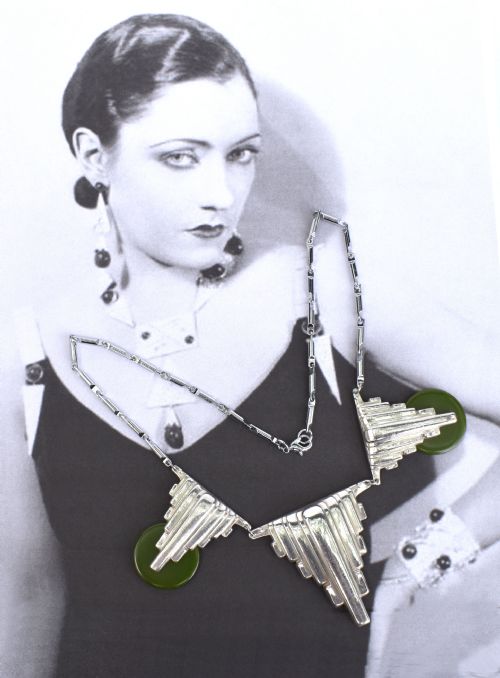


1930s Bakelite Jewellery
These pieces of 1930s bakelite jewellery bring striking Art Deco geometry and vibrant colour to any collection.
1930s Bakelite Jewellery
1930s bakelite jewellery encompasses necklaces, earrings, bracelets, brooches, and dress clips shaped by the bold aesthetic of the Art Deco period. These ornaments capture the modernist spirit of the interwar years through geometric forms and saturated colours that defined the era's accessories.
The pieces you encounter here lean heavily into modernist design, frequently pairing colourful synthetic resins with polished chrome metal. While the majority originate from the 1930 decade, occasional early twentieth-century examples also appear among the selection.
How they were made
Manufacturers utilised early synthetic plastics such as bakelite, phenolic resin, and galalith, cutting and moulding them into geometric shapes. These colourful resin components were then typically mounted in frames of chrome or chrome metal.
Many designs incorporated flexible elements like elastic to ensure comfortable wear for necklaces and bracelets. The combination of industrial metals with vibrant synthetic resins was a hallmark technique of the period's modernist makers.
Current listings feature Art Deco items created from bakelite, phenolic resin, galalith, and chrome metal.
What varies in quality
Quality in these ornaments rests primarily on the sophistication of the modernist design and the precision of the construction. Pieces that successfully integrate chrome metal with complex resin geometry stand apart from simpler mouldings.
The preservation of the original materials also dictates the standing of a piece. Clean integration of elastic, metal, and resin components without structural modification marks the finer examples.
Jakob Bengel
The 1930s Bakelite Jewellery Glossary
- Bakelite
- An early synthetic phenol-formaldehyde resin widely utilised in interwar design for its versatility and rich colour range. It formed the backbone of affordable modern jewellery.
- Galalith
- A semi-synthetic plastic derived from casein and formaldehyde, often employed in modernist pieces for its smooth finish and vibrant hues. It resembles bakelite but originates from milk protein.
- Dress clip
- An accessory featuring a hinged mechanism with teeth on the reverse, designed to clamp securely onto lapels, necklines, or straps. They were immensely popular during the Art Deco period.
- Modernist
- A design style emerging in the early twentieth century that favoured clean lines, functional forms, and industrial materials over traditional ornamentation. It heavily influenced 1930s accessories.
1930s Bakelite Jewellery: Frequently Asked Questions
What is 1930s bakelite jewellery?
These ornaments are period accessories fashioned from early synthetic plastics, primarily taking the form of necklaces, earrings, and dress clips.
They reflect the modernist design ethos of the 1930s through geometric shapes and industrial material combinations.
How do I wear these pieces?
Necklaces and earrings from this era suit both evening wear and tailored daytime outfits, adding a distinct splash of colour.
Dress clips attach easily to lapels or collars, offering versatile placement options for vintage accessories.
What materials are used?
The primary component is synthetic resin, most notably bakelite and galalith, known for their deep tones and durability.
Chrome metal frequently complements the plastic elements, occasionally supported by elastic for flexibility.