


Brown Walnut Canterbury Stand
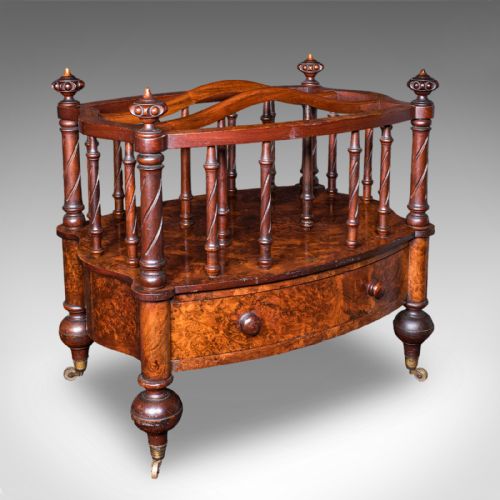
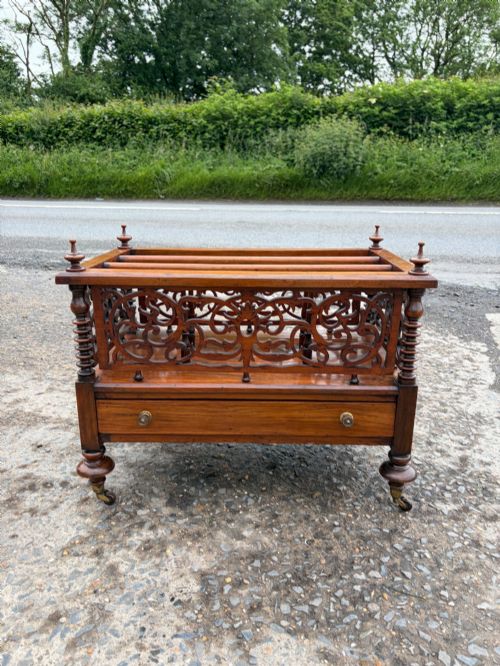
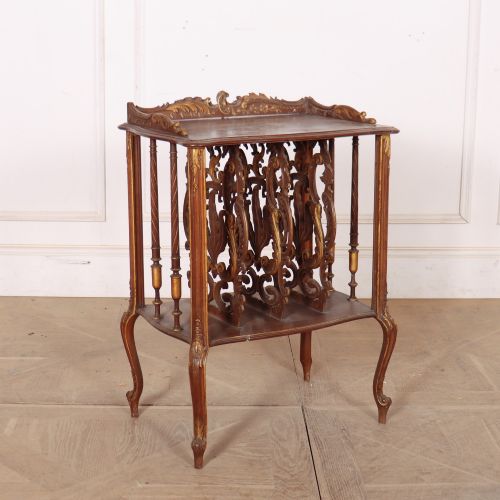
These brown walnut canterbury stands are practical pieces designed to hold sheet music and periodicals, bringing rich timber tones to a room.
Brown Walnut Canterbury Stand
A brown walnut canterbury stand is primarily defined by its partitioned sections for organising books, magazines or sheets of music, often combined with drawers or lower tiers. The pieces gathered here span the Victorian and Edwardian eras, alongside select examples from the Regency period and the nineteenth century.
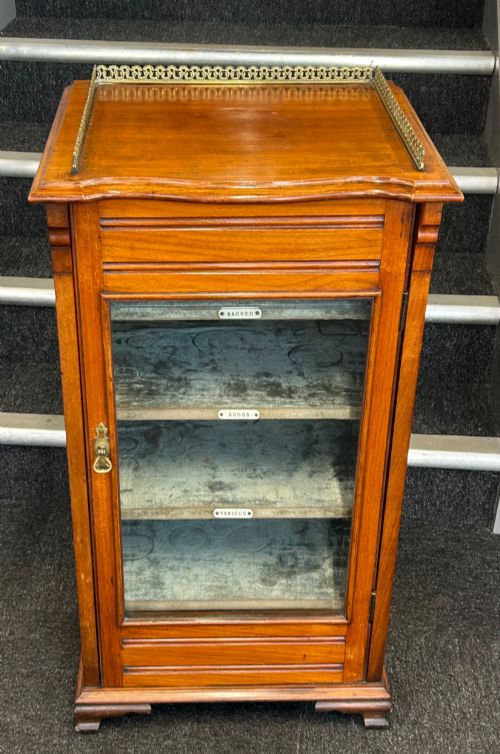
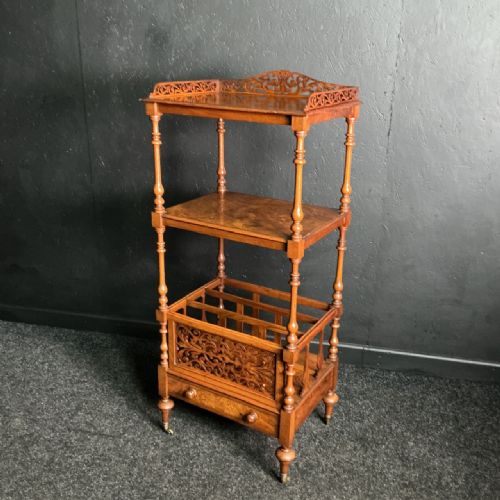
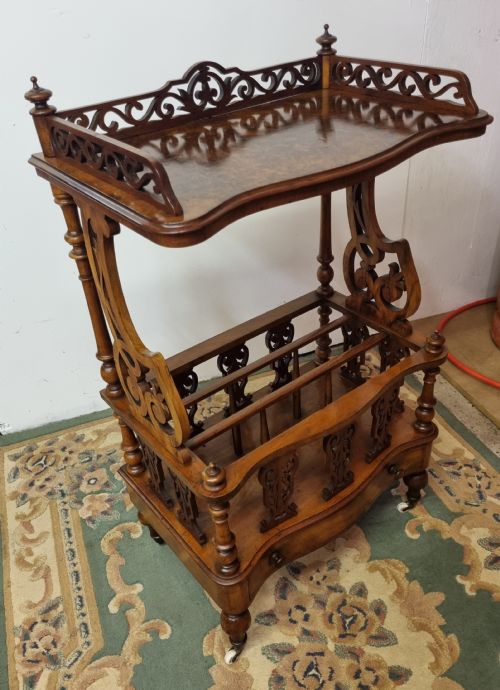
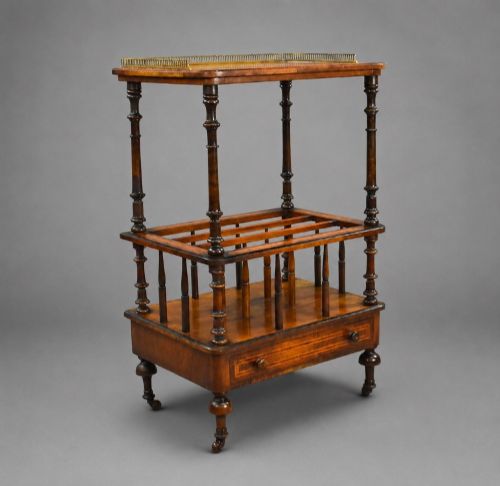
Most items you encounter on this page take the form of traditional canterburys, music cabinets or whatnots constructed from walnut and burr walnut. These functional stands served domestic music rooms and drawing rooms, evolving from simple open compartment racks into elaborate multi-tiered furniture items with inlaid details.
Makers utilised various secondary forms such as side tables and magazine stands, demonstrating how the classic canterbury frame adapted to changing household storage needs. You will find pieces featuring turned supports, glass doors and brass accents alongside standard open fretwork designs.
Construction and materials
Cabinet makers relied heavily on walnut and burr walnut veneers, applying figured timber to prominent exterior surfaces to highlight natural grain patterns. Structural components often involved solid walnut timber, sometimes stained black to imitate ebony or paired with contrasting wood inlay.
Decorative elements incorporate brass fittings, ceramic castors, glass panels and fabric accents, particularly on music cabinets and display pieces. Skilled artisans also applied intricate wood inlay and carved details, shaping serpentine profiles and fretwork partitions by hand.
Listings feature walnut, burr walnut and black walnut timber alongside brass, glass, ceramic, fabric and wood inlay.
Evaluating craftsmanship and condition
The distinction between standard utility items and superior examples lies in the selection of burr walnut veneer and the crispness of the wood inlay. Substantial proportions, well-defined serpentine shaping, and the presence of integrated drawers or fitted music compartments elevate certain pieces above simpler designs.
Quality also rests on the preservation of original brass castors, glass doors, and delicate fretwork panels without excessive timber shrinkage or veneer lifting. Fine execution in the turned supports and interior partitions demonstrates the skill applied during the Victorian and Edwardian periods.
Shoolbred
The Brown Walnut Canterbury Stand Glossary
- Canterbury
- A low stand with partitions designed for holding sheet music, newspapers or magazines. Originating in the late eighteenth century, it frequently includes a small drawer below.
- Burr Walnut
- Timber taken from a growth on a walnut tree, yielding intricate, swirling grain patterns. Cabinet makers prized this veneer for high-status Victorian and Edwardian furniture.
- Whatnot
- An open set of freestanding shelves used for displaying ornaments or holding books. These tiers often sit atop a canterbury base.
- Fretwork
- Ornamental design created by cutting patterns through thin wood panels using a saw. This technique appears on the partition dividers of many Victorian stands.
- Serpentine
- A furniture front or shelf edge curved in a wave shape, convex in the centre and concave at the ends. This contour adds visual movement to solid timber pieces.
Brown Walnut Canterbury Stand: Frequently Asked Questions
What is a canterbury stand used for?
These stands were originally built to hold sheet music, scores and periodicals near a piano or in a Victorian drawing room. The partitioned upright sections kept paper organised and accessible.
Today, they serve equally well beside a modern sofa to store current magazines, books or daily newspapers while adding period character to the space.
How do I distinguish Victorian from Edwardian pieces?
Victorian examples tend to feature darker, heavily figured burr walnut, elaborate wood inlay, carved fretwork and substantial proportions. They often combine multiple functions, acting as both a canterbury and a whatnot.
Edwardian pieces generally present a lighter, more restrained aesthetic with slim profiles. Music cabinets from this later era frequently incorporate glass doors and simpler decorative schemes.
What is the difference between a music cabinet and a canterbury?
A traditional canterbury consists of open upright partitions mounted above a low frame, occasionally featuring a small drawer at the base. It allows immediate access to unbound sheets and magazines.
A music cabinet is an enclosed piece of furniture featuring a door, sometimes glazed, behind which fall-front or fixed shelves keep bound volumes protected.
Can I use these stands for modern storage?
The vertical compartments suit vinyl records, art portfolios, large books and contemporary periodicals. Their compact footprints make them practical for smaller rooms.
Care should be taken with heavy loads on older timber partitions, but standard daily use presents no difficulty for sturdy nineteenth-century frames.