


Brown Mountain Landscape Painting
A brown mountain landscape painting captures elevated terrain through earthy tones, drawing the eye toward rugged peaks and atmospheric valleys.
Brown Mountain Landscape Painting
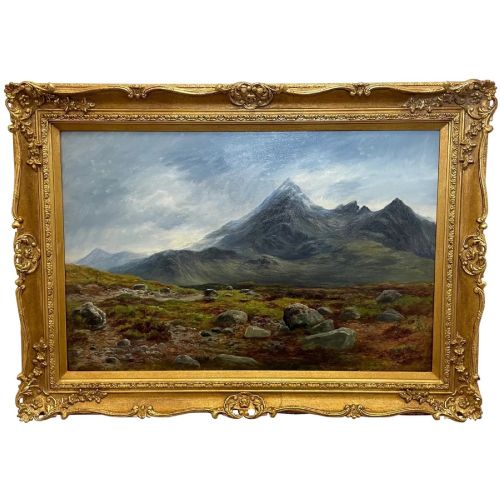
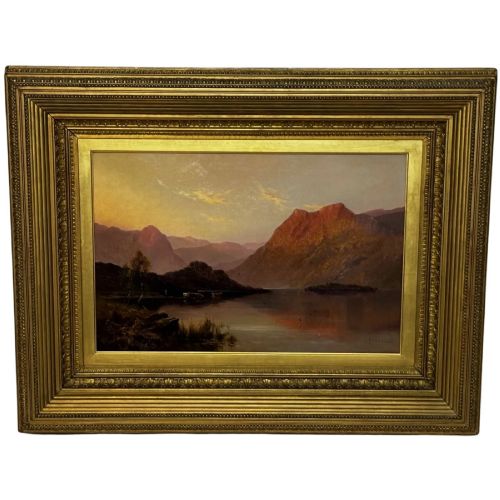
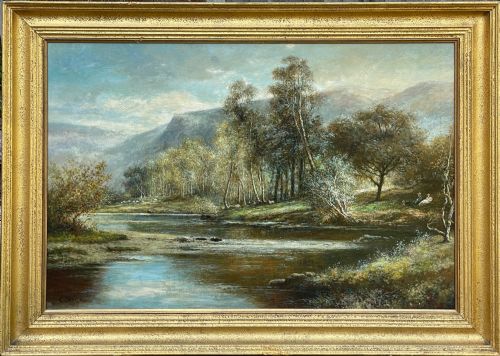
A brown mountain landscape painting portrays upland terrain, crags, and valleys through a palette of ochres, umbers, and muted earth tones. These works frequently record specific British and European ranges, including Scottish highlands, Welsh valleys, and Cumbrian lakes.
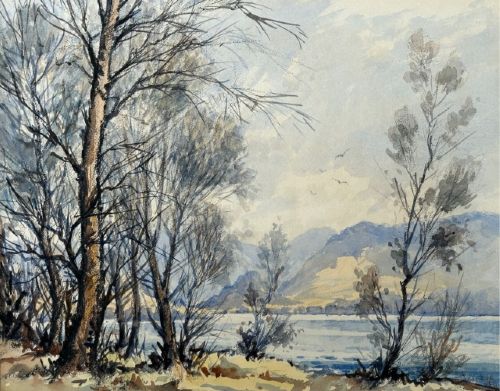
The selections span the nineteenth century through the mid twentieth century, encompassing Victorian romanticism, Scottish impressionism, and the Norwich school. Framed formats dominate, ranging from small watercolours on paper to large oil paintings on canvas.
Materials and technique
Artists built these compositions primarily using oil paint on canvas or board, alongside watercolour and gouache applied to paper. Wood frames, often featuring gesso enrichment, house the majority of these landscape works.
Brushwork varies from the tight, descriptive detail of the mid-nineteenth century British school to the looser, atmospheric handling seen in later impressionist and twentieth century examples.
Listings feature works executed in oil on canvas, watercolour, and gouache across the nineteenth and twentieth centuries.
Assessing quality and execution
Quality rests in the artist's handling of light, scale, and atmospheric depth across the mountainous terrain. Superior examples demonstrate confident brushwork and precise topographical atmosphere rather than formulaic studio production.
Condition of the medium and the presence of original framing contribute to the integrity of the piece. Works retaining clear provenance and signatures from recognised regional painters command greater interest.
William Beattie Brown·Alfred Fontville de Breanski·Robert Leslie Howey·Thomas Lound·William Miller Frazer·Cornelius Pearson·Sidney Richard Percy·Charles Jones·Louis Bosworth Hurt·Edward John Niemann·James Kay·Percy Lancaster·James Poole·Charles Pettitt·Clarence Roe
The Brown Mountain Landscape Painting Glossary
- Gouache
- An opaque water-based medium that provides solid colour and matte surfaces in works on paper.
- Gesso
- A plaster-like material applied to wooden frames before gilding or painting to create smooth decorative mouldings.
- Norwich School
- A regional group of artists influenced by Dutch landscape traditions, focusing on local scenery.
- Provenance
- The documented history of ownership associated with a work of art.
Brown Mountain Landscape Painting: Frequently Asked Questions
How do I date a mountain painting?
Dating relies on stylistic markers, framing techniques, and artist signatures recorded in nineteenth and twentieth century records. Costume details of any figures present also help narrow the period.
Examining the canvas backing, stretchers, and medium provides additional physical evidence of the era of creation.
Where were these landscapes typically painted?
Artists often worked directly from nature in mountainous regions such as the Scottish Highlands, Snowdonia, and the Lake District. They translated these field studies into finished oils and watercolours back in the studio.
Specific topographical titles frequently identify the exact valleys, lakes, and peaks depicted.
How should I hang a framed oil painting?
Select a wall space away from direct sunlight and steady heat sources to protect both the canvas and the historical frame. Ensure picture hooks match the weight of the wooden and gessoed frame.
Period frames benefit from secure double hanging fixings to distribute weight evenly.
What is the difference between oil and watercolour?
Oil paint utilises a slow-drying medium on canvas or board, allowing for rich texture, blending, and deep earthy tones. Watercolour applies transparent pigments to paper, producing lighter, more immediate atmospheric effects.
Both mediums were utilised extensively across nineteenth century British landscape art.