

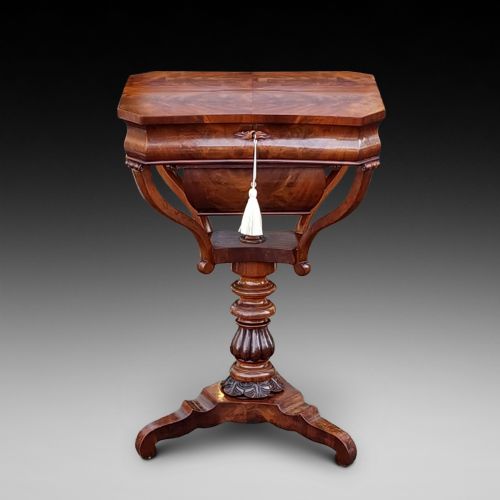
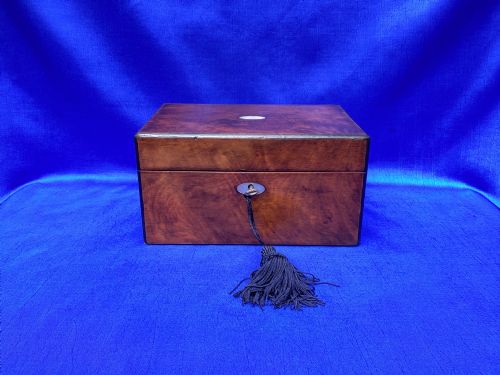


Brown Mahogany Workbox
A brown mahogany workbox offers an ingenious place to sort threads, lace and correspondence while anchoring a room with dark grain.
Brown Mahogany Workbox
When buyers search for a brown mahogany workbox, they encounter compact storage pieces designed for domestic needlework and small treasures. These objects range from small portable boxes meant for a tabletop to larger work tables fitted with stands and drawers.
The versions most commonly met on this page span the Georgian, Regency, Victorian and Edwardian eras. They appear as sewing tables, occasional tables and decorative boxes intended to keep implements orderly.
How they were made
Cabinetmakers built these pieces using solid and veneered timber, frequently selecting flame mahogany to create movement across the lid and drawer fronts. They enriched the dark surfaces with contrasting inlay work using boxwood, satinwood and shell motifs.
Interiors often feature fitted compartments lined with fabric to hold sewing tools securely. Finer examples incorporate delicate brass mounts, bone details or mother-of-pearl accents to elevate the design.
Brown Mahogany Workbox Retail Price Guide 2026
Typical asking prices for brown mahogany workbox among the pieces listed under this phrase on Sellingantiques today, from the lower quarter to the upper quarter. They describe what is for sale here now, not the wider market.
Some nineteenth-century workboxes include tiny secret compartments hidden beneath the sliding trays for truly private correspondence.
What varies in quality
The distinction between a standard piece and a superior one lies in the choice of timber figure and the precision of the joinery. Flame mahogany and crisp stringing mark out pieces that received greater attention from the workshop.
Fitted interiors also set examples apart, particularly those retaining well-organised compartments and original linings. Simpler utility boxes contrast with sophisticated work tables on stands that double as lamp or side tables.
The Brown Mahogany Workbox Glossary
- Workbox
- A portable box or standing table fitted with compartments for sewing implements, threads and small personal items. These pieces were essential fixtures in period sitting rooms.
- Flame mahogany
- A highly figured wood veneer sliced from where a branch joins the main tree trunk, creating a characteristic ripple effect. This pattern was prized for table tops and box lids.
- Inlay
- A technique where contrasting materials such as satinwood or boxwood are set flush into the primary wood surface to form geometric or decorative patterns.
- Tunbridge ware
- Small wooden decorative items adorned with intricate mosaic patterns made from many tiny pieces of naturally coloured wood. These intricate designs are characteristic of nineteenth-century production.
Brown Mahogany Workbox: Frequently Asked Questions
What is a brown mahogany workbox used for?
These pieces served as portable or stationary storage for sewing materials, needlework tools and personal letters. Ladies kept them close at hand in the parlour for daily crafting tasks.
Today they function equally well as jewellery boxes, desk tidies or small occasional tables placed beside a chair.
How do I tell a Regency workbox from an Edwardian one?
Regency examples often feature bold mahogany grains, architectural lines and brass paw feet or ring handles. They reflect the classical influence of the early nineteenth century.
Edwardian pieces tend to be lighter in appearance, frequently incorporating delicate boxwood stringing and shell inlay motifs typical of the early twentieth-century revival styles.
What is a work table?
A work table is a piece of furniture standing on legs that incorporates a fitted drawer or an attached fabric bag for holding sewing projects. They combine the utility of a sewing box with the stability of a small side table.
Many examples from the Regency and William IV periods also served dual purposes as lamp tables.
Are interiors usually fitted?
Most traditional workboxes contain internal compartments, small lids and partitions designed to keep spools and needles separated. Some retain original fabric linings and miniature turned pulls.
Simpler boxes may present an open well, while sophisticated tables often feature multi-layered pull-out trays.