


Brown Mahogany Weather Glass
A brown mahogany weather glass brings dependable domestic forecasting into the home with the deep warmth of figured timber.
Brown Mahogany Weather Glass
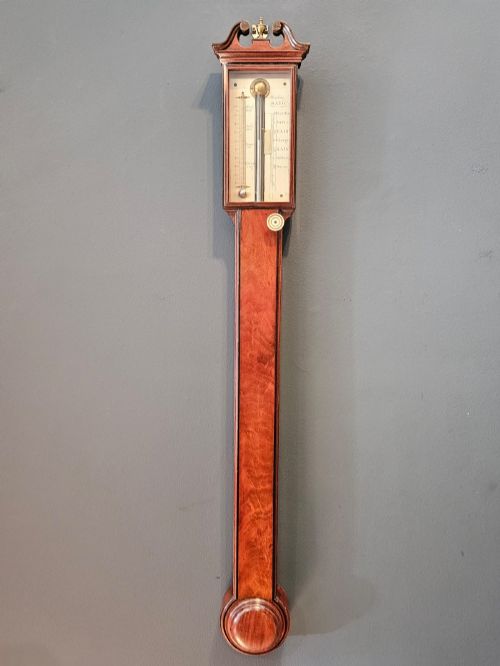
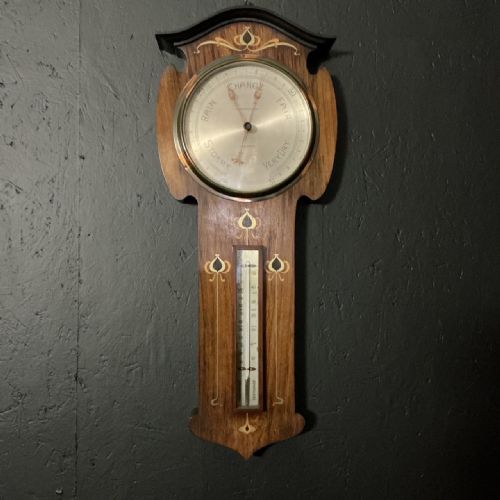
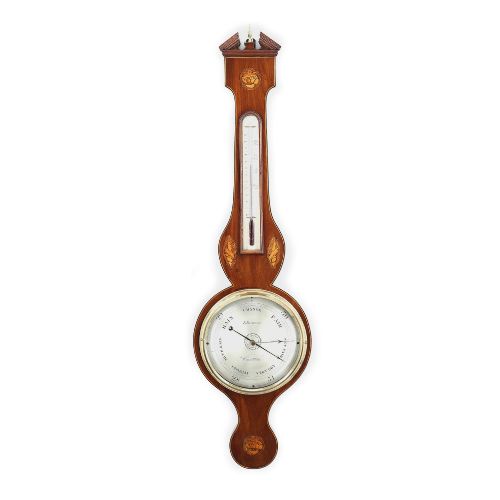
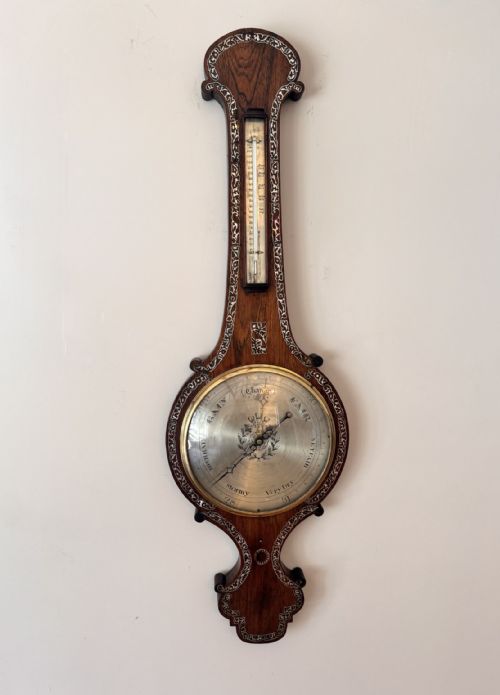
When you search for a brown mahogany weather glass, you are looking at domestic scientific instruments housed in rich, dark timber cases spanning the Georgian, Regency, and Victorian eras. These pieces range from tall stick barometers to sweeping wheel variants, each designed to measure atmospheric pressure while serving as an imposing focal point for a hallway or study.
The most common examples you will encounter on this page are wheel barometers and stick barometers framed in solid or veneered mahogany, often enriched with brass dials and delicate string inlay. Originating from workshops across Britain, these instruments blend practical utility with the cabinetmaker's art, reflecting changing interior tastes from the eighteenth century into the Edwardian period.
How they were made
Cabinetmakers constructed the wooden housings from dense, durable mahogany, frequently selecting figured timber for the principal panels and applying boxwood or satinwood inlay to accent the borders. Selected models incorporate mother of pearl dials or bone recording vernier scales, requiring meticulous hand-fitting to ensure the fragile glass tubes and mercury reservoirs remained secure.
Dial faces were engraved on brass plates, often silvered for legibility, and protected beneath heavy convex or flat glass bezels. Makers balanced the internal mechanics of the barometer or barograph within the wooden carcass, allowing the instrument to respond accurately to barometric changes while maintaining structural integrity.
Several Victorian models include built-in thermometers so you can fret about both the pressure and the temperature simultaneously.
What varies in quality
The distinction between standard domestic instruments and exceptional examples lies in the selection of the timber and the refinement of the brasswork. Superior pieces display highly figured mahogany grain, intricate boxwood stringing, and finely engraved dials signed by known makers, whereas ordinary versions utilise plain timber and simpler paper or unadorned brass scales.
Proportion and case architecture also dictate standing; instruments featuring carved onion tops, dampened damp-proof cistern covers, or supplementary thermometers and spirit levels represent more ambitious commissions by skilled makers.
B. Besozzi of Weymouth·Molton of Norwich·Jenkins of Old Swindon·W.E. Pain of Cambridge·S&B Solomons of London·J Groce, York·S. P. Cohen·Negretti & Zambra·Malacrida of Dublin
The Brown Mahogany Weather Glass Glossary
- Stick barometer
- A tall, narrow instrument where the mercury column is exposed against a vertical scale, offering a direct reading of barometric pressure.
- Wheel barometer
- A banjo-shaped instrument that uses a float and pulley system to translate mercury movement into the rotation of a pointer around a large circular dial.
- Vernier scale
- A small sliding auxiliary scale that allows the user to read barometric pressure down to fractions of an inch or millibar.
- Cistern
- The enclosed reservoir at the base of a barometer that holds the reserve of mercury exposed to atmospheric pressure.
- String inlay
- A narrow strip of contrasting light wood, such as boxwood, embedded flush into the darker mahogany surface to create decorative borders.
Brown Mahogany Weather Glass: Frequently Asked Questions
How do I read a brown mahogany weather glass?
Observe the position of the indicator needle or the top of the mercury column against the engraved scale. Rising levels generally indicate settling weather, while falling levels warn of approaching rain or wind.
Utilise the secondary vernier scale if present to take precise measurements, comparing the current reading with the previous day's pressure marked by the set hand.
Where should I hang a stick barometer?
Mount the instrument on an interior wall away from direct sunlight, radiators, and heavy vibrations. Hallways and studies provide stable ambient temperatures which help preserve the historic wood case.
Ensure the wall fixings are secure, as mahogany barometers carry considerable weight from the timber frame and internal mercury reservoirs.
Are these mercury instruments safe to keep at home?
The sealed glass tubes contain liquid mercury, which remains entirely enclosed during normal domestic conditions. Standard handling and hanging pose no hazard to occupants.
Take care during relocation to keep the instrument tilted or inverted according to the maker's instructions, preventing the mercury column from striking the top of the glass tube.
How do I tell a Georgian barometer from a Victorian one?
Georgian instruments tend to feature restrained architectural proportions, simpler mahogany veneers, and damp-proof cistern covers shaped as understated urns or domes. The dial inscriptions are typically crisp and understated.
Victorian examples frequently display more exuberant ornamentation, including carved scrollwork, onion top pediments, mother of pearl accents, and elaborate brass hygrometer or thermometer attachments.