
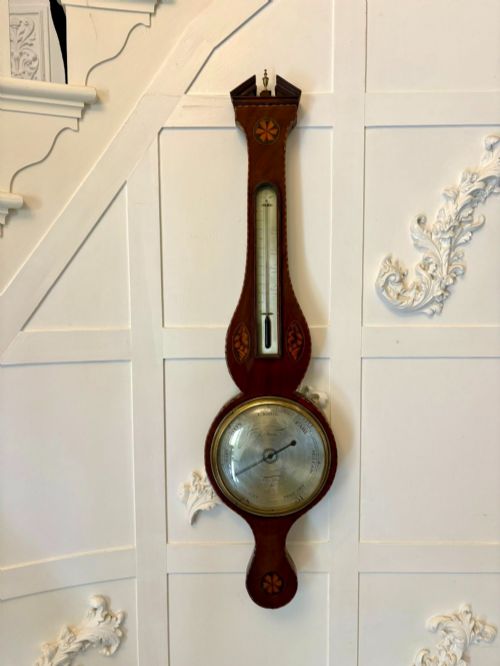
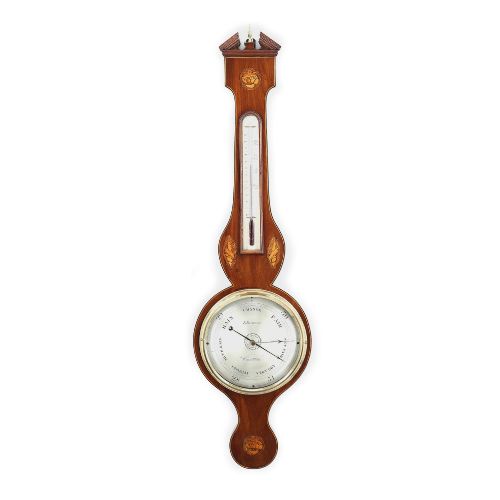


Brass Wheel Barometer
These brass wheel barometers combine reliable weather prediction with striking woodwork, making them a practical and decorative focal point for any hall.
Brass Wheel Barometer
A brass wheel barometer is a mercurial instrument housed in a wooden wall case, designed to display atmospheric pressure on a dial linked to a visible indicator. When you search for this phrase, you are looking at domestic weather instruments originating mostly from the Georgian, Regency, and Victorian periods.
The most common version met on this page is the banjo-shaped wall barometer, usually constructed from mahogany or rosewood and finished with a brass dial bezel. These pieces frequently incorporate subsidiary dials, such as hygrometers or alcohol thermometers, mounted above the main circular face.
Originating from provincial workshops as well as metropolitan makers across Britain, these instruments reflect the domestic interiors of the eighteenth and nineteenth centuries. Their forms range from simple linear frames to sophisticated designs featuring string inlay and shell motifs.
How they were made
Makers constructed the primary cases from solid and veneered hardwoods like mahogany, rosewood, and satinwood, often shaping the timber into distinctive curved profiles. Brass formed the bezels, pointers, and hanging rings, providing a durable contrast to the dark wood surrounds.
The delicate mercurial barometer tubes sat within the wooden trunk, connected via a cord and pulley to a brass wheel mechanism that moved the external pointer. Silvered metal dials were engraved with weather scales and maker details, then protected beneath a fitted glass cover.
Many makers doubled as opticians and instrument grinders, ensuring your weather glass shared a workshop with pocket telescopes.
What varies in quality
The fineness of the cabinetwork and the complexity of the timber veneers distinguish standard examples from superior pieces. Marquetry details, boxwood stringing, and well-proportioned swan-neck pediments indicate a higher grade of manufacture.
The crispness of the engraving on the silvered dial and the quality of the brass fittings demonstrate the skill of the original workshop. Retaining the original mercury tube and unbroken glass components preserves the integrity of the instrument.
B. Besozzi of Weymouth·Ganthony of London·Prada of High Wycombe·Fagioli of Clerkenwell London·Jenkins Of Old Swindon·James H Kelly of Glasgow·Watkins·H Marks High Street Bloomsbury·Vecchio & Co of Shaftsbury·Bianchi Ipswich·A. Rivolta·Bassi·Luisetti of London·J C Moretti of King's Lynn·F Salteri & Co Nottingham·L. Malacrida·George Dollond of London·Schiavi of Chesham
The Brass Wheel Barometer Glossary
- Banjo barometer
- A wall barometer shaped with a bulbous lower cistern cover and a slender upper trunk. This form dominated domestic weather glass production throughout the Georgian and Victorian eras.
- Silvered metal
- A brass dial plate treated with a silver solution to create a bright, legible surface for engraved graduations. This finish tarnishes naturally over time if exposed to dampness.
- Mercurial barometer
- An instrument that measures atmospheric pressure by balancing the weight of mercury in a glass tube against the outside air. These systems require careful handling during transport.
- Bezel
- The brass ring that holds the glass cover securely in front of the dial face. It often opens on a hinge to allow access to the pointer.
- Hygrometer
- A subsidiary dial measuring atmospheric humidity, frequently integrated into the upper trunk of a wheel barometer. It operates using organic materials such as animal hair or synthetic fibres.
Brass Wheel Barometer: Frequently Asked Questions
How do I read a wheel barometer?
The main dial displays air pressure readings from storm to very dry, with the pointer showing current conditions. Tapping the glass gently helps settle the mechanism to indicate the accurate reading.
Secondary dials often show temperature or humidity, giving a broader picture of atmospheric changes over the course of the day.
Can I hang these barometers on any wall?
These instruments need to hang vertically on a secure wall fixing to keep the internal mercury tube and pulley mechanism aligned. Avoid placing them near direct heat sources or exterior doors subject to heavy vibrations.
Proper placement ensures the internal cord and weight system operates smoothly without catching inside the wooden case.
How do I date a mahogany barometer?
Georgian examples often feature simple architectural lines or subtle shell inlay, while Regency pieces introduce bolder rosewood veneers and convex mirror elements. Victorian versions frequently display heavier mouldings and larger dial diameters.
Maker signatures and address details engraved on the dial provide further clues to the active working period of the workshop.
Are these barometers still accurate?
When the mercurial column and internal linkages are intact, these instruments respond reliably to changes in barometric pressure. They function as both decorative antiques and working weather indicators.
Routine maintenance by a specialist ensures the mercury tube remains clean and the mechanical linkages move freely.