


Sheraton Wheel Barometer
These sheraton wheel barometer pieces combine precision engineering with fine cabinet-making, offering an elegant focal point for any traditional wall.
Sheraton Wheel Barometer
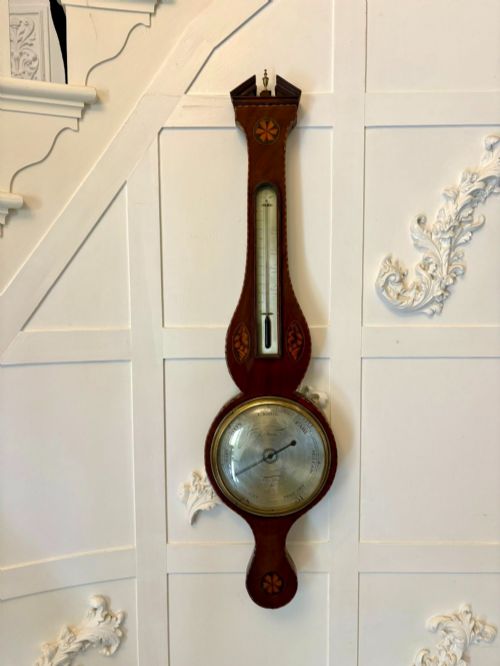
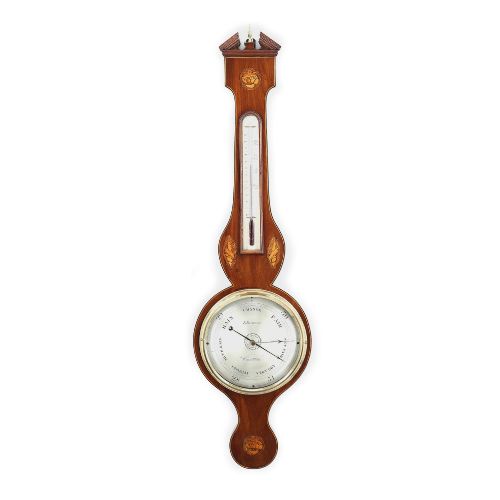
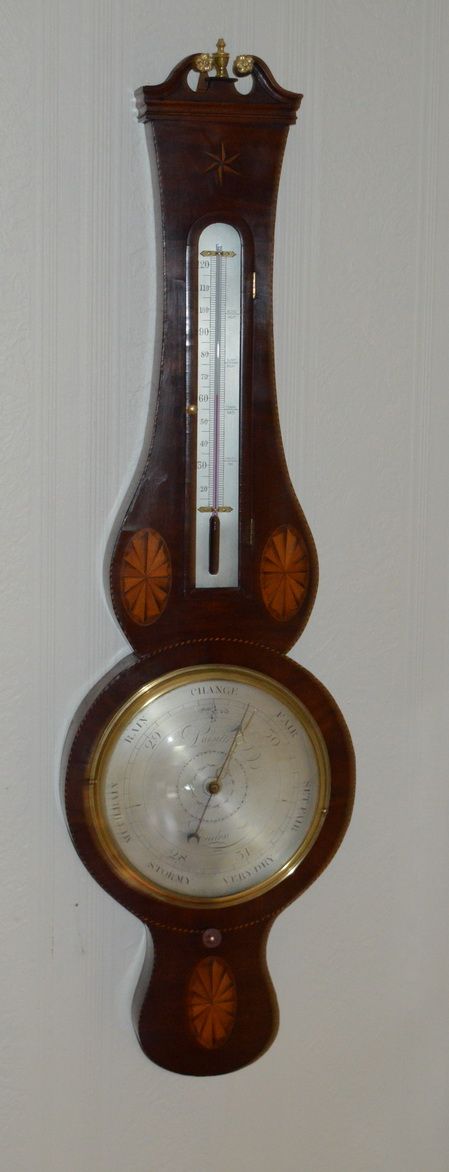
A sheraton wheel barometer is a wall-mounted instrument housed within a distinctive wooden case, designed to measure atmospheric pressure while serving as an ornamental furnishing. Most examples on this page date from the Georgian, Regency, and Victorian periods, showcasing the classic banjo shape with a circular dial at the top and a larger thermometer or spirit level box beneath.
The form developed primarily during the eighteenth and nineteenth centuries, emerging in various regional workshops across Britain. Pieces from this era frequently feature symmetrical wooden frames designed to hang securely in hallways and reception rooms.
The selection here encompasses both restrained mahogany models and more ornate interpretations incorporating diverse timber inlays. Buyers seeking a functional antique instrument will find these wall barometers represent the height of period domestic science.
Materials and Construction
Brass fittings, including hygrometer bezels, thermometer scales, and suspension rings, provide essential mechanical contrast to the dark timber cases. Glass protects the delicate paper or painted dials, while internal mercury tubes perform the meteorological measurements.
Sheraton Wheel Barometer Retail Price Guide 2026
Typical asking prices for sheraton wheel barometer among the pieces listed under this phrase on Sellingantiques today, from the lower quarter to the upper quarter. They describe what is for sale here now, not the wider market.
Listings feature mahogany, rosewood, and satinwood cases spanning the Georgian, Regency, and Victorian periods.
Judging Quality
Superior quality rests in the crispness of the cabinet-making and the subtlety of the wood inlay rather than mere ornamentation. Finer examples display meticulous matching of timber veneers across the curved trunk and dampness indicators.
The legibility and artistry of the engraved dial plate separate standard workshop output from exceptional pieces. Signed dials bearing the maker's name and location generally denote higher grade production and greater historical interest.
B. Besozzi of Weymouth·Prada of High Wycombe·L Casatelli of Liverpool·Vecchio & Co of Shaftsbury·A. Rivolta·J Groce, York·Luisetti of London·J C Moretti of King's Lynn
The Sheraton Wheel Barometer Glossary
- Banjo barometer
- A domestic weather glass featuring a circular dial at the top mounted above an elongated trunk. This shape dominated British instrument making throughout the Georgian and Victorian eras.
- Inlay
- A decorative technique where small pieces of contrasting wood, such as boxwood and satinwood, are fitted into recessed cavities within the primary timber surface. This creates intricate geometric patterns and shell motifs.
- Neoclassical
- A style drawing inspiration from classical antiquity, characterised by symmetry, restrained ornamentation, and architectural motifs. It heavily influences the design of late eighteenth and nineteenth-century furniture.
- Hygrometer
- An instrument used to measure humidity, frequently incorporated as a secondary circular dial near the top of a wheel barometer. It helps monitor atmospheric moisture levels alongside barometric pressure.
Sheraton Wheel Barometer: Frequently Asked Questions
How do I hang a wheel barometer?
These instruments require a sturdy brass screw or wall hook fixed securely into solid masonry or a wooden wall stud. Hang the piece upright using the fitted brass ring at the top of the case.
Ensure the wall surface is completely flat so the case hangs plumb without twisting the wooden frame. Avoid placing the instrument near direct heat sources or exterior doors subject to heavy vibration.
Do these barometers still work?
Many surviving examples retain their original mercury tubes and can indicate shifts in atmospheric pressure. However, internal mechanisms may require professional calibration after transit.
Treat the readings as historical indicators rather than precision meteorological data. The physical movement of the needle still responds reliably to approaching weather changes.
How do I identify a Georgian barometer?
Examine the timber selection, dial typography, and construction methods used within the case. Georgian examples typically feature dense mahogany cabinets with hand-hammered brass fittings and restrained inlay.
Look for hand-written maker signatures on the paper dial behind the glass. Regional variations often display distinct dial layouts characteristic of specific provincial instrument makers.