
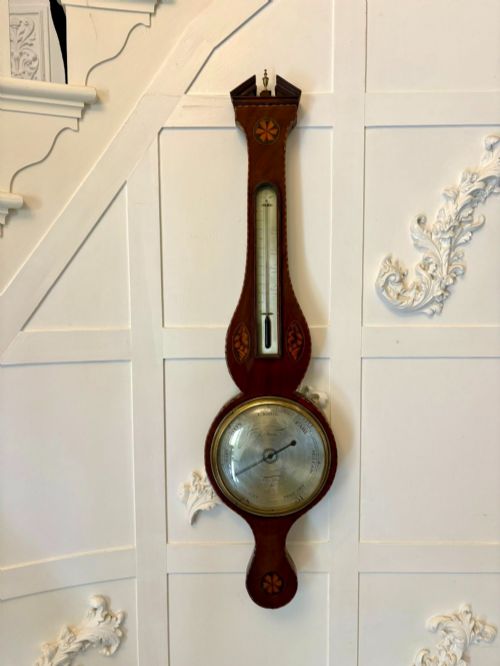




Georgian Weather Station
These georgian weather station pieces are precision barometers and thermometers crafted to monitor atmospheric pressure, offering both scientific utility and classic interior elegance.
Georgian Weather Station
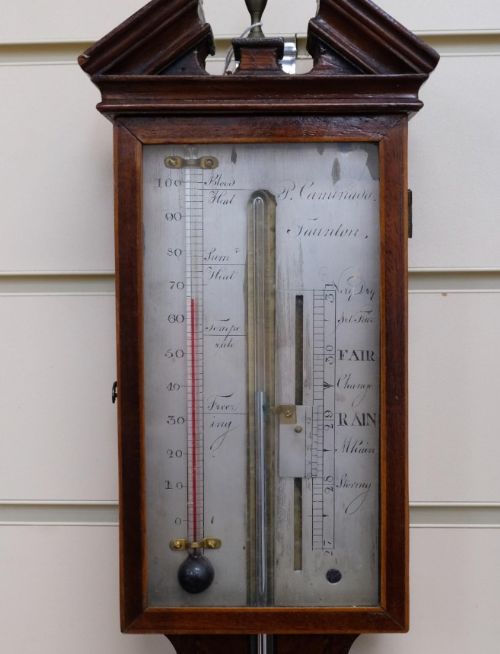
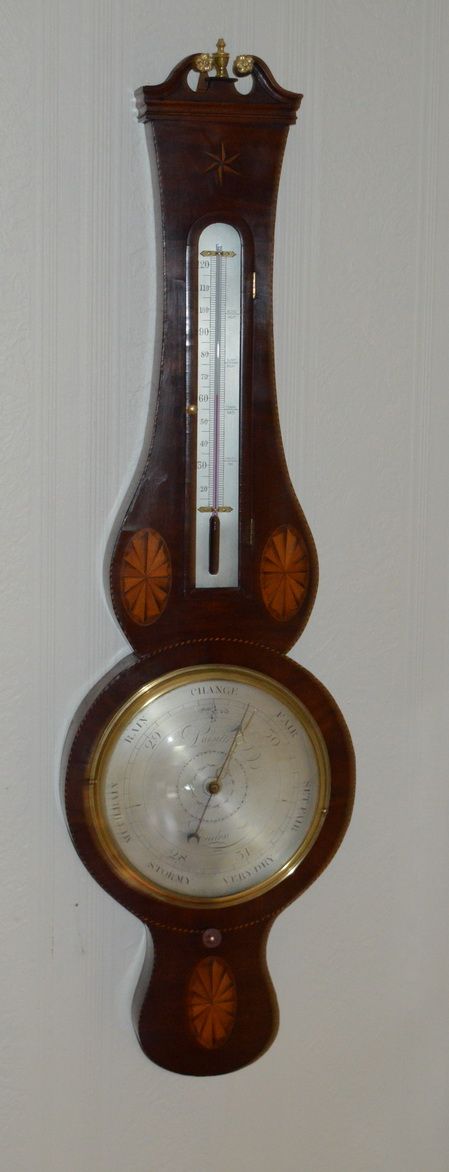
A georgian weather station typically takes the form of a stick barometer or a wheel banjo barometer, designed to measure atmospheric changes with mercury columns and silvered metal dials. When you search for a georgian weather station, you encounter instruments housed in mahogany cases, sometimes enriched with satinwood or bone details.
The pieces listed on this page span the georgian and regency periods alongside later revivals, reflecting the enduring demand for these domestic barometers. Wall barometers dominate the selection, functioning as both practical instruments and striking decorative fixtures for hallways and libraries.
Materials and construction methods
Makers constructed the cases primarily from solid mahogany, often selecting timber with rich grain patterns and applying fine shell inlay or stringing for visual depth. Glass protects the delicate dial faces and thermometer tubes, while brass fittings secure the mechanical components and suspension points.
The internal barometer tubes utilise mercury to register barometric pressure, paired with engraved silvered brass or silvered metal scales that display weather predictions. Specialist artisans calibrated these sensitive movements by hand to ensure accurate pressure readings within the timber housing.
Periods represented span from the eighteenth century through the regency era into later nineteenth-century Victorian interpretations.
Assessing quality in a georgian weather station
Quality rests upon the crispness of the cabinetwork, from the precision of the mahogany case proportions to the finesse of any shell inlay. Finer examples display meticulously engraved silvered metal dials with clear, legible lettering and decorative floral or geometric motifs.
The reputation of the maker inscribed on the dial or scale plate also influences the standing of the piece, as established instrument makers applied greater care to the movement and housing. Intact original glass and well-preserved mercury tubes distinguish superior survivals from heavily altered counterparts.
P. Caminada·JB Bergna·Gilbert London·Luisetti of London·L. Malacrida
The Georgian Weather Station Glossary
- Banjo barometer
- A domestic barometer housed in a distinctive curved wooden case resembling a banjo, typically featuring a circular dial at the top and a thermometer or spirit level below.
- Stick barometer
- A tall, narrow wall barometer containing a vertical glass tube filled with mercury, mounted directly onto a wooden backboard with a exposed or glazed scale.
- Silvered metal
- A brass or copper plate treated with a silver solution to create a bright, matte finish, commonly used for the engraved dials of barometers and thermometers.
- Shell inlay
- A decorative woodworking technique where contrasting pieces of lighter wood, such as satinwood, are cut into shell shapes and set flush into the mahogany surface.
Georgian Weather Station: Frequently Asked Questions
How do I read a mercury barometer?
The mercury column rises and falls inside the glass tube in response to atmospheric pressure changes. You read the current pressure against the engraved scale on the dial.
Many wheel barometers feature a secondary pointer that you set manually over the main needle to track whether the pressure is rising or falling since your last check.
Where should I hang a wall barometer?
Hang your barometer on an interior wall away from direct sunlight, radiators, and heavy draughts. Temperature fluctuations can affect the instrument and distort readings.
A stable location in a hallway or study provides the ideal environment to keep the timber case and internal mercury mechanism safe.
How do I tell an 18th century barometer from a 19th century one?
Eighteenth-century examples often display simpler mahogany stick cases with understated mouldings and maker signatures engraved directly onto the brass scale plate. Nineteenth-century pieces frequently adopt the banjo shape with more elaborate shell inlay and decorative pediments.
Examining the construction joints, fixings, and style of the dial typography helps clarify the period of manufacture.
Are these barometers still accurate?
Many historic barometers remain surprisingly accurate when the mercury column is intact and the internal linkage functions correctly. They respond reliably to shifts in local weather patterns.
Calibration can sometimes be adjusted via the screw mechanism at the base, though most owners appreciate them as historic instruments as much as active forecasters.