
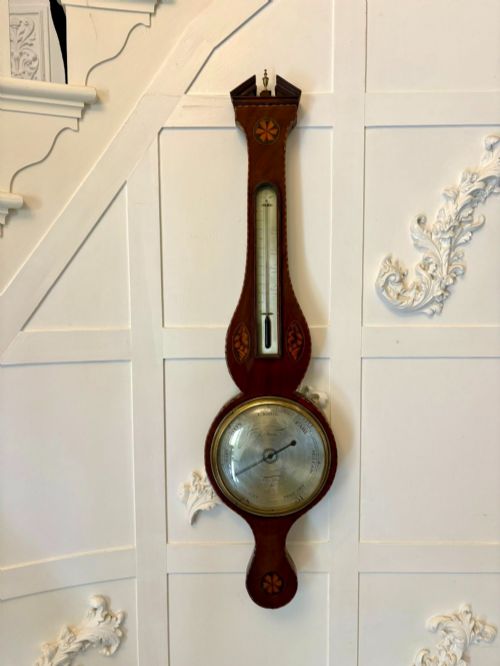
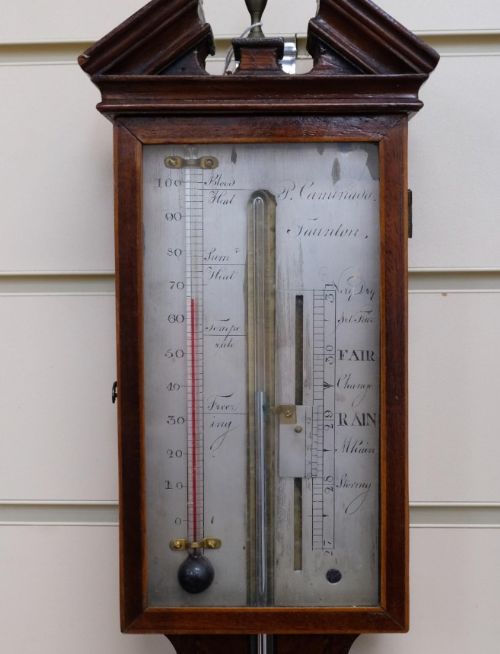


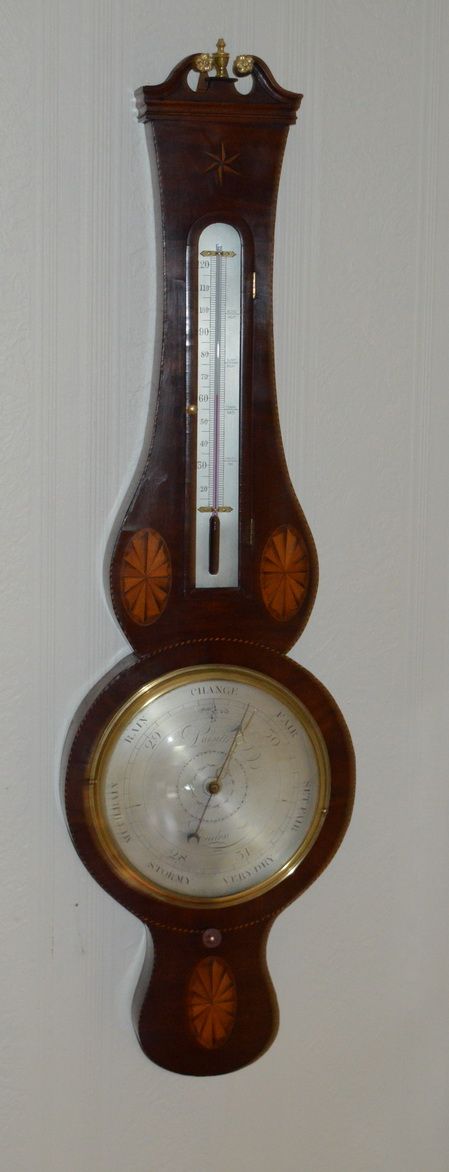


Georgian Mahogany Weather Station
A Georgian mahogany weather station is a domestic scientific instrument of distinction, prized for its timber depth and precision dials.
Georgian Mahogany Weather Station
A georgian mahogany weather station brings together atmospheric measurement and fine cabinetmaking in domestic interiors. Collectors encounter wall-hanging forms ranging from wheel barometers to stick barometers across this selection.
The pieces span periods from the eighteenth century through the Victorian era and into later revivals. Most examples adopt the banjo or stick format housed in rich timber cases.
How they were made
Makers constructed the cases using solid and veneered mahogany, frequently accented with satinwood stringing or shell inlay. Glass plates protect the sensitive dials while brass fixtures secure the mechanical components.
Internal mercury tubes provide the barometric readings alongside silvered metal or brass scales inscribed with weather indicators and maker signatures.
Materials appearing across these listings include mahogany, glass, brass, silvered metal, satinwood, and bone.
What varies in quality
Quality rests upon the crispness of the case joinery and the sophistication of the dial engraving. Finer examples display meticulous shell inlay and well-balanced proportions that elevate them beyond utility objects.
The reputation of the maker inscribed upon the silvered metal plate heavily influences the standing of an instrument. Retaining original mercury tubes and untouched timber surfaces further distinguishes superior specimens.
P. Caminada·JB Bergna·Jenkins Of Old Swindon·Vecchio & Co·Gilbert London·Luisetti of London·L. Malacrida
The Georgian Mahogany Weather Station Glossary
- Banjo barometer
- A domestic weather instrument featuring a characteristic bulbous lower section and a tapering upper stem resembling the stringed musical instrument. These wall pieces often incorporate multiple meteorological dials.
- Stick barometer
- A tall, narrow wall instrument that houses a vertical mercury column exposed behind a glass protector. This form prioritises scientific accuracy over decorative complication.
- Silvered metal
- A brass or copper alloy treated to produce a matte silver finish that receives engraved numerals and text. The contrasting dark fill makes barometer scales legible.
- Satinwood
- A luminous exotic hardwood utilised for contrasting stringing and decorative inlay on case fronts. Its golden hue complements deep brown mahogany.
Georgian Mahogany Weather Station: Frequently Asked Questions
How do stick and wheel barometers differ?
Stick barometers display a direct vertical column of mercury for simple pressure reading. Wheel barometers translate that movement through a pulley system to a circular dial face.
Both forms served as principal household weather indicators throughout the Georgian and Victorian periods.
Where were these instruments displayed?
Owners hung them in entrance halls, libraries, and parlours where guests could consult local atmospheric changes. Their polished timber cases matched the finest domestic furniture of the era.
Positioning them away from direct heat sources helped protect the internal mercury mechanisms and wooden frames.
Can these barometers still measure weather?
Many historic instruments retain functional mercury columns that respond accurately to barometric pressure shifts. Their primary appeal today, however, remains their decorative presence and historical craftsmanship.
Consulting a specialist conservator ensures proper handling of the sensitive internal components.
How do I identify a Georgian instrument?
Look for characteristic cabinetmaking traits such as hand-cut dovetails, dense Cuban mahogany, and traditional shell inlay motifs. Maker signatures inscribed on the silvered dial plate often provide a direct date.
Stylistic elements like pediment shapes and hygrometer placements also help differentiate eighteenth-century pieces from later revivals.