
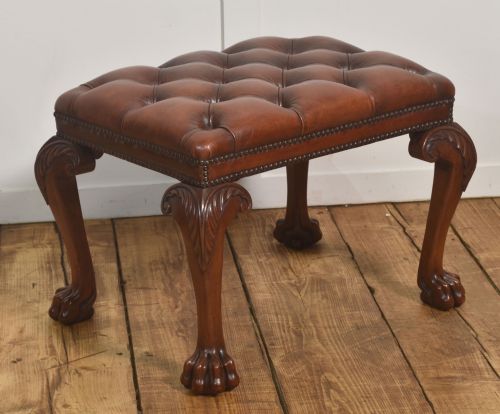
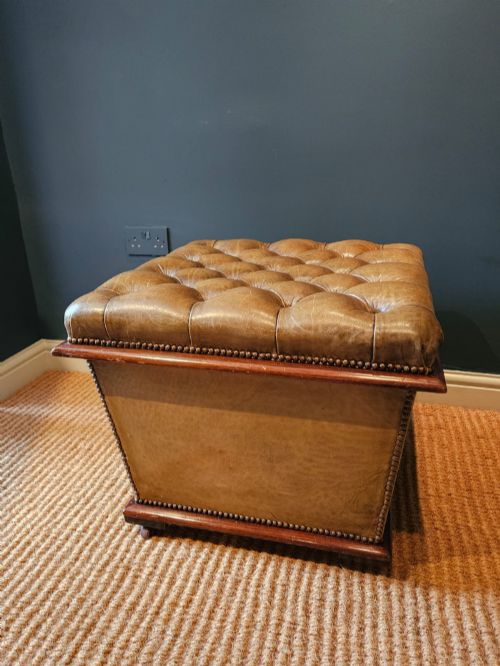


Brown Mahogany Footrest
These brown mahogany footrest pieces combine timber frames with leather, fabric, or cane surfaces across various periods.
Brown Mahogany Footrest
When you search for a brown mahogany footrest, you encounter wooden frames constructed from mahogany paired with upholstered or woven surfaces. These objects span periods from the eighteenth century through to the early twentieth century.
The items listed on this page appear primarily as stools, ottomans, and armchairs with resting functions. You are most likely to meet Victorian and nineteenth-century examples alongside Chippendale-style and Regency pieces.
Forms range from small framed footstools and long upholstered benches to X-framed stools and reclining library armchairs. Some incorporate storage or adjustable mechanisms within the wooden structure.
How they were made
Makers utilised solid mahogany for the structural frames, shaping timber into cabriole legs and X-frame supports. Joinery techniques secure the wooden components while applied brass details appear on specific items.
Upholstery methods involve stretching leather, tweed, textile, or woven cane across the frames. Padding and fixed covers complete the functional resting surfaces on stools and chairs.
Listings span from the 18th century through the Victorian era to the 1920s, employing mahogany, brass, leather, and woven cane.
What varies in quality
The distinction across these pieces lies in the precision of the timber carving and the integrity of the frame construction. Finer examples display carefully shaped cabriole legs or balanced proportions.
Material selection also differentiates the range, seen in the choice of durable leather or woven bergere cane alongside the density of the mahogany. Original upholstery or retained adjustment mechanisms add to the execution.
The Brown Mahogany Footrest Glossary
- Bergere
- A type of woven cane panel used for seating and rest surfaces. It provides a light, flexible texture within a wooden frame.
- Cabriole leg
- A furniture leg that curves outward and then tapers inward, finishing in a pad or foot. This form appears frequently on eighteenth and nineteenth-century seating.
- Ottoman
- A low upholstered seat or footstool without a back or arms. Versions in this selection often feature interior storage.
- X-framed
- A furniture structure formed by intersecting diagonal cross-members. This design supports small stools and chairs from the Regency period onward.
- Chippendale style
- A decorative style drawing on eighteenth-century designs. It utilises mahogany timber and carved details.
Brown Mahogany Footrest: Frequently Asked Questions
How were these used?
These pieces served primarily as footrests, fireside rests, and seats in libraries and parlours.
Larger items functioned as reclining armchairs or ottomans with storage compartments for household items.
How do I live with them?
Position them in living rooms or studies as functional footrests or low occasional seating alongside existing furniture.
Maintain the mahogany frames with standard wood care and protect leather or fabric surfaces from direct heat.
How do I tell periods apart?
Examine the leg shapes, frame proportions, and structural details against known design eras.
Georgian and Regency items display classical lines, while Victorian examples often feature heavier mahogany frames and cabriole legs.
What materials are used?
Frames are constructed from mahogany timber, sometimes accented with brass fittings.
Upholstery materials include brown leather, tweed, fabric, textile, and woven cane.