
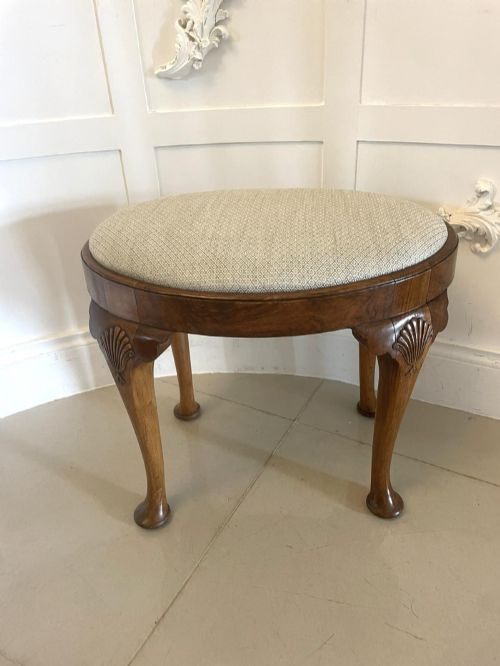
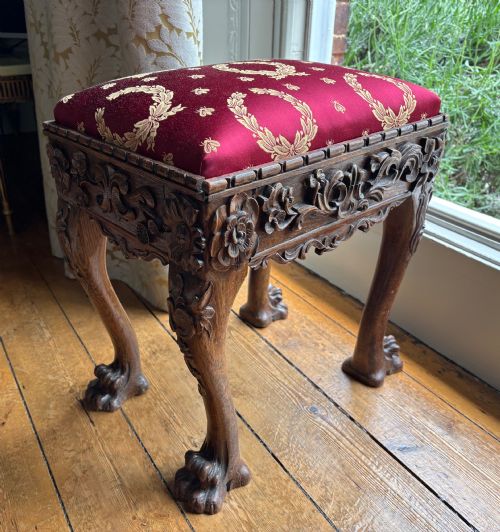
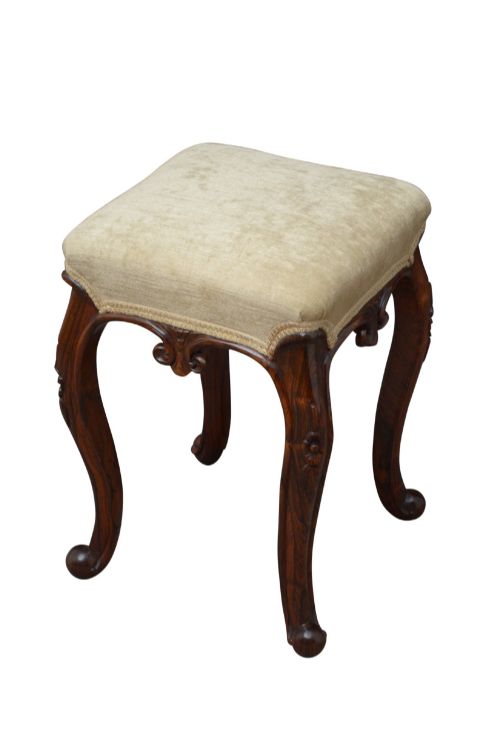
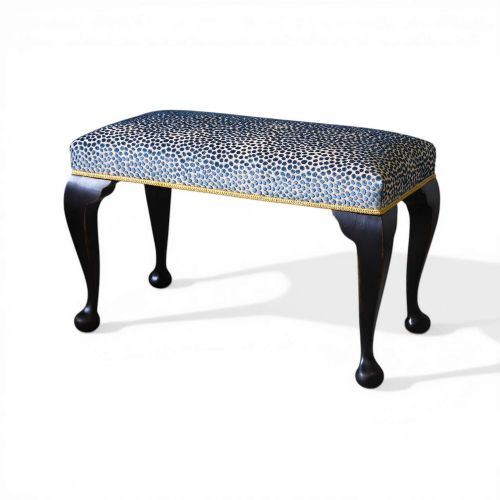
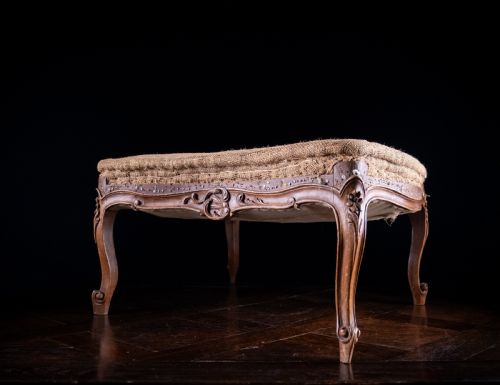
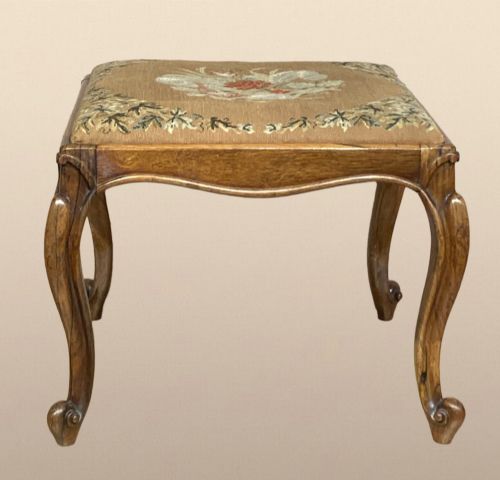


Edwardian Cabriole Footstool
An edwardian cabriole footstool is a low seat raised on curved legs, offering a refined touch of period comfort to any sitting room.
Edwardian Cabriole Footstool
The edwardian cabriole footstool search phrase brings up low seating designed for domestic comfort, spanning the Edwardian era, the Victorian period, and the early twentieth century. Buyers seeking this form encounter walnut, mahogany, and rosewood frames paired with fabric, wool, and tapestry upholstery.
Most examples found here reflect revival design currents, drawing heavily on Queen Anne, Chippendale, and Louis XV styles. These pieces function primarily as dressing table stools, piano seats, and low footrests for parlours and drawing rooms.
Forms vary from oval and rectangular shapes to compact window seats and dressing stools. The cabriole leg profile dominates the selection, though turned legs and ebonised finishes also appear across the inventory.
How they were made
Frames are constructed from dense hardwoods such as walnut, mahogany, rosewood, beech, and goncalo alves wood. Joinery techniques of the period ensure stability, while carved details in revival styles are shaped directly into the solid timber.
Upholstered elements utilise textile, wool, fabric, tapestry, and leather secured over padded seats. Additional decorative hardware includes brass elements and painted finishes where specified by the maker's design.
Listings span the Victorian and Edwardian eras, incorporating materials from walnut and mahogany to brass and tapestry.
What varies in quality
Quality rests in the crispness of the timber carving and the selection of cabinet woods such as figured walnut or rosewood. Heavier framing timbers and substantial proportions signal superior construction.
The integrity of the frame joints and the execution of revival styles dictate the overall standard. Finer pieces demonstrate careful attention to the curve of the leg and the harmony of the upholstery.
The Edwardian Cabriole Footstool Glossary
- Cabriole leg
- A furniture leg that curves outward and then tapers inward, mimicking an animal's curving leg. This form became a defining feature of eighteenth-century design and later revival periods.
- Revival
- A design movement that reinterprets historical styles from earlier centuries. Examples include Queen Anne, Chippendale, and Louis XV revivals.
- Goncalo alves
- A dense exotic hardwood used for cabinetmaking and furniture framing, known for its distinct figuring. It appears in mid-nineteenth-century seating.
- Ebonised
- Wood treated with a finish to imitate ebony. This dark treatment was common on Victorian and Edwardian frames.
- Needlework
- Hand-stitched textile work used for upholstery on period stools and footrests. It provides decorative texture to the seat top.
Edwardian Cabriole Footstool: Frequently Asked Questions
What is an edwardian cabriole footstool?
An edwardian cabriole footstool is a compact low seat supported by curved legs, originating from the early twentieth century or the preceding Victorian era.
These pieces were built as dressing table stools, piano seats, or footrests, combining functional upholstery with decorative revival woodwork.
How do I identify the period?
Period identification relies on timber selection, upholstery materials, and the specific revival style of the frame. Victorian examples often feature heavy rosewood or walnut, while Edwardian versions frequently utilise lighter mahogany or ebonised finishes.
Cabinet woods and leg profiles help narrow down whether a piece dates to the mid-nineteenth century or the early twentieth.
Were these stools used in bedrooms?
Many examples function specifically as dressing table stools designed for placement in bedrooms and dressing rooms. Their low profile made them suitable for sitting before vanity tables.
Other variants served as piano stools or small window seats in larger reception rooms.
How do I care for the wood?
Maintenance involves dusting the hardwood frame regularly and keeping the piece away from direct sunlight and strong heat sources. Gentle cleaning preserves the polish on walnut, mahogany, and rosewood surfaces.
Upholstery requires careful vacuuming with a soft brush attachment to protect delicate textiles and needlework.