



Brown Leather Throne Chair
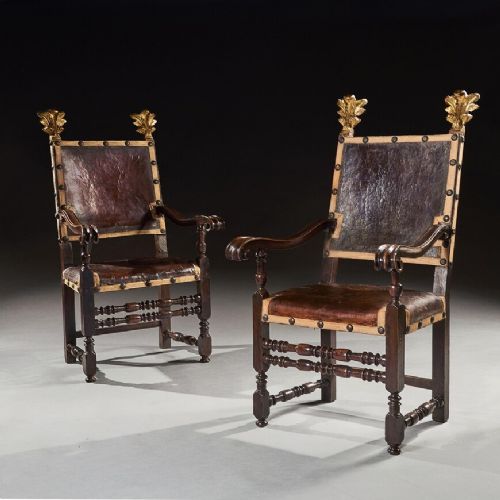
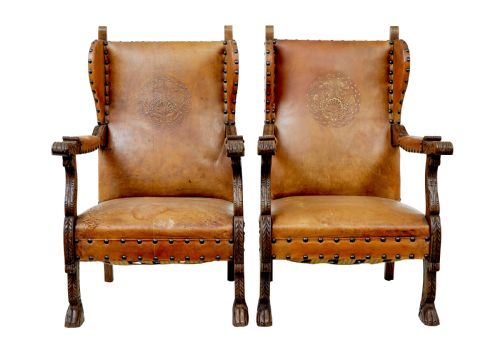
A brown leather throne chair commands any room with high-backed authority and rich upholstery.
Brown Leather Throne Chair
When you search for a brown leather throne chair, you are looking at substantial armchairs built to make a bold visual statement. The pieces listed here span several centuries, reaching from the seventeenth century through to the early twentieth century.
The selection includes matched pairs as well as single armchairs, featuring high backs, carved wooden frames, and upholstered leather panels.
How they were made
These armchairs rely on sturdy timber frames constructed primarily from oak and walnut, often heavily carved to define their imposing silhouettes. Some iterations incorporate parcel-gilt details or gold leaf to accent the woodwork.
The upholstery employs durable leather, sometimes embossed or secured with metal studs along the edges. Buttoned leather upholstery also appears among the Victorian Gothic Revival pieces, adding texture and depth to the seat and back.
Brown Leather Throne Chair Retail Price Guide 2026
Typical asking prices for brown leather throne chair among the pieces listed under this phrase on Sellingantiques today, from the lower quarter to the upper quarter. They describe what is for sale here now, not the wider market.
Listings span from the seventeenth century to the twentieth century, utilising oak, walnut, and mahogany alongside leather and brass studs.
What varies in quality
The distinction between ordinary and exceptional pieces rests primarily on the depth and execution of the woodwork. Intricate, deep carving across the oak and walnut frames elevates a chair beyond simpler vernacular forms.
The treatment of the leather upholstery also defines the upper tier of the range. Embossed details, buttoning, and the integration of brass metal studs demonstrate a higher level of craftsmanship.
A.W.N. Pugin
The Brown Leather Throne Chair Glossary
- Baroque
- A flamboyant style characterised by rich ornamentation and dramatic curves. Italian Baroque pieces in this selection date back to the seventeenth century.
- Gothic Revival
- A nineteenth-century movement that revived medieval architectural forms. These chairs often feature pointed arches and heavy timber construction.
- Jacobean Revival
- A style drawing on early seventeenth-century English design, typically utilising dark oak and formal, straight-lined framing.
- Parcel-gilt
- Woodwork partially gilded with gold leaf. This technique highlights specific carved details on the frame.
- Carver
- An armchair designed to match a set of dining chairs, usually featuring arms. These pieces often serve as standalone statement seats.
Brown Leather Throne Chair: Frequently Asked Questions
How were these chairs used?
These imposing armchairs served as principal seats for heads of households or high-ranking figures, intended to project status and authority.
Placed at the head of a table or beside a hearth, they provided commanding support and visual weight within a room.
How do I live with one?
Position the chair against a panelled or plain wall to let its high back and carved timber frame stand out clearly.
Pair it with softer textiles in the room to balance the heavy oak or walnut structure and dark leather upholstery.
How do I tell periods apart?
Examine the timber species and the style of the carvings to identify the era of construction. Seventeenth-century pieces often display Italian Baroque or early oak characteristics, whilst nineteenth-century examples frequently lean into Gothic Revival or Victorian interpretations.
Notice how turnings and joinery shift from robust seventeenth-century handcrafting to more elaborate Victorian revival styling.
Are these chairs comfortable?
The supportive high backs and wide wooden arms are built for an upright, formal posture rather than lounging. Upholstered leather panels provide a firm seat that softens with age and regular use.
Generous proportions ensure plenty of room, though the heavy wooden frames remain solid and unyielding.