

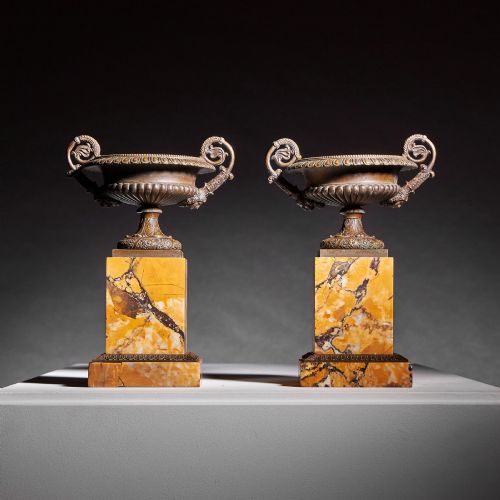
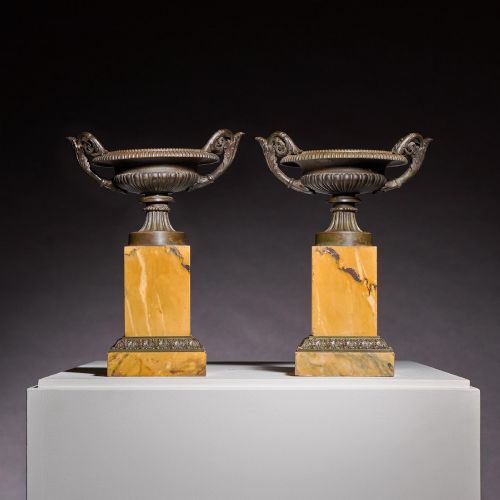
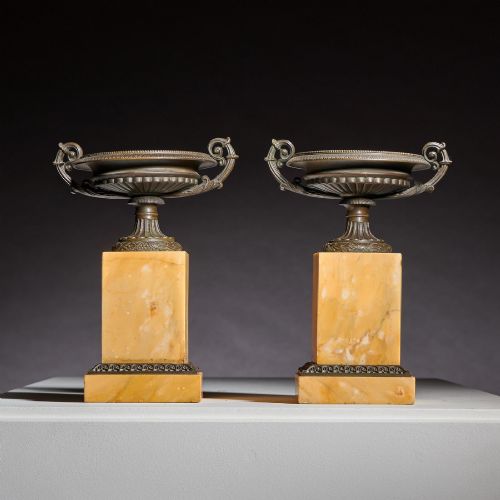
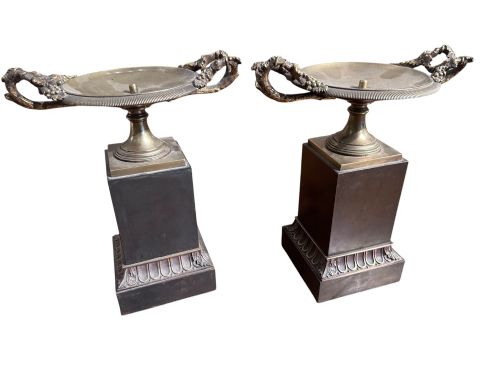


Bronze Marble Tazza Pair
A bronze marble tazza pair combines classical metalwork with solid stone pedestals, bringing stately proportion and architectural presence to a room.
Bronze Marble Tazza Pair
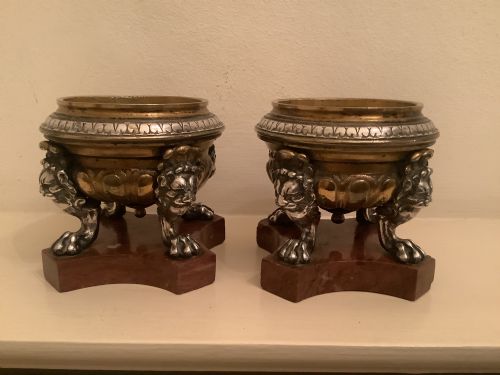
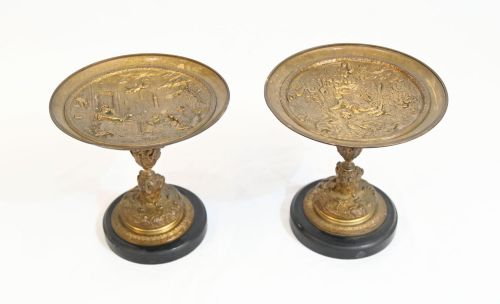
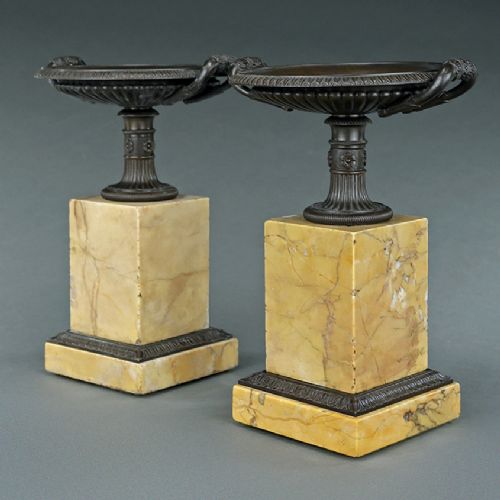
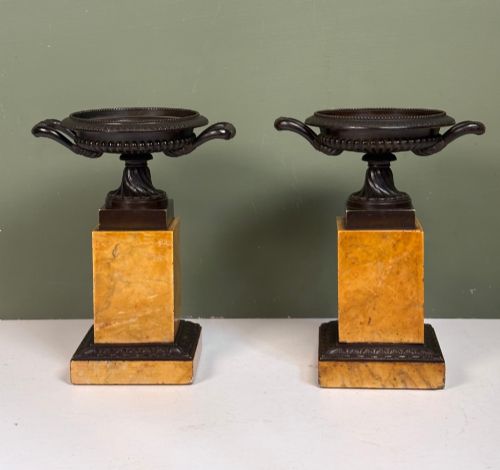
A bronze marble tazza pair consists of shallow ceremonial dishes raised on stone plinths, designed as ornamental centrepieces during the nineteenth century. These decorative objects draw heavily on classical antiquity, frequently echoing the souvenir culture of the Grand Tour across Italy and France.
The versions most commonly met on this page date from the nineteenth century, including specific periods like Regency, Charles X, and Victorian eras. French Empire and neoclassical designs dominate the selection, often taking the form of classical tazzas, ornamental vases, and uriform bowls.
Makers and designers of the period combined shallow metal basins with substantial stone bases to create balanced decorative objects. They function primarily as mantel garnitures or table ornaments, reflecting nineteenth-century enthusiasm for classical archaeology and ancient forms.
How they were made
The construction relies on the union of cast metal and turned stone, employing patinated bronze, gilt bronze, and ormolu alongside various coloured marbles. Workshops utilised black marble, red marble, giallo antico, and Siena marble for the plinths and columns, contrasting the dark or gilded tones of the metal bowls above.
Metal components undergo casting and detailed chasing, sometimes incorporating silvered finishes or fire gilding to highlight classical motifs. Stonework is meticulously lathe-turned and polished, then joined to the metal basins through internal threaded rods or secure pins.
Bronze Marble Tazza Pair Retail Price Guide 2026
Typical asking prices for bronze marble tazza pair among the pieces listed under this phrase on Sellingantiques today, from the lower quarter to the upper quarter. They describe what is for sale here now, not the wider market.
Some nineteenth-century travellers carried home heavy stone plinths in their luggage just to ensure their mantelpiece looked properly classical.
What varies in quality
The distinction between standard examples and the finest pieces lies in the crispness of the metal chasing and the selection of the stone. Superior pairs display deeply undercut bronze ornamentation, sharp classical detailing, and highly figured Siena or rouge marble with rich natural veining.
Proportion and scale also dictate quality, as larger pairs or those featuring elaborate ormolu mounts and combined patinated and silvered surfaces represent more ambitious workshop production. The precision of the joinery between the heavy stone base and the bronze vessel indicates the care taken during initial manufacture.
The Bronze Marble Tazza Pair Glossary
- Tazza
- A shallow saucer-shaped vessel mounted on a stem and foot, originating from ancient drinking vessels. In nineteenth-century decorative arts, it serves purely an ornamental function on a pedestal base.
- Grand Tour
- A cultural journey through Europe, particularly Italy, undertaken by young upper-class men in the eighteenth and nineteenth centuries. Souvenirs purchased on these travels included classical bronze and marble tazzas made after ancient models.
- Ormolu
- Finely ground high-carat gold applied to a bronze object using a mercury amalgamation process. This technique gives the metal a distinctive warm, golden lustre seen on neoclassical and Empire mounts.
- Siena Marble
- A prized yellow-gold Italian marble featuring dark grey or purple veining. It is frequently used for the plinths and columns of nineteenth-century decorative objects.
- Patinated Bronze
- Bronze treated with chemical solutions to produce a controlled surface colour, typically dark brown or greenish-black. This finish provides contrast against polished stone and gilt metal elements.
Bronze Marble Tazza Pair: Frequently Asked Questions
What is a bronze marble tazza pair?
These items are ornamental shallow vessels cast in bronze and mounted onto turned marble plinths, produced primarily during the nineteenth century. They served as decorative objects inspired by classical antiquity and archaeological discoveries.
Craftsmen drew upon French Empire, Regency, and neoclassical design vocabularies to create symmetrical pairs intended for display on mantelpieces or large tables.
How were these objects used originally?
In nineteenth-century interiors, these pieces functioned purely as decorative ornaments rather than tableware. They were often placed as mantel garnitures or centrepieces in formal drawing rooms.
Their design reflected the owners' cultural literacy and engagement with the classical past, echoing the heritage collected during European travels.
How do I style them in a modern interior?
Their architectural silhouette makes them effective on sideboards, mantels, or console tables where their vertical proportions can be appreciated. Pair them with complementary classical objects or allow them to stand alone as sculptural focal points.
The contrast between dark bronze and coloured marbles such as Siena or black marble helps anchor them within both traditional and contemporary room schemes.
How do I tell Regency pieces from later Victorian examples?
Regency and early nineteenth-century examples often display sharper neoclassical casting and frequently incorporate rich Siena marble bases associated with Grand Tour souvenirs. The handling of the patination and the weight of the cast bronze tend to reflect stricter adherence to ancient Roman and Greek proportions.
Later Victorian versions may exhibit heavier framing, broader interpretations of Empire styles, and alternative stone selections like black or red marble. Examining the quality of the chase work and the assembly methods helps clarify the period of manufacture.