




Bronze Jewellery Chest
These bronze jewellery chests are substantial tabletop containers designed for valuables, combining heavy metalwork with fitted compartments.
Bronze Jewellery Chest
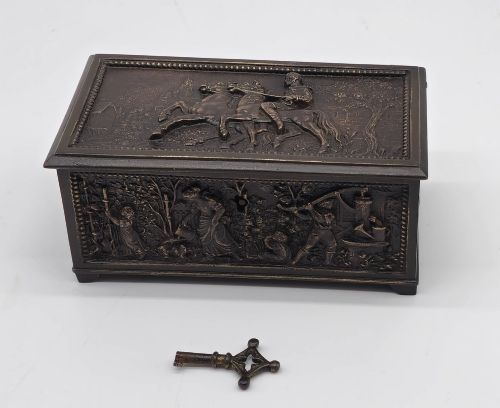
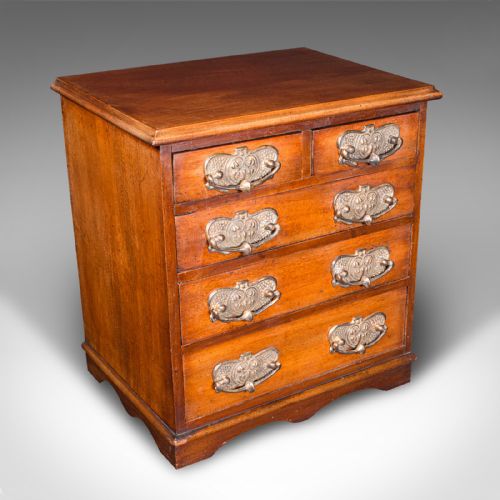
A bronze jewellery chest is a small tabletop container designed to hold valuables, often taking the form of a miniature commode, a casket, or a strong box. The phrase covers several distinct variations, from French chateau styles and Art Nouveau domed boxes to English Regency specimen cases and miniature chests of drawers.
The versions most frequently met on this page originate from nineteenth-century France and England, drawing on periods such as the Victorian era, Regency, and Louis XVI style. These objects frequently utilise decorative motifs, rural scenes, or animal decoration to enhance their utility as trinket boxes and decorative containers.
How they were made
The construction of these pieces relies on heavy cast metal, gilt bronze, or ormolu framing timber or glass bodies. Makers combined mahogany, kingwood, hardwood, and marble to create sturdy frames that supported ornate metal mounts.
Surface decoration involved fine casting, silvering, gilding, enamel work, and painted panels depicting rural scenes. Frames were assembled with panels of crystal, glass, or stone, secured with detailed metal fittings.
One unexpected strong box includes a secret letter compartment, designed to keep romantic secrets safe from prying eyes.
What varies in quality
The standard of these chests is determined by the crispness of the bronze casting and the precision of the joinery between metal and wood, glass, or marble. Superior examples display deeply chased surface detail and harmonious proportions across miniature furniture forms.
Material selection divides the range, distinguishing simple brass-framed glass boxes from heavy cast bronze caskets featuring painted enamel panels, integrated secret drawers, or sophisticated miniature commode mechanisms.
S Theeman·AB Paris
The Bronze Jewellery Chest Glossary
- Ormolu
- Gilded bronze applied to furniture and decorative objects. This technique was widely utilised by French makers during the nineteenth century to highlight mounts.
- Commode
- A low chest of drawers. Miniature versions serve as decorative jewellery chests with fitted compartments.
- Casket
- A small ornamental box for valuables or jewellery. These containers often feature hinged lids and velvet linings.
- Meiji Period
- A Japanese historical era spanning from eighteen sixty-eight to nineteen twelve. Pieces from this time often incorporate bronze animal decoration on hardwood bodies.
- Bombe
- A swelling or convex furniture shape. This curved profile appears on French style miniature commodes.
Bronze Jewellery Chest: Frequently Asked Questions
What were bronze jewellery chests used for?
These chests served as secure tabletop containers for storing precious trinkets, rings, and letters in domestic settings. Wealthy households utilised them in bedrooms and drawing rooms.
They also functioned as decorative objects in their own right, displaying fine metalwork and materials like marble or crystal to visitors.
How do I date a bronze jewellery chest?
Dating relies on identifying stylistic markers such as Art Nouveau curves, Louis XVI symmetry, or Victorian Gothic revival details. The combination of materials, including specific woods and cast metal techniques, points to particular decades.
Maker marks or stamps on the bronze work also provide direct evidence of origin and production period.
How do I clean bronze jewellery chests?
Maintenance requires gentle dusting with a soft, dry cloth to prevent dirt accumulation in the chased details of the metal. Aggressive metal polishes must be avoided to protect the original gilt or silvered surfaces.
Wooden and marble sections should be treated according to their specific material needs, keeping moisture away from lined interiors.
Where were most bronze jewellery chests made?
A significant proportion of these pieces originated in nineteenth-century France, particularly Paris, where workshops specialised in gilt bronze and ormolu mounts. English makers also produced notable tabletop cabinets and strong boxes.
Design influences crossed borders, leading to French styles manufactured for international markets alongside domestic English variations.