


Bronze Hunting Sculpture
A bronze hunting sculpture captures the athletic tension of hounds, gun dogs and field sports in solid metal.
Bronze Hunting Sculpture
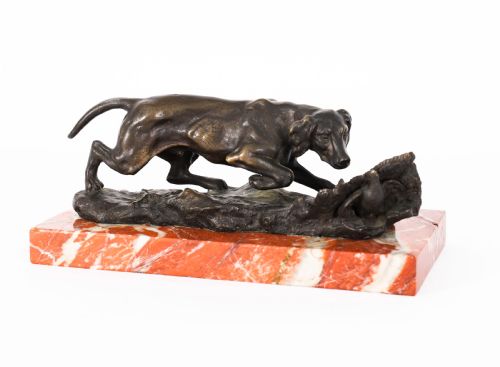
When you search for a bronze hunting sculpture, you encounter animalier studies, figures of hounds, setters, pointers, and hunting scenes originating predominantly from the nineteenth and early twentieth centuries. These works record the anatomy and behaviour of working dogs, foxes, and game birds with close observation.
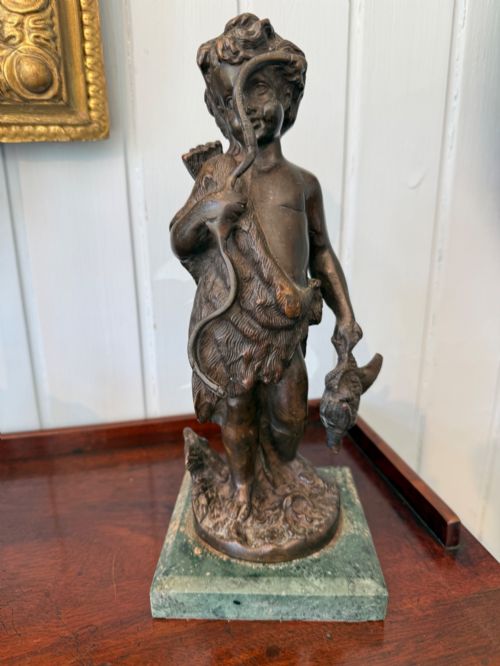
You are most likely to meet French animalier bronzes from the Victorian and Edwardian periods, frequently mounted on marble or onyx bases. Figures range from resting hounds and retrieving setters to dramatic groups involving hunters, horses, and prey.
English and Russian interpretations also appear, spanning nineteenth-century neoclassical compositions to Art Deco depictions of borzois and retrievers. The subjects focus squarely on the pursuit, featuring gundogs putting up pheasants, hounds with hares, and mounted huntsmen.
How they were made
Foundries utilised the lost-wax technique or sand-casting methods to capture fine details in bronze, spelter, and silvered bronze. Molten metal filled moulds that rendered musculature, fur textures, and feathered game with precision.
Many sculptures incorporate mixed media, pairing cast metal figures with polished marble, onyx, or wooden plinths. Cold painting and ormolu highlights occasionally add colour and contrast to the metallic surfaces.
Several bronze hounds are caught mid-thought, pondering the eternal mystery of pheasants and hares.
What varies in quality
Quality rests upon the crispness of the chase-work and the fidelity of the casting, which determines whether fine details like fur and feather remain sharp. Superior pieces retain the vitality and exact anatomical proportions modelled by accomplished sculptors.
The choice and finish of the base material also distinguish better works, with heavy, well-fitted marble or onyx plinths enhancing the sculpture. Casts produced directly during an artist's lifetime hold greater distinction than later posthumous editions or substitute metal figures.
Carl Kauba·Jules Moigniez·Delabrierre·Auguste Nicholas Cain·Antoine Louis Barye·Christophe Fratin·Pierre-Jules Mène·John Willis Good·Isidore Bonheur·Dubucand·Nikolai Lieberich·L.Bureau
The Bronze Hunting Sculpture Glossary
- Animalier
- A nineteenth-century artistic movement focusing on the realistic portrayal of animals, particularly wild beasts and domestic hounds. Sculptors in this style studied live specimens closely in menageries and fields.
- Lost-wax casting
- A method of metal casting where a molten metal is poured into a mould that has been created by means of a wax model. The wax is melted and drained away, allowing intricate detail to transfer to the bronze.
- Spelter
- An alloy of zinc and other metals frequently used as a substitute for bronze. It is lighter in weight and softer than bronze, often patinated to simulate other metals.
- Ormolu
- Gilded bronze, where a finely ground gold-mercury amalgam is applied to a bronze object and heated. This technique imparts a rich golden finish to decorative mounts and highlights.
- Cold painted
- A finishing technique where paint is applied to a bronze object without being fired in a kiln. This method allows for delicate polychrome details on animal and human figures.
Bronze Hunting Sculpture: Frequently Asked Questions
What is an animalier bronze?
An animalier bronze is a nineteenth-century sculpture focusing on realistic animal subjects, particularly hounds and wildlife.
These pieces capture creatures in motion or repose with careful attention to natural anatomy.
How do I identify a cast after an artist?
Sculptures marked as 'after' an artist are later editions produced from existing models rather than lifetime casts.
Foundries often reproduced successful animalier works after the sculptor's death using the original forms.
Why are some figures mounted on marble?
Marble and onyx bases provide stability and a formal weight to heavy metal sculptures.
These stone plinths became standard for nineteenth and twentieth-century cabinet bronzes to elevate the display.
What is the difference between bronze and spelter?
Bronze is a durable alloy of copper and tin capable of holding exceptionally sharp casting details.
Spelter is a softer zinc alloy used for decorative figures that requires gentler handling to avoid surface wear.