


Bronze Hunting Dog Statue
A bronze hunting dog statue captures the fierce energy and steadfast loyalty of the chase in solid metal.

Bronze Hunting Dog Statue
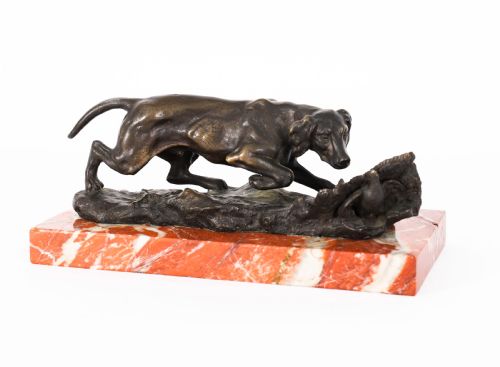
A bronze hunting dog statue represents the pinnacle of Animalier sculpture, focusing specifically on gundogs, hounds, and working dogs in realistic poses. These pieces capture resting hounds, setters with rabbits, and dynamic groups flushing pheasants or interacting with birds.
The versions most frequently met on this page date from the nineteenth century and the Art Deco period, originating predominantly from French workshops. They appear as standalone figures or mounted upon heavy stone bases like marble and onyx.
How they were made
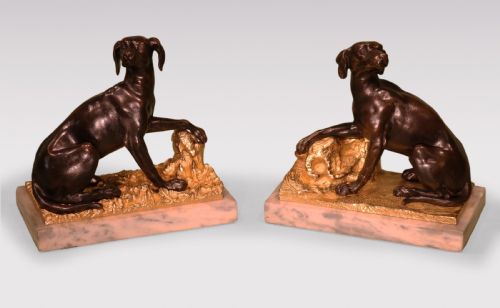
Foundries utilised the lost-wax casting technique or sand casting to produce these detailed metal figures, allowing sculptors to render musculature and fur with precision. Many pieces combine patinated bronze with gilt ormolu, while some later or alternative examples employ spelter or cast iron.
Many figures are mounted upon heavy bases of marble or onyx, providing a solid foundation for the metalwork. Certain examples also feature cold-painted surfaces, adding naturalistic colour to the bronze.
Bronze Hunting Dog Statue Retail Price Guide 2026
Typical asking prices for bronze hunting dog statue among the pieces listed under this phrase on Sellingantiques today, from the lower quarter to the upper quarter. They describe what is for sale here now, not the wider market.
Several hounds share their bronze space with unfortunate pheasants, rabbits, and birds.
What varies in quality
Quality rests in the anatomical accuracy of the hound and the crispness of the chasing work applied to the metal after casting. Superior examples display subtle musculature and realistic textures in the fur, whereas lesser casts lose these fine details.
The integration between the sculpture and its stone base, as well as the depth and richness of the bronze patina, distinguishes a masterwork from a standard foundry production.
Carl Kauba·Jules Moigniez·Delabrierre·C Masson·Auguste Nicholas Cain·Antoine Louis Barye·Christophe Fratin·Pierre-Jules Mêne·DUBUCAND·L.Bureau
The Bronze Hunting Dog Statue Glossary
- Animalier
- A nineteenth-century artistic movement dedicated to the realistic portrayal of animals, particularly wild beasts and hunting dogs. Practitioners often studied live subjects in menageries.
- Spelter
- A zinc alloy frequently utilised as a cost-effective alternative to bronze, particularly for figures produced during the Art Deco period. It takes patination well to simulate heavier metals.
- Ormolu
- Gilded bronze, where a layer of gold is applied to a bronze base using mercury or electrochemical methods. It provides a bright, contrasting metallic finish.
- Patinated bronze
- Bronze treated with chemicals and heat to produce a specific surface colour, ranging from deep brown to verdigris. This finish protects the metal and enhances visual depth.
Bronze Hunting Dog Statue: Frequently Asked Questions
What is an Animalier bronze?
An Animalier bronze is a nineteenth-century sculpture focused specifically on realistic representations of animals, particularly dogs, horses, and wildlife. These works were created by specialised sculptors who closely studied animal anatomy and movement.
Artists aimed for lifelike precision, capturing working dogs in active pursuits like hunting or retrieving game.
How can I tell bronze from spelter?
Bronze is heavier, denser, and generally cooler to the touch than spelter, with a more resonant sound when tapped. Spelter is a softer zinc alloy that often shows lighter grey metal underneath worn areas of its surface finish.
Examining the underside or hidden mounting points can also reveal the distinct weight and composition of true bronze.
Why are some dogs mounted on marble?
Marble and onyx bases provided structural stability for heavy metal sculptures and added an architectural element to display pieces. These heavy plinths became standard during the nineteenth century and into the Art Deco period.
The stone base often contrasts nicely with the dark patinated bronze of the hound.
Are these statues French in origin?
Many nineteenth-century and early twentieth-century animal sculptures originated in France, where specialised foundries and master sculptors dominated the genre. French artists established high standards for metal casting and animal anatomy.
However, makers from other European countries also produced notable works in similar styles.