
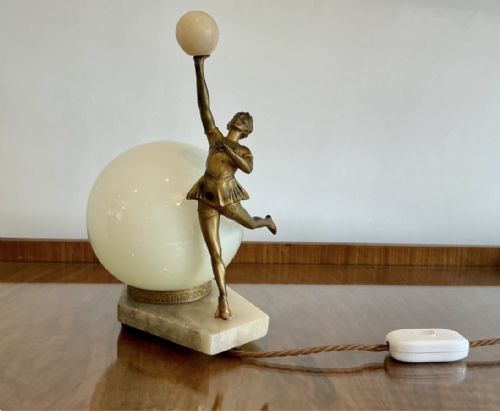


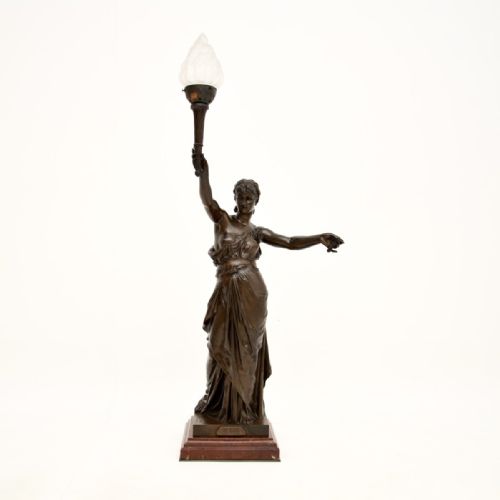


Bronze Female Figure Lamp
A bronze female figure lamp marries sculptural form with domestic illumination, bringing a classical or modernist presence to any interior.
Bronze Female Figure Lamp
When you search for a bronze female figure lamp, you encounter sculptural lighting fixtures that incorporate human forms across various historical periods. These pieces range from compact table lamps to large torcheres standing several feet tall.
The versions most frequently met on this page span the Victorian era, the nineteenth century, and the Art Deco period of nineteen thirty. They appear as table lamps, desk lamps, floor lamps, torcheres, and wall lights.
Makers and artists represented in these pieces include Humphrey Hopper, Jean-Jules Cambos, Coutan, and Auguste Moreau. Their creations utilise distinct regional approaches from England and France.
Materials and construction
These figures utilise cast metals such as bronze and patinated spelter, alongside silvered spelter and brass. Surfaces often receive patination, cold painting, or gilding to enhance the sculptural details of the female forms.
Supporting elements and shades incorporate complementary materials including marble, glass, frosted glass, and plaster. Torcheres and figural lampbases frequently integrate these media to balance weight and light diffusion.
Bronze Female Figure Lamp Retail Price Guide 2026
Typical asking prices for bronze female figure lamp among the pieces listed under this phrase on Sellingantiques today, from the lower quarter to the upper quarter. They describe what is for sale here now, not the wider market.
Listings feature works spanning the nineteenth century, the Victorian period, and nineteen thirty Art Deco.
Quality variations
The choice of secondary materials, such as heavy marble bases or high-grade frosted glass shades, distinguishes more substantial floor lamps and table pieces from lighter, mass-produced alternatives.
Humphrey Hopper·Jean-Jules Cambos·Coutan·Auguste Moreau
The Bronze Female Figure Lamp Glossary
- Torchere
- A tall stand or ornamental candlestick, often adapted as a floor lamp to hold a light source aloft. These fixtures can reach significant heights, such as seven feet.
- Spelter
- An alloy of zinc and copper used as an economical alternative to bronze. It accepts patination and silvering effectively for figural sculptures.
- Cold painted
- A technique where paint is applied to metal without heat fixing. This finish appears on Victorian pieces to add colour to the surface.
- Patinated metal
- Metal treated with chemicals or heat to produce a coloured surface layer. This process deepens the visual texture of the figure.
Bronze Female Figure Lamp: Frequently Asked Questions
What periods do these lamps come from?
The pieces span the Georgian, Regency, and Victorian eras, alongside nineteenth-century French works and nineteen-thirties Art Deco designs.
Each period imparts distinct stylistic characteristics to the female figures and their supporting bases.
How were torcheres originally used?
Torcheres served as grand decorative stands that illuminated large rooms with candles or oil lamps before electrical wiring became common.
Over time, many of these tall fixtures underwent conversion to hold electric lamp fittings and shades.
Are spelter and bronze different?
Bronze is a durable copper and tin alloy prized for its strength and ability to hold fine casting detail.
Spelter is a softer zinc alloy that offers a lighter weight and was frequently patinated or silvered to resemble bronze.
How do I place a tall torchere?
Large torcheres and floor lamps suit corners of reception rooms or hallways where their height creates a strong vertical focal point.
Smaller table lamps sit comfortably on desks, side tables, or cabinets as task or accent lighting.