


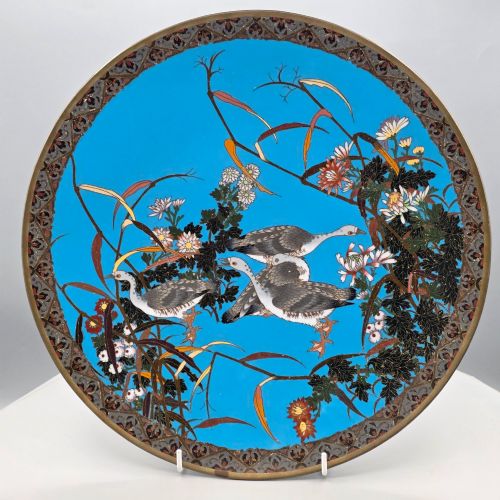



Bronze Cloisonne Charger
A bronze cloisonne charger is a substantial decorative plate worked in wire and enamel, bringing intense colour and intricate Japanese craftsmanship to a room.
Bronze Cloisonne Charger
These items are large decorative plates, dishes and wall chargers originating from Japanese workshops during the nineteenth century, including the Edo and Meiji periods. When you search for a bronze cloisonne charger, you encounter circular vessels depicting natural subjects such as geese, chrysanthemums, birds and dragons.
The objects span several decades from the 1860s through to 1900, demonstrating a clear evolution in Japanese decorative metalwork. Many examples feature signed panels or specific motifs like leaping koi and auspicious symbols, rendered on substantial bronze or copper foundations.
How they were made
Artisans constructed these chargers by soldering flat wire, typically brass or silver wire, onto a bronze or copper base to form the outlined cells of the design. These partitioned cells were then filled with coloured enamel paste before being fired in a kiln and polished to a smooth finish.
Certain pieces utilise alternative core materials such as porcelain within a technique known as Totai Shippo, mimicking tree bark and traditional metalwork. The meticulous application of wirework requires steady hands to achieve precise geometric and pictorial boundaries.
Bronze Cloisonne Charger Retail Price Guide 2026
Typical asking prices for bronze cloisonne charger among the pieces listed under this phrase on Sellingantiques today, from the lower quarter to the upper quarter. They describe what is for sale here now, not the wider market.
Listings feature items spanning the 1860s to 1900, encompassing the Edo and Meiji periods through copper, bronze, and silver wire materials.
What varies in quality
Quality rests upon the complexity and precision of the wirework alongside the clarity of the enamel infill. Finer examples display intricate pictorial subjects like detailed dragons, birds, or leaping koi with minimal pitting in the glazed surface.
The presence of an artist signature, such as Kinkozan, elevates a piece, indicating a higher tier of workshop production. Scale and ambition also divide the range, with larger dimensions and unusual base materials like Totai Shippo marking out exceptional output.
Kinkozan
The Bronze Cloisonne Charger Glossary
- Cloisonne Enamel
- An ancient decorative technique where metal wires form compartments on a base to hold coloured glass paste. These compartments are fired and polished flat.
- Totai Shippo
- A specific Japanese method involving enamel applied over a porcelain body rather than metal. This creates the appearance of cloisonne on a ceramic core.
- Meiji Period
- A significant era in Japanese history spanning from 1868 to 1912, noted for a surge in refined decorative arts exported globally.
- Charger
- A large ornamental plate intended for display on walls or furniture rather than for serving food at a table.
- Edo Period
- The period of Japanese history lasting from 1603 to 1867, preceding the Meiji era and yielding early examples of these heavy decorative dishes.
Bronze Cloisonne Charger: Frequently Asked Questions
What is a bronze cloisonne charger?
A bronze cloisonne charger is a large decorative plate created by partitioning metal surfaces with fine wire and filling the sections with coloured enamel. These items functioned primarily as display pieces for walls and cabinets.
Originating largely from Japanese workshops during the nineteenth century, they showcase traditional motifs including dragons, birds and floral arrangements.
How do I date a bronze cloisonne charger?
Dating relies on the stylistic markers, period designations, and specific material characteristics recorded in the manufacture. Pieces from the Edo period contrast with the later output of the Meiji era through distinct aesthetic choices.
Examining the complexity of the wirework and the depth of the bronze or copper base provides further context regarding the decade of production.
How should I display a charger?
Chargers are designed for visual presentation rather than dining use, making them suitable for wall mounting with secure plate hangers. Alternatively, they sit safely on sturdy plate stands placed upon flat surfaces.
Keeping them away from direct sunlight helps preserve the vibrant tones of the enamel infill.