




Bronze Big Cat Sculpture
A bronze big cat sculpture brings raw predatory power indoors, rendered in metal across nineteenth-century realism and twentieth-century modernism.

Bronze Big Cat Sculpture
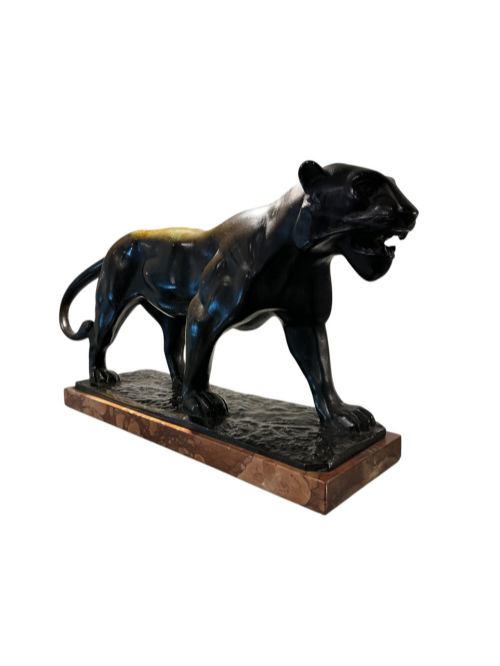
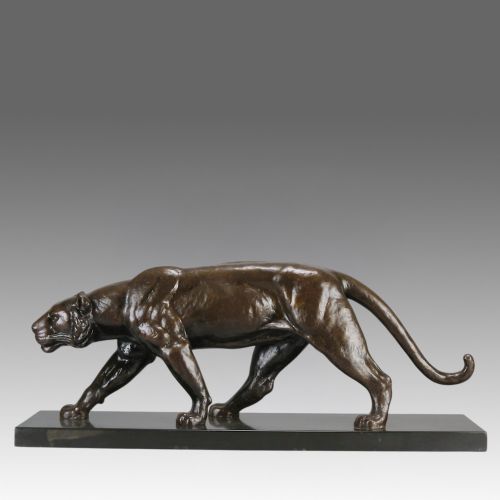
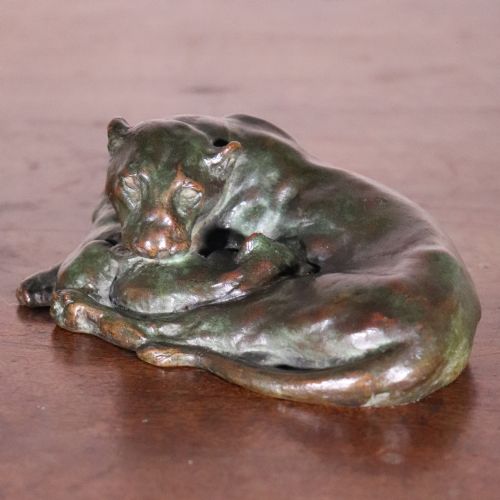
A bronze big cat sculpture captures tigers, panthers, lions, and jaguars in repose, prowling, or locked in combat. These pieces range from nineteenth-century French animalier studies to sleek Art Deco interpretations.
You will most frequently encounter nineteenth-century French bronzes and Art Deco iterations on marble bases. Subjects vary from solitary crouching panthers to pairs of tigers and lioness studies.
Origins stretch from French foundries to Austrian workshops, spanning periods from the late nineteenth century through to the mid-twentieth century. Many sit on heavy marble or onyx plinths designed to anchor the composition.
Materials and methods
Sculptors utilised hot-cast bronze and cold-painted bronze, alongside spelter for later or more accessible interpretations. Metals were often patinated to achieve deep brown, black, or metallic finishes.
Foundries employed the lost-wax casting method for complex figures, allowing fine detail in musculature and fur. Bases were carved from solid blocks of black or veined marble and onyx to support the weight of the metal.
Materials recorded across the inventory include patinated bronze, cold-painted bronze, spelter, silvered bronze, paint, marble, and onyx.
Assessing quality and execution
Quality rests in the anatomical precision of the feline and the crispness of the chase work on the metal surface. Superior pieces show nuance in tension, muscle tone, and expression rather than flat casting.
The integration between the sculpture and its stone base marks distinction. Heavier, finely polished marble plinths and sharp foundry signatures elevate the standing of a work.
Alexandre Ouline·Franz Bergman·G. Gardet·Clovis Masson·Michel Decoux·Georges Gardet·Louis Riche·E. Drouot
The Bronze Big Cat Sculpture Glossary
- Animalier
- A nineteenth-century artistic movement dedicated to the realistic portrayal of animals, particularly wild beasts. Practitioners focused on capturing accurate anatomy and movement.
- Cold-painted bronze
- A technique where bronze sculptures are painted with several layers of cold enamel rather than fired in a kiln. This method allows for vibrant, multi-coloured finishes.
- Patinated bronze
- Metal treated with chemical solutions to produce a specific surface colour or aged finish. Dark brown and black patinas are common on feline subjects.
- Spelter
- A zinc-based alloy often utilised as a cost-effective alternative to bronze. It takes patination well and appears frequently in twentieth-century decorative pieces.
Bronze Big Cat Sculpture: Frequently Asked Questions
What is the difference between bronze and spelter?
Bronze is a durable copper alloy capable of holding fine chisel work and supporting heavy cantilevered forms. Spelter is softer, lighter, and composed mainly of zinc.
Underneath the surface finish, spelter feels lighter than bronze and may show a silvery-grey metal if chipped. Bronze remains the preferred medium for durability and crisp detail.
Why are marble bases used on these sculptures?
Marble bases provide structural stability and weight to anchor dynamic, extended feline compositions. They also offer a clean architectural contrast to organic animal forms.
During the Art Deco period, contrasting black and variegated marble plinths became an integral part of the design aesthetic.
How can I tell nineteenth-century pieces from later ones?
Nineteenth-century works typically rely on naturalistic animalier realism, often featuring foundry marks and signature engravings directly into the casting. The patination tends to show deeper, hand-applied warmth.
Twentieth-century Art Deco examples lean towards stylised, geometric streamlining, frequently paired with stepped marble bases and occasionally utilising spelter.