







Bronze and Marble Garniture
A bronze and marble garniture brings together cast metal and polished stone to anchor a mantelpiece with matched decorative harmony.

Bronze and Marble Garniture
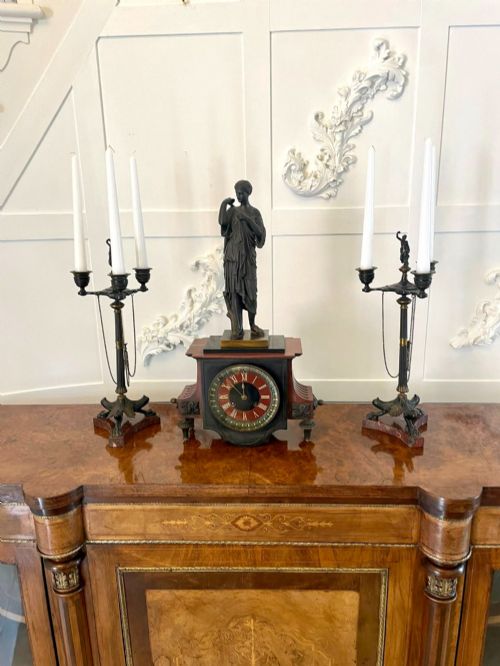
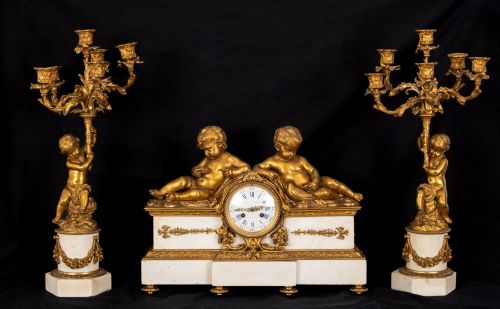
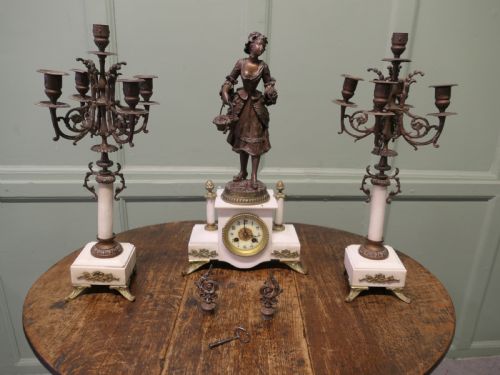
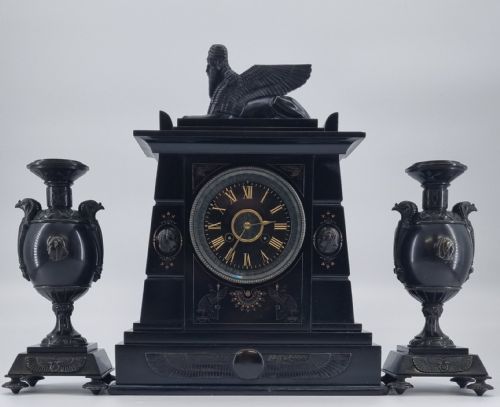
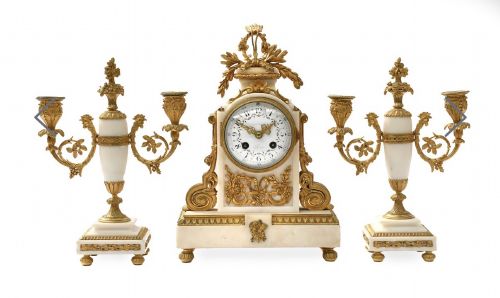
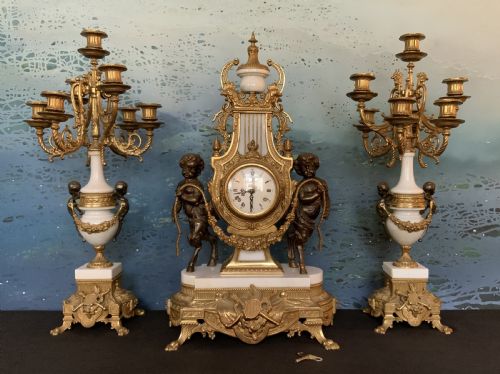
A bronze and marble garniture typically comprises a central mantel clock accompanied by a matching pair of side pieces, such as candelabra, urns or vases. These sets emerge prominently from nineteenth-century French workshops, spanning styles from the formal grandeur of the French Empire and Louis XVI revivals to later Victorian interpretations.
The central clock frequently shares its material palette and decorative motifs with the flanking objects, creating a unified display for a drawing room or parlour. Buyers most commonly encounter nineteenth-century examples pairing patinated or gilded metals with contrasting white, red or siena marble bases.
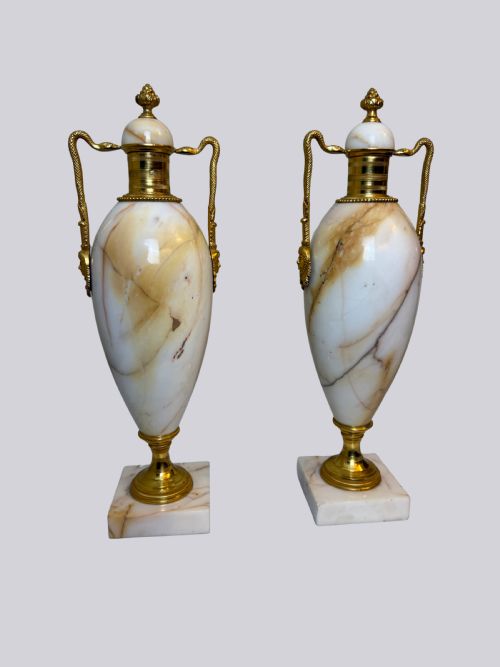
Beyond complete three-piece sets, the search encompasses paired cassolettes, decorative amphora vases and candleholders mounted on stone plinths. The overarching design language draws heavily on Neoclassical themes, incorporating classical urn forms, cherubs and architectural marble columns.
Materials and construction methods
Foundries cast metal components in bronze, brass or spelter, subsequently applying mercury gilding, ormolu or dark patination to achieve varied surface finishes. Enamel dials, painted ceramic plaques and intricate brass clock movements complete the functional elements of the timepieces.
Stonemasons shaped natural marble, white onyx and siena marble into architectural plinths, urn bodies and clock housings, turning and polishing the stone to a smooth lustre. Metal mounts, cast handles and figural ornaments were then mechanically secured or pinned directly into the heavy stone foundations.
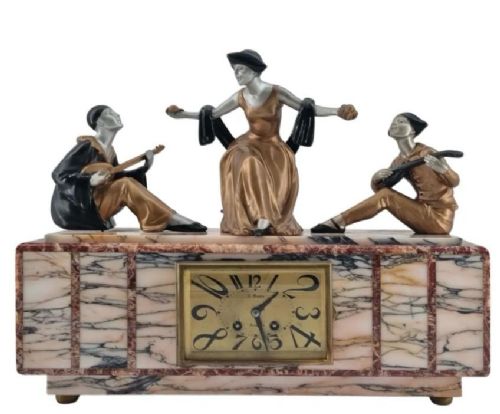
Listings feature items spanning the nineteenth century, including specific dates from 1850 through to Art Deco pieces from the 1920s and 1930s.
Assessing craftsmanship and execution
The standard of a bronze and marble garniture rests heavily on the crispness of the metal chasing and the depth of the gilding or ormolu. Finer examples display hand-finished detailing in the bronze casting, where facial expressions, drapery and foliate scrolls remain sharp and well-defined.
The selection and preparation of the stone foundation also mark the distinction between tiers of production. Heavier, unblemished marble blocks with precise corner mitres and tightly fitted bronze mounts demonstrate superior workshop standards compared to lighter or simpler assemblies.
H Luppens Paris·Sega
The Bronze and Marble Garniture Glossary
- Garniture
- A set of matching decorative objects for a mantelpiece, usually consisting of a central clock and two flanking candelabra, vases or urns.
- Ormolu
- Gilded bronze, where finely ground gold amalgam is applied to a bronze base through heat processing to produce a rich golden surface.
- Cassolette
- A decorative vessel, often in marble and bronze, featuring a reversible lid that converts an ornamental urn into a candleholder.
- Spelter
- A zinc alloy used as a less expensive alternative to bronze for cast figures and decorative mounts, frequently painted to simulate bronze.
- Portico clock
- A mantel clock designed with architectural columns supporting the movement case above a rectangular marble base.
Bronze and Marble Garniture: Frequently Asked Questions
What pieces make up a garniture?
A standard garniture consists of a central mantel clock accompanied by two matching side ornaments, which might take the form of candelabra, urns or cassolettes. These matched sets were designed to sit together on a fireplace mantel or console table.
The pieces share identical design motifs, materials and patination, creating a balanced visual arrangement that was popular in nineteenth-century interiors.
How do I care for marble and bronze?
Dust marble and bronze components regularly with a soft, dry cloth to prevent the accumulation of grit in crevices and engraved details. Avoid using commercial metal polishes or harsh chemical cleaners, as these can strip historical patination or damage applied gilding.
Keep the stone and metal away from direct sunlight and damp environments to protect the marble polish and prevent corrosion on the metal surfaces.
How do I wind an antique clock?
Antique clock movements require a dedicated winding key inserted gently into the dial winding holes to tension the mainsprings. Turn the key smoothly in the direction specified for the particular movement, avoiding overwinding to prevent internal strain.
Ensure the clock rests on a completely level marble base to keep the pendulum swinging evenly and maintaining accurate timekeeping.
How do I identify Louis XVI style?
Louis XVI style pieces feature strict symmetry, straight architectural lines and classical motifs such as acanthus leaves, urns, ribbons and laurel wreaths. This aesthetic moves away from the asymmetrical curves of earlier Rococo designs in favour of Neoclassical restraint.
The combination of white or coloured marble with restrained gilt bronze mounts serves as a hallmark of this revival period in nineteenth-century decorative arts.