




Broad Arm Windsor
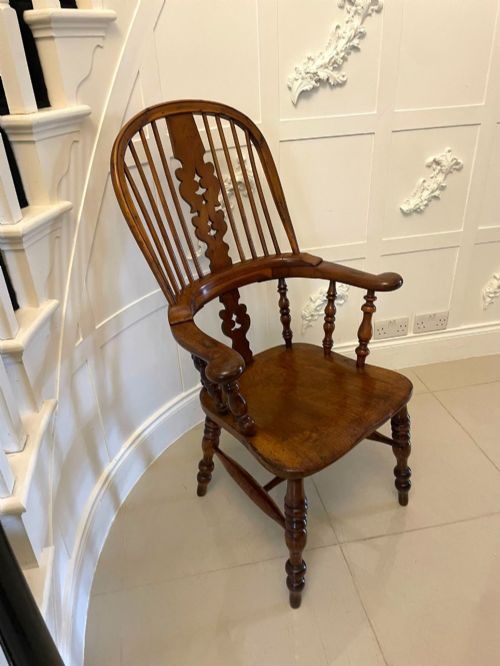
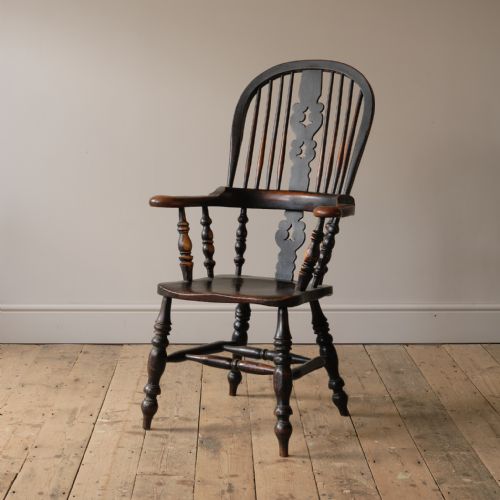
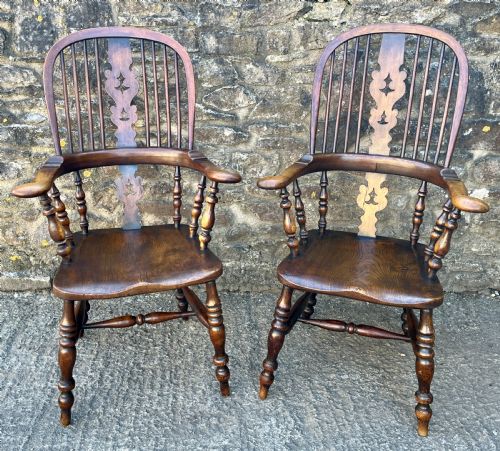
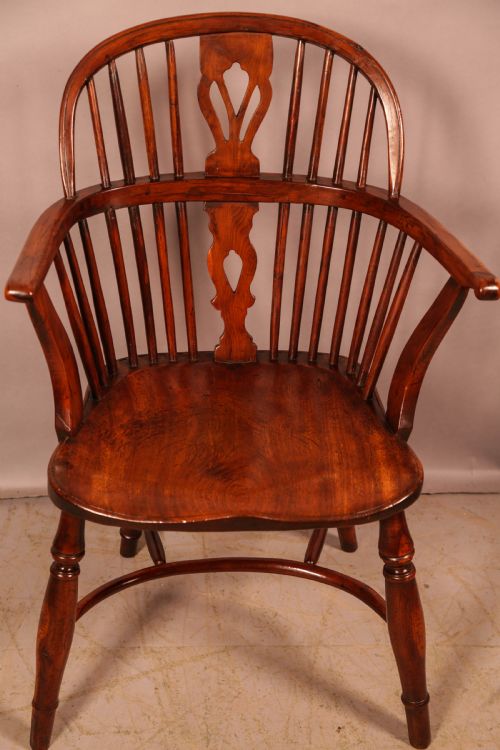
These broad arm windsor armchairs offer a generous flat wooden rest for writing or working, shaped from solid country timbers.
Broad Arm Windsor
A broad arm windsor is a distinct regional armchair built with an expanded wooden paddle on one side to serve as a writing surface or desk rest. The form emerges primarily in nineteenth century country furniture, spanning the Victorian and Edwardian eras.
Most examples found here date from the nineteenth century, including pieces attributed to specific northern centres such as Yorkshire and Worksop. They appear as individual armchairs, pairs, or low and high back variants designed for domestic use.
Makers constructed these seats to handle daily utility in farmhouses and provincial homes, combining sturdy stick-built spindles with carved wooden saddles. The resulting seating balances robust construction with utilitarian comfort.
How They Were Made
Makers combined contrasting timbers within a single chair, pairing dense yew or sturdy ash for the bent parts and spindles with thick elm for the saddle seats. This selection utilised local woods suited to steam bending and weight bearing.
The broad arm itself was typically shaped from a single solid plank, securely jointed into the back bow and supported underneath by additional spindles or turned struts. Seats were deeply adzed and hollowed by hand to provide comfort without upholstery.
Listings feature nineteenth century pieces constructed from yew, ash, and elm, spanning Victorian styles and regional Yorkshire origins.
What Varies In Quality
Quality rests in the harmony of the timber selection and the crispness of the turning on the undercarriage spindles and legs. A finer armchair shows well-figured yew grain or clean ash matching, while lesser examples rely on heavier, plain timber.
Proportion and stance dictate the visual success of the piece, particularly the curve of the arm paddle and the rake of the legs. Stronger construction involves tight joinery where the thick arms meet the main bow without excessive movement.
Allsop Worksop·Worksop Made
The Broad Arm Windsor Glossary
- Broad arm
- An expanded flat wooden rest attached to the side of an armchair to function as a writing surface. This arm provides extra width on one side for papers or books.
- Spindle
- A slender turned wooden rod forming the vertical supports of the chair back. Spindles are tenoned directly into the seat and the top bow.
- Bow
- The bent wooden piece forming the upper back rail of the armchair. It is typically steam bent from a continuous piece of ash or yew.
- Saddle seat
- A thick wooden seat base shaped with hollows and contours by an adze. This carving provides ergonomic seating depth without padding.
- Underframe
- The system of turned legs and connecting stretchers supporting the seat base. It provides structural rigidity to the entire chair.
Broad Arm Windsor: Frequently Asked Questions
What is a broad arm windsor used for?
These armchairs served practical functions in provincial homes and studies where a built-in writing surface was useful. The wide wooden paddle on the side provided a convenient desk space for reading or correspondence.
Over time, they became staple seating in farmhouses and country houses, valued for their combination of a sturdy armchair and a writing desk.
How do I identify a Yorkshire windsor?
Yorkshire examples often feature distinctive lower back designs and specific turning details on the undercarriage legs. Regional makers utilised local ash and yew alongside sculpted elm seats.
Examining the construction methods and timber choices helps distinguish pieces originating from northern workshops during the nineteenth century.
Are these chairs comfortable to sit in?
The comfort comes from the deeply carved wooden saddle seat rather than any soft padding or upholstery. The ergonomic hollowing supports the body for long periods of sitting.
Additionally, the wide arm provides a natural resting place for the arms while reading, writing, or relaxing.
What woods were used to build them?
Craftmen relied on native British timbers, most notably yew wood, ash, elm, and occasional beech or oak. Elm was standard for the thick seats due to its resistance to splitting.
Upper bows and arms typically utilised flexible ash or richly figured yew wood, while legs and spindles were turned from matching hardwoods.