


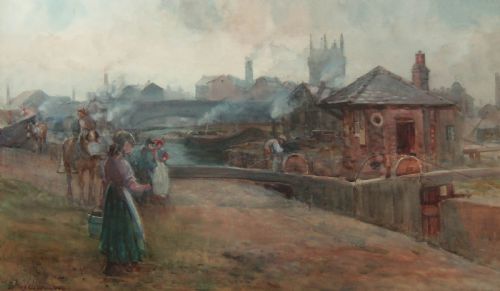

British School Maritime Watercolour
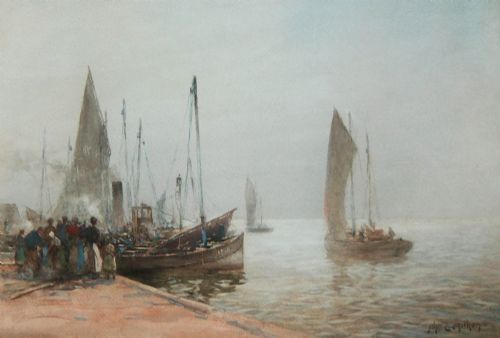
British school maritime watercolour works capture coastal harbours, fishing fleets and tidal rivers with fluid washes of pigment on paper.
British School Maritime Watercolour
When you search for british school maritime watercolour, you encounter historic paintings executed on paper using water-soluble pigments, often framed behind glass in wood mouldings. These works document coastal life, shipping scenes and tidal estuaries across the nineteenth and twentieth centuries.
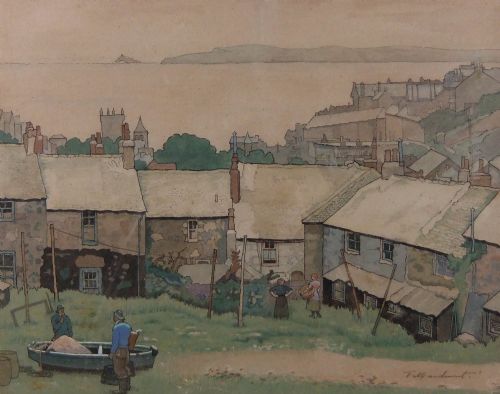
The pieces on this page span several distinct periods, including the Victorian era, the Edwardian years and the interwar decades. You will find coastal depictions linked to regional groups such as the Newlyn School and the St Ives School, alongside works by named British marine artists.
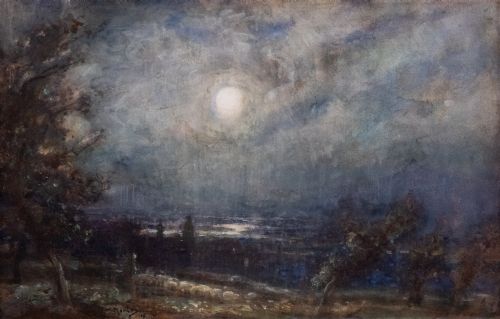
Subjects range from bustling Yorkshire fishing ports and Scottish coastal towns to moonlit lakes and river shipping. The most common format is an original painting on paper, presenting either an intimate view of fisherfolk or a broader seascape with sailing ships and clippers.
Materials and technique
These works rely primarily on watercolour pigment applied to paper, occasionally augmented with ink or bodycolour to define details of rigging, architecture and figures. The support is typically a heavy sheet of rag paper or watercolour paper that holds washes of colour without warping excessively.
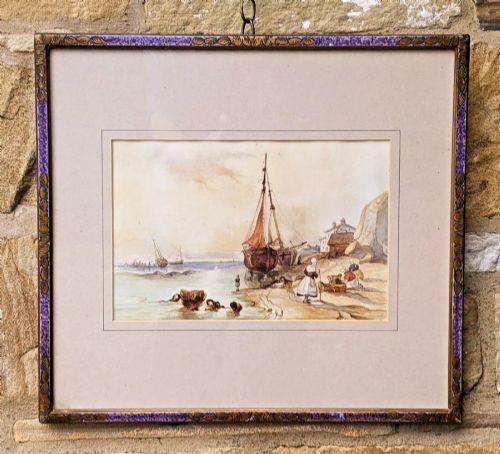
Artists built up their compositions through transparent washes, preserving the white of the paper for highlights such as breaking waves, sails and moonlight. Framing historically involved wood mouldings and protective glass to shield the delicate paper and water-soluble pigments from moisture and light.
Materials recorded across these artworks include watercolour pigment, ink, glass and wood frames protecting original paper supports.
Assessing quality and execution
Quality in these watercolours depends upon the surety of the brushwork and the artist's ability to capture the atmosphere of the coast or river. Stronger examples display confident handling of light, water and skies, whereas weaker works can feel stiff or overly laboured.
The reputation of the maker and the specificity of the location also influence the standing of a piece. Signed works by documented Victorian and Edwardian painters typically exhibit superior draughtsmanship and composition compared to anonymous topographical sketches.
James E. Aitken·Thomas William Morley·Thomas Maidment·William Frederick Settle·Arthur Tucker·Frank H. Mason·William Wyld·Henry Barlow Carter·Percy Brooke·Ralph Todd·Thomas Bush Hardy·William Lee Hankey·S. J. Lamorna Birch·Arthur Netherwood·Rowland Henry Hill·Gordon Meadows
The British School Maritime Watercolour Glossary
- Watercolour pigment
- Finely ground colour particles mixed with a water-soluble binder. This medium allows for luminous washes that let the reflective quality of the paper shine through.
- Bodycolour
- Watercolour paint mixed with a white pigment to render it opaque. Artists utilise this technique to add sharp highlights to sails, foam and clouds.
- Newlyn School
- An art colony based in Cornwall during the late nineteenth and early twentieth centuries. Practitioners focused on plein-air painting of local fisherfolk and coastal life.
- St Ives School
- A twentieth-century grouping of artists working in the Cornish coastal town. They drew inspiration from the local marine environment and harbour architecture.
- Provenance
- The documented history of ownership surrounding a work of art. A clear lineage adds context to the piece and confirms its attribution.
British School Maritime Watercolour: Frequently Asked Questions
What subjects do these watercolours depict?
The works primarily illustrate coastal harbours, fishing boats, rivers and shipping scenes around British waters. Many pieces record specific locations in Yorkshire, Cornwall, Scotland and along the Thames.
Artists focused on the daily routines of coastal communities, capturing sailing vessels, drifters and tidal landscapes under varying weather and light conditions.
How should I frame and display a watercolour?
Watercolours require careful framing behind glass with a mount that keeps the paper from touching the glazing directly. This prevents condensation from damaging the delicate pigments.
Display the painting away from direct sunlight to avoid fading the water-soluble colours and discolouring the paper over time.
How do I identify the period of a painting?
Dating often relies on artist signatures, framing styles, costume details of the figures and written inscriptions on the reverse or front of the paper. Nineteenth-century works frequently show Victorian rigging types and clothing.
Later pieces from the early twentieth century often reflect the looser brushwork associated with British Impressionism and regional artist colonies.
Are these works original paintings?
Every piece listed under this heading is an original, hand-painted watercolour on paper rather than a mechanical reproduction or print. Artists applied pigment directly to the sheet.
Brushstrokes, paper texture and pencil underdrawing remain visible upon close inspection under appropriate lighting.