


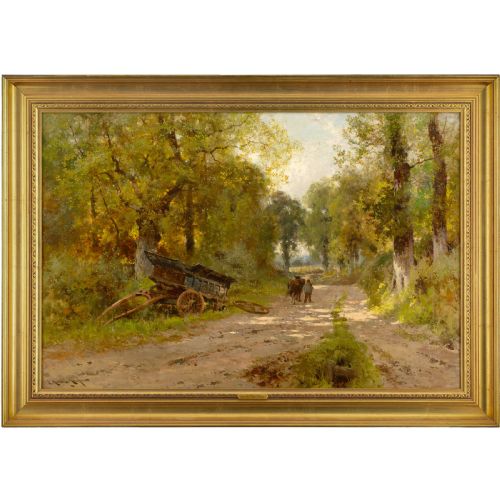


British Pastoral Fine Art
British pastoral fine art captures rural life through oil and watercolour, bringing fields, rivers and herds into the home.
British Pastoral Fine Art
British pastoral fine art depicts countryside scenes, agricultural labour and river valleys across the nineteenth and twentieth centuries. These paintings record shepherds, cattle, harvest fields and country lanes through the styles of British Impressionism and Victorian realism.
Framed artwork on this page ranges from early Victorian watercolours to Edwardian oil paintings on canvas and wood panel. Landscapes featuring rivers, sheep and farm workers form the core of the selection.
Works originate from various British regions including Wales, Yorkshire, Kent and the Scottish Highlands. The common thread is a focused attention on rural scenery and agricultural life.
Materials and methods
Artists painted primarily with oil paint on canvas, wood panels and boards, or applied watercolours onto paper. These pigments capture the light and atmosphere of rural England, Wales and Scotland.
Canvases and wood supports were typically housed within giltwood frames that enhanced the depth of the landscape. Watercolours on paper received protective glass glazing alongside traditional framing.
Listings span from the mid nineteenth century through the nineteen sixties, utilising oil paint, watercolour, canvas, wood and paper.
Judging quality
Quality rests in the handling of light and shadow, spatial depth and the naturalism of figures and animals within the landscape. Superior brushwork creates convincing texture in foliage, water and wool.
Compositional balance separates standard topographical views from accomplished artistic statements. The integration of livestock and labourers with the surrounding terrain determines the visual success of the piece.
Tom Campbell·Cornelius Pearson·John Sanderson Wells·George Vicat Cole·Sidney Richard Percy·Thomas Baker·George Turner·Ernest Higgins Rigg
The British Pastoral Fine Art Glossary
- Oil on Canvas
- Pigment mixed with drying oil applied to stretched woven fabric. This medium allows for rich colour blending and textured brushstrokes.
- Watercolour
- Pigment suspended in a water-soluble base applied to paper. It offers luminous transparency well suited to atmospheric skies and rivers.
- Giltwood
- Wood carved and coated with gold leaf. Frames made this way provide a traditional decorative border for oil paintings.
- Wood Panel
- A flat wooden board used as a rigid painting support. Artists often worked on these smaller surfaces during the nineteenth and early twentieth centuries.
British Pastoral Fine Art: Frequently Asked Questions
What subjects appear in these paintings?
Paintings show rural subjects including harvest fields, rivers, coastal landscapes and mountain valleys. Shepherds, cattle, horses and farm workers frequently populate the foreground.
Scenes draw from locations across Britain, capturing local agricultural life and topography during the nineteenth and early twentieth centuries.
How do oil and watercolour differ?
Oil paintings use thick pigments on canvas or wood panels, allowing for heavy texture and deep colour layering. Watercolours employ translucent washes on paper.
Oils generally suit robust framing without glass, while watercolours require protective glazing to prevent moisture and surface damage.
How should I hang these artworks?
Artworks look best displayed on neutral walls away from direct sunlight to protect pigments and paper. Adequate spacing allows the giltwood frames to define the composition.
Stable indoor humidity prevents wood panels and canvas from warping or cracking over time.
How do I identify the period?
Periods are identified through framing styles, canvas preparation, artist signatures and subject matter conventions. Victorian works often lean towards detailed realism, while Edwardian and later pieces embrace impressionistic brushwork.
Examine the back of the panel or canvas for framing labels, inscriptions and artist notes that record dates.