


Brass Tap Samovar
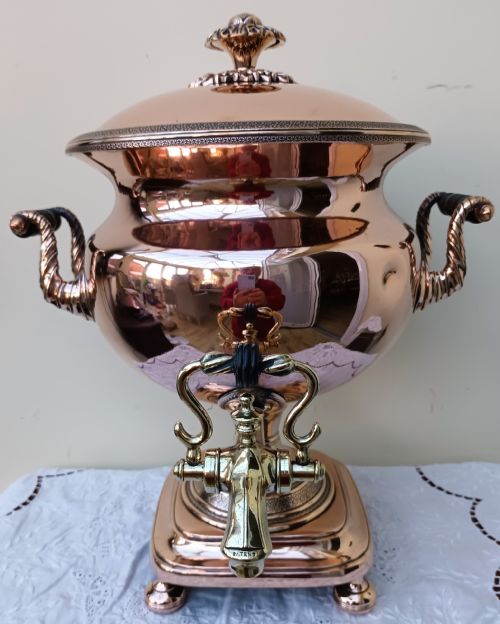
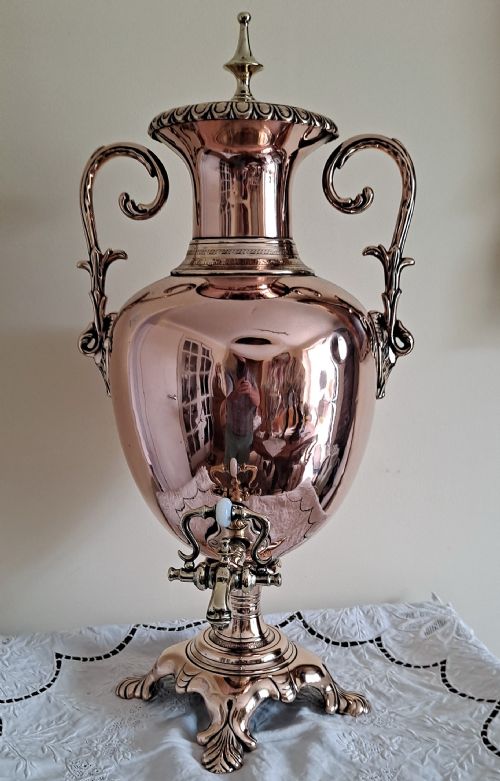
These brass tap samovars are period vessels designed for heating water, combining copper, brass and wood across Georgian, Regency and Victorian eras.
Brass Tap Samovar
A brass tap samovar is a heated vessel designed for preparing hot water, appearing primarily as tea urns, coffee urns and water urns. These pieces originate across the Georgian, Regency and Victorian periods, with 19th Century examples forming the core of what is available.
The forms span traditional tea urns and kettle samovars, frequently executed in combinations of copper and brass. English and Dutch origins are represented, moving from George III styles through to late Victorian interpretations.
How they were made
Construction relies heavily on sheet copper and cast brass, often complemented by wooden handles and ebonised wood details. Toleware surfaces appear alongside painted and gold leaf finishes on specific urns.
Makers shaped these metals by hand, integrating internal heating tubes or chambers and fitting functional brass taps near the base. Internal tinplate linings were standard for containing potable water safely.
Some Victorian kettle samovars double as miniature industrial engines in appearance, ready to steam tea for an entire parlour.
What varies in quality
Quality rests in the heaviness of the gauge of copper and the crispness of the brass casting used for handles, spouts and feet. Finer examples display meticulous dovetail or hand-beaten seams that remain tight and true.
The sophistication of the surface finish and the preservation of original wooden insulating mounts or ebonised details distinguish the superior pieces from standard utilitarian production.
The Brass Tap Samovar Glossary
- Samovar
- A heated metal urn traditionally used to boil water for tea. These vessels typically feature a central internal chimney and a spigot near the base.
- Toleware
- Lacquered or enamelled metalware, usually tinplate, decorated with paint and sometimes gold leaf. This technique creates a durable coloured surface on domestic vessels.
- Ebonised wood
- Timber treated to resemble ebony, frequently utilised for handles and insulating knobs on metal urns. It provides a dark, smooth contrast to polished brass and copper.
- Tea urn
- A large standing vessel designed to maintain hot water for tea service in domestic settings. They often incorporate decorative handles and sturdy pedestal bases.
Brass Tap Samovar: Frequently Asked Questions
What is a brass tap samovar?
A brass tap samovar is a traditional heated metal vessel used for boiling water, typically featuring a spigot at the base for dispensing.
These pieces date from the Georgian, Regency and Victorian eras, constructed primarily from copper and brass with wooden insulated handles.
How were these urns used historically?
These vessels stood on dining or tea tables to heat and supply water for large household gatherings.
Hot coals placed in an internal vertical tube kept the water at temperature throughout the service.
How do I date a copper samovar?
Dating relies on stylistic markers, such as the neoclassical proportions of the George III period versus the heavier ornamentation of Victorian design.
Construction methods, including hand-beaten seams and the specific shaping of the brass taps, also indicate the period of manufacture.
Are these samovars still functional?
While many retain their original brass taps and internal chambers, period samovars are primarily acquired as decorative antiques.
Using them today often requires professional restoration of the internal tinplate lining to ensure safety.