



Brass Surveying Compass
These brass surveying compass pieces are reliable instruments built to map land and navigate terrain, offering a tangible link to historical field work.
Brass Surveying Compass
When you search for a brass surveying compass, you are looking at scientific instruments designed for navigation, mapping, and land measurement. The pieces listed on this page span several periods, from the Georgian era through the Victorian period and into the Edwardian years.
The most common versions met here include pocket-sized travellers, military-pattern prismatic instruments, and larger boxed theodolites or mine's compasses. These functional items reflect the technical demands of surveyors, explorers, and military personnel over two centuries.
Originating largely from British workshops and makers, these instruments combine utility with solid mechanical construction. Their forms range from simple folding ruler sights to complex radial theodolites equipped with boxwood scales.
How they were made
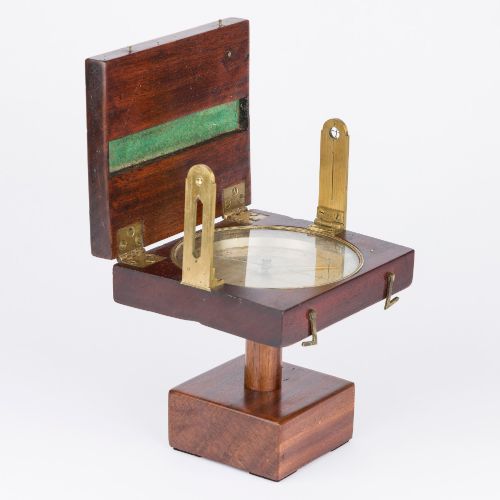
The primary material underpinning these instruments is heavy cast and turned brass, often paired with silvered metal dials for clear graduations. Glass protects the delicate needle and dial faces, while boxwood and steel components provide precise internal movement and sighting edges.
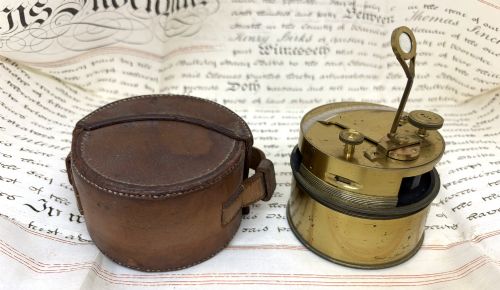
Many examples are housed in fitted wooden cases made from mahogany or pine, frequently lined with leather or velvet to protect the instruments during travel. Metal parts display careful engraving, lacquering, and hand-stamped maker inscriptions characteristic of period scientific workshops.
Brass Surveying Compass Retail Price Guide 2026
Typical asking prices for brass surveying compass among the pieces listed under this phrase on Sellingantiques today, from the lower quarter to the upper quarter. They describe what is for sale here now, not the wider market.
Current listings feature instruments spanning the Georgian, Victorian, and Edwardian periods, constructed primarily from brass, mahogany, and glass.
What varies in quality
Quality in these instruments rests upon the precision of the graduation work, the crispness of the maker's signature, and the mechanical integrity of the folding sights and gimbals. Instruments signed by notable makers demonstrate superior machining and finer dial division compared to unsigned generic production.
The preservation of original fitted wooden cases and auxiliary components like leather straps or sighting rules elevates an example. Pieces retaining their original silvered finishes and smooth rotational movement stand apart from those showing heavy utilitarian wear.
G. Davis of Leeds·P. Orr, Madras·Baker, London·W&S Jones·Stanley, London·Barker and Son·R. Field and Son, Birmingham
The Brass Surveying Compass Glossary
- Theodolite
- A precision instrument for measuring horizontal and vertical angles, mounted on a base or tripod. These complex devices often incorporate multiple leveling screws and telescopic sights.
- Prismatic Compass
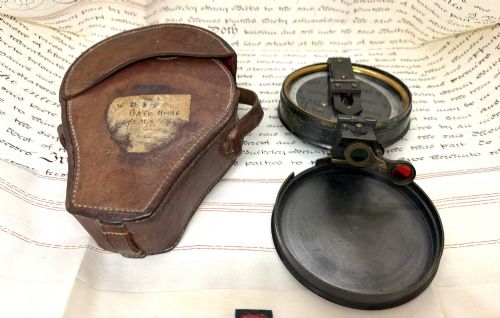
- A pocket-sized navigation instrument that allows the user to take a bearing and read the dial simultaneously through a prism. This design aids in rapid and accurate field surveying.
- Clinometer
- A tool used for measuring angles of slope, elevation, or depression of an object with respect to gravity. It frequently accompanies compasses in military and mining compendiums.
- Boxwood
- A dense, pale yellow wood traditionally used for scale rules and dial inlays due to its dimensional stability. It provides a sharp contrast against dark engraved markings.
- Beam Compass
- An instrument consisting of a bar with two adjustable slides, used for drawing or measuring large circles and distances. These are common in architectural and large-scale cartography.
Brass Surveying Compass: Frequently Asked Questions
What is a prismatic compass?
A prismatic compass is a portable navigation device that incorporates an internal prism to let the user view the bearing scale while sighting a distant landmark. This optical arrangement speeds up field measurements.
These instruments were widely adopted for military and exploratory work where rapid and accurate directional data was essential.
How do I date a brass compass?
Dating relies on stylistic details, materials, and engraved maker signatures that correspond to known working periods of the firm. Victorian and Georgian pieces often feature distinct hand-engraved typography and mahogany housings.
Comparing the specific mechanical layout and patent markings to known historical examples helps narrow the period of manufacture.
Were these used in the military?
Many surviving examples were issued for military, colonial, or wartime service, often marked with specific patterns or government acceptance stamps. They were built robustly to withstand harsh field conditions.
Compasses from the Edwardian and WWI eras frequently show this military utility in their rugged construction and leather storage cases.
How do I display a surveying compass?
These instruments suit desk or cabinet display, particularly when housed in their original mahogany or pine transport boxes. Opening the box or mounting the compass on its base reveals the brass dials and internal needle.
Keep them away from direct sunlight and strong magnetic fields to preserve both the instrument and its historical context.