


Antique Surveying Compass
An antique surveying compass is a precision brass instrument for finding direction and angles in the field, valued by collectors for its mechanical ingenuity.
Antique Surveying Compass
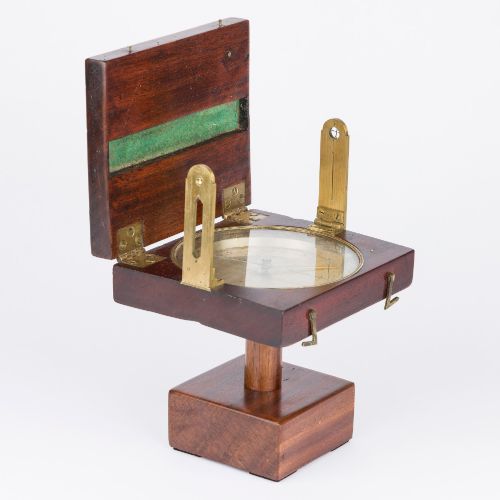
When you search for an antique surveying compass, you encounter brass and glass instruments spanning the Georgian, Victorian, and Edwardian periods. The selection includes simple pocket forms alongside complex scientific devices like theodolites and clinometers.
Most examples you meet on this page originate from British makers and military workshops. These range from polished mahogany-cased field instruments to compact prismatic compasses designed for travel and exploration.
How they were made
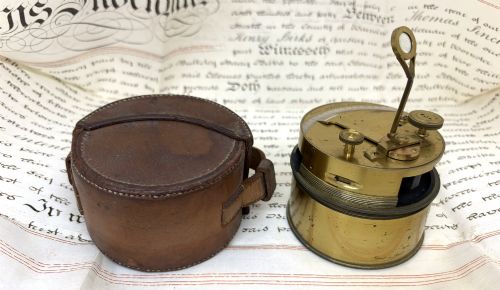
Makers constructed these instruments primarily from heavy brass, often pairing the metal dials and housings with protective glass faces and silvered metal scales. Fitted boxes utilise timber such as mahogany, pine, and boxwood to keep the delicate mechanisms secure.
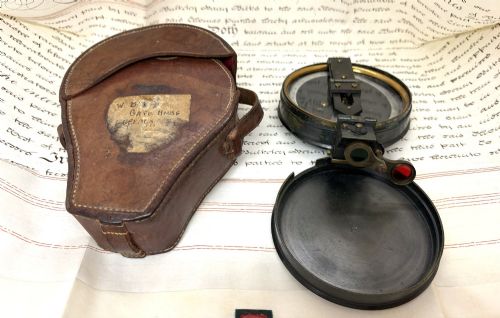
Internal components incorporate fine steel needles and delicate pivots, sometimes accompanied by leather carrying cases for field use. The construction combines robust outer protection with precise interior engineering to ensure reliable field measurements.
The listings span from Georgian examples up to Edwardian military issues, utilising brass, mahogany, boxwood, and silvered metal.
What varies in quality
The distinction between standard utility items and superior instruments lies in the crispness of the engraved markings and the smoothness of the mechanical action. Finely divided silvered metal scales and signed brass plates indicate higher standards of workshop production.
Superior pieces retain their original fitted wooden cases and complete auxiliary sights or folding rulers. The presence of identifiable maker signatures and specialised military or scientific markings elevates the historical interest of the instrument.
G. Davis of Leeds·P. Orr, Madras·Baker, London·W&S Jones·Stanley, London·Barker & Son·Watkins·J Hicks·R. Field & Son, Birmingham
The Antique Surveying Compass Glossary
- Clinometer
- An instrument used for measuring angles of slope, elevation, or depression of an object with respect to gravity. These often appear alongside compass sights on surveying instruments.
- Theodolite
- A precision optical instrument for measuring angles between designated points in the horizontal and vertical planes. They represent the more complex end of antique field surveying equipment.
- Prismatic compass
- A pocket-sized navigation instrument featuring an internal prism that allows the user to view the magnetic bearing and the target simultaneously. This design aids rapid field reading.
- Beam compass
- A drafting instrument consisting of a bar with two adjustable pointed legs used for scribing large circles or measuring distances. These are distinct from magnetic direction-finding compasses.
- Silvered metal
- A base metal treated with a thin layer of silver to create a bright, legible surface for engraved graduations. It provides high contrast against dark instrument bodies.
Antique Surveying Compass: Frequently Asked Questions
How do you use an antique surveying compass?
Surveyors used these brass instruments in the field to measure bearings, map land parcels, and lay out boundaries. The folding sights helped the operator align the needle precisely with a distant landmark.
Today, they serve as desk ornaments or display pieces rather than working tools for navigation. Collectors enjoy holding the heavy brass cases and observing the movement of the delicate needles.
What is a prismatic compass?
A prismatic compass includes an internal glass prism that reflects the bearing scale directly to the user's eye through a sighting slit. This allowed the surveyor to read the magnetic direction while looking straight at the target.
Military personnel and explorers favoured this pattern for rapid mapping in the field. The inclusion of the prism distinguishes them from standard magnetic compasses.
Are these compasses still accurate?
While the magnetic needles still respond to the Earth's field, historic instruments are collected for their craftsmanship rather than modern navigation. Friction on the aged pivot points can reduce sensitivity.
Displaying them away from strong magnetic interference preserves their delicate internal balances. They remain fascinating artefacts of 19th and early 20th century science.