



Victorian Surveying Equipment
Victorian surveying equipment is precision brass and mahogany instrumentation built for field measurement, sought after for its tactile mechanics and rich history.
Victorian Surveying Equipment
Victorian surveying equipment encompasses professional instruments and scientific apparatus utilised for mapping, navigation, and civil engineering during the nineteenth century. These objects include brass theodolites, drainage levels, pocket barometers, and specialised compasses housed in fitted wooden cases.
The versions most frequently met on this page date from the mid to late nineteenth century, reflecting the industrial expansion and cartographic demands of the era. Makers such as Baker, L Casella & Co, Negretti & Zambra, and W. H. Harling produced much of this precision gear.
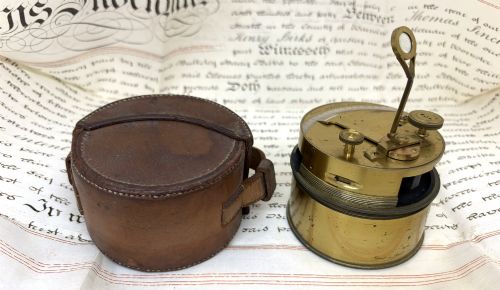
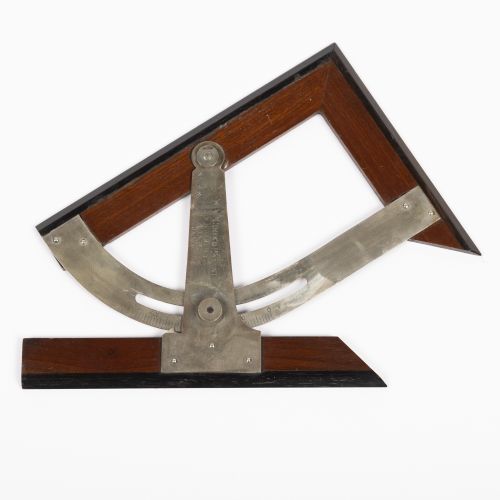
Compasses, clinometers, and pantographs form a significant part of the selection, often combining boxwood, glass, and gilt brass. Many items retain their original leather cases or mahogany boxes, complete with retailer signatures and patent details.
Materials and Construction
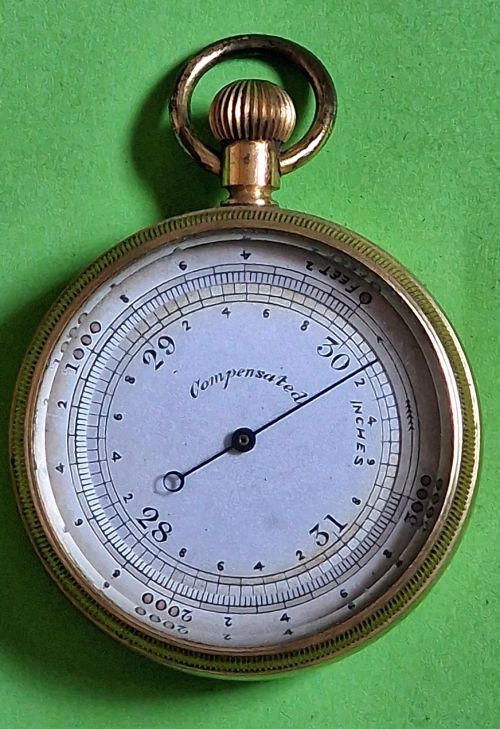
Brass serves as the primary structural metal for theodolites, transits, and compasses, providing the necessary weight, stability, and durability for field use. This is frequently paired with glass for optical elements and levels, alongside steel for needles and fine adjustment screws.
Enclosing timber cases are predominantly constructed from solid mahogany, offering robust protection during transport across difficult terrain. Boxwood is utilised for folding rules and linear scales, while leather covers protect portable pocket barometers and compendiums.
Listings feature scientific instruments spanning from the early Victorian era through to nineteen-ten, predominantly constructed from brass, mahogany, and boxwood.
Assessing Quality
Quality in these instruments rests upon the precision of the engraving, the smoothness of the mechanical movements, and the clarity of the optics. Finer pieces demonstrate crisp maker signatures, precise graduations on the brass circles, and snug, well-fitted joints in the woodwork.
The survival of original components, such as secondary lenses, matching mahogany cases, and specific retailer signatures, elevates an example. Simpler utility instruments contrast with complex patented devices like Latimer Clark's portable transit or specialised artificial horizon sets.
Baker London·L Casella & Co·Latimer Clark·Negretti & Zambra·Thomas Dunn·W. H. Harling·John Lilley & Son·Barker & Son·J Hicks
The Victorian Surveying Equipment Glossary
- Theodolite
- A precision optical instrument for measuring horizontal and vertical angles, mounted on a base or tripod. It forms a cornerstone of traditional land surveying and civil engineering.
- Clinometer
- An instrument used for measuring angles of slope, elevation, or depression of an object with respect to gravity. Surveyors and military personnel utilised these for topographical mapping.
- Pantograph
- A mechanical linkage connected in a parallelogram geometric shape based on parallel lines, used for copying maps and plans at a different scale. Draughtsmen relied on this to enlarge or reduce drawings accurately.
- Artificial Horizon
- A device used to determine the horizontal plane when natural horizons are obscured, typically employing a reflective surface of black glass. It was essential for precise astronomical navigation and surveying.
- Transit Instrument
- A telescope mounted on an axis perpendicular to its optical axis, used for observing celestial bodies passing the meridian. Portable versions allowed field surveyors to establish accurate time and longitude.
Victorian Surveying Equipment: Frequently Asked Questions
What is a theodolite used for?
A theodolite measures horizontal and vertical angles in large-scale land surveys and civil engineering projects. Surveyors mounted them on tripods to map terrain and establish property boundaries.
These instruments combine telescopic sights with graduated metal circles to achieve high precision. They represent the apex of nineteenth-century mechanical and optical engineering.
How do I date Victorian instruments?
Dating relies on engraved maker signatures, patent numbers, stylistic shifts in brasswork, and associated trade labels inside wooden cases. Many pieces carry specific presentation dates or retailer addresses that anchor their timeline.
Reference books and historical trade directories help match serial numbers and makers to exact active decades. The transition from heavy brass to lighter aluminium alloys marks the close of the period.
How should I display brass instruments?
Brass surveying tools look striking on desks, bookshelves, or inside glass cabinets where their mechanical complexity can be appreciated up close. Keeping them out of direct sunlight prevents the wooden cases from drying out and cracking.
Allowing the metal to retain its natural age patina maintains the historic character of the piece. Avoid aggressive metal polishes that strip away surface history.
Are these instruments still accurate?
While many retain working mechanics, compasses point true and levels remain balanced, they function primarily as historic artefacts rather than modern construction tools. Calibration can drift over a century of temperature changes and handling.
Collectors value them for their craftsmanship and scientific heritage rather than daily field utility. Gentle handling ensures delicate glass vials and pivots remain undamaged.