





Brass Mantel Garniture
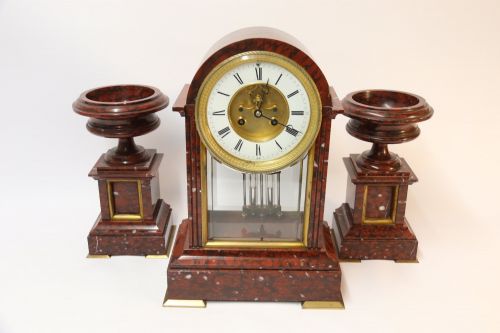
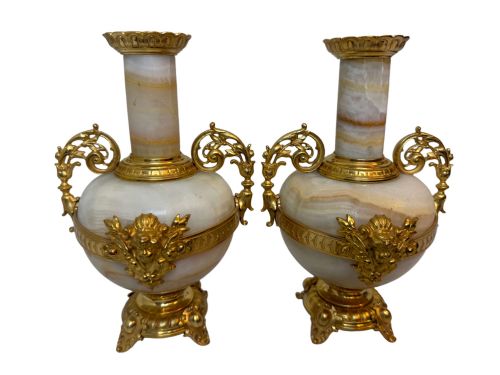
A brass mantel garniture brings symmetry and striking presence to a chimney piece, uniting a central clock with matching companion urns or vases.
Brass Mantel Garniture
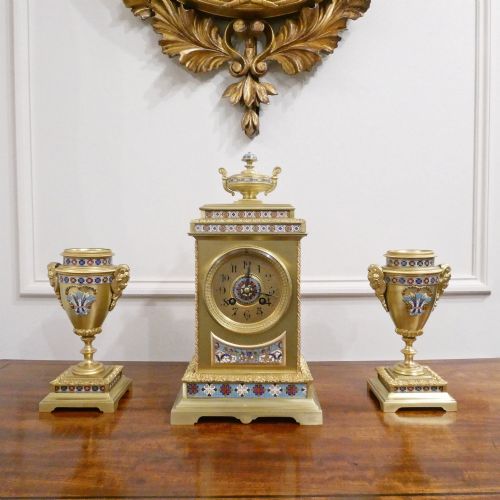
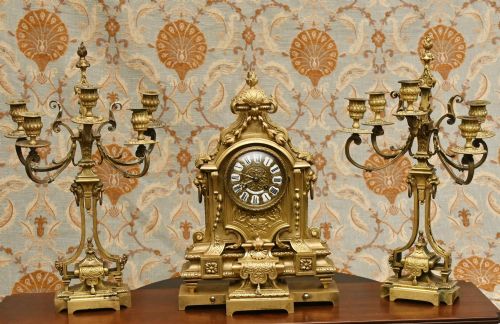
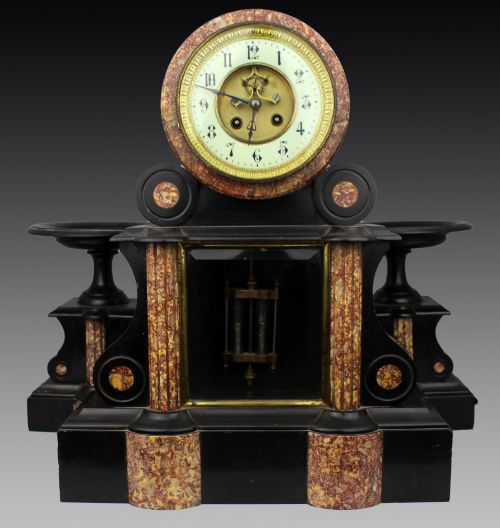
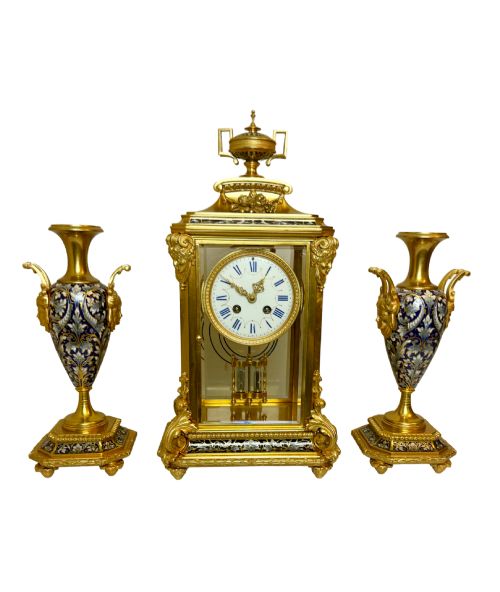
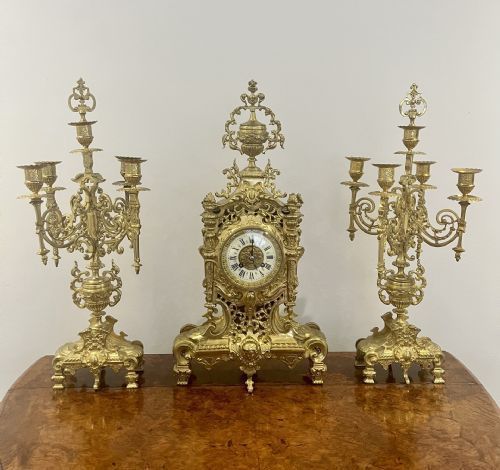
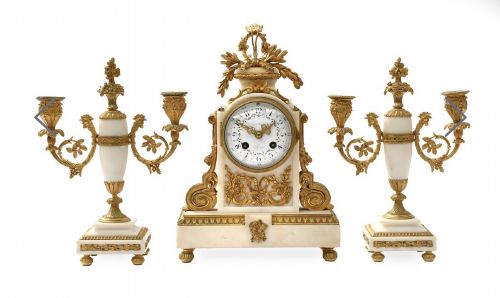
A brass mantel garniture consists of a matched three-piece or multi-piece set designed to sit together on a fireplace ledge, anchored by a central timekeeper flanked by matching vases, ewers or candelabras. When searching for a brass mantel garniture, buyers encounter complete sets spanning the nineteenth century up to the art deco period, predominantly originating from French workshops and Victorian makers.
The form developed as a unified decorative scheme for the principal rooms of the house, where symmetry ruled interior design. Most examples combine a mechanical eight-day clock movement with matching side pieces that repeat the motifs and materials of the central housing.
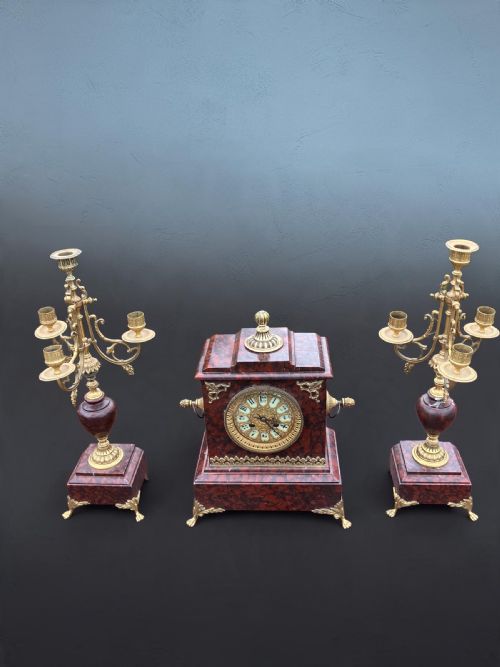
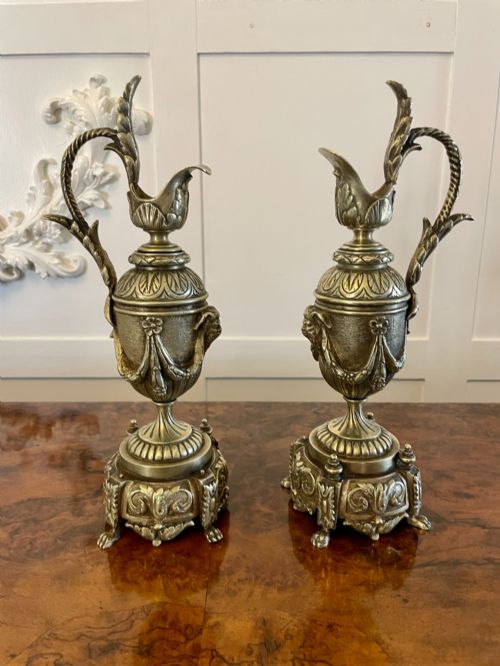
The pieces on this page lean heavily towards nineteenth-century French manufacture, incorporating architectural marble cases, cast metal mounts and decorative side pieces. Buyers find everything from compact Victorian brass ewers to large multi-piece marble clock sets designed for grand chimney pieces.
Materials and Construction
Maker's workshops built these sets using heavy structural bases of black, red, green or white marble, onyx and slate, which provided a stable foundation for the metalwork. Heavy brass, gilt bronze and ormolu mounts were cast and chased to form ornate feet, bezels, finials and figural garnishes.
Surface ornamentation frequently incorporated champlevé and cloisonné enamel work, alongside glass panels for four-glass clocks and inset porcelain plaques. Movements were mechanical, driven by spring or weight mechanisms that powered eight-day strikes.
Brass Mantel Garniture Retail Price Guide 2026
Typical asking prices for brass mantel garniture among the pieces listed under this phrase on Sellingantiques today, from the lower quarter to the upper quarter. They describe what is for sale here now, not the wider market.
Cupid occasionally oversees the mantel from an ormolu perch, reminding everyone that time flies when you are admiring marble.
Evaluating Quality
The distinction between ordinary and superior sets lies in the crispness of the bronze casting and the depth of the hand-chasing on the metal mounts. Finer sets display sharper relief in decorative foliage and figures, with heavier gauge brass and substantial marble or onyx plinths.
Movement maker marks stamped on the backplate indicate the standard of clockmaking craftsmanship, separating anonymous movements from those produced by recognised Paris clockmakers. The harmony of the matching pieces and the integration of enamel or porcelain details determine the overall cohesion of the set.
Japy Frères·Samuel Marti·A.D Mougin·Finnigan Manchester·Vincenti of Paris·Deniere Paris
The Brass Mantel Garniture Glossary
- Garniture
- A set of matching decorative objects designed to be displayed together on a mantelpiece or sideboard. It typically comprises a central clock flanked by two matching vases, ewers, candelabras or urns.
- Ormolu
- Finely ground high-carat gold mercury-gilded onto a bronze base. This technique creates a rich, durable golden finish characteristic of French decorative metalwork.
- Champlevé
- An enamelling technique where troughs or cells are hollowed out of the metal surface and filled with vitreous enamel before firing. The resulting design sits flush with the surrounding metal borders.
- Portico clock
- A mantel clock featuring an architectural case supported by columns or pillars. This classical form often appears in marble within nineteenth-century garniture sets.
- Candelabra
- A branched candlestick designed to hold multiple candles. In clock garnitures, a pair of matching candelabras frequently forms the side pieces alongside the central clock.
Brass Mantel Garniture: Frequently Asked Questions
How do I wind the clock?
Most antique mechanical garniture clocks utilise an eight-day movement driven by springs that are wound using a specific key inserted into winding holes on the dial. The key turns the arbour to tension the mainspring inside the movement.
Care must be taken not to overwind the mechanism, stopping as soon as resistance is felt to protect the historical springs.
Where should I place a garniture?
These sets were traditionally designed for the mantelpiece above a fireplace, where the central clock sat in the middle with matching side pieces flanking it symmetrically. They also function effectively on wide sideboards, console tables, or deep shelf units.
Because many sets incorporate heavy marble bases and delicate glass or enamel components, placement requires a stable, level surface away from direct foot traffic.
How do I identify French styles?
French mantel sets often display specific historical revival traits, such as the ornate scrolling foliage of Rococo Revival or the strict symmetry and urn motifs of Louis XVI style. Makers frequently stamped their machinery or cast signatures onto the brass movement backplates.
Materials also provide clues, as French workshops extensively utilised champlevé enamel, gilt bronze, and variegated marbles during the nineteenth century.