
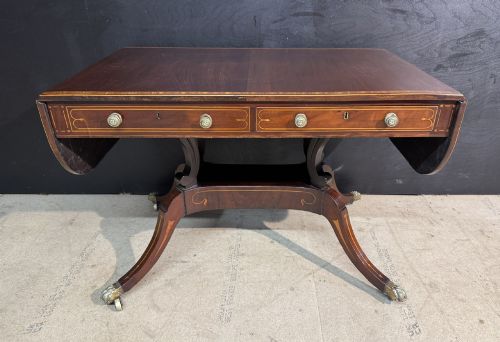
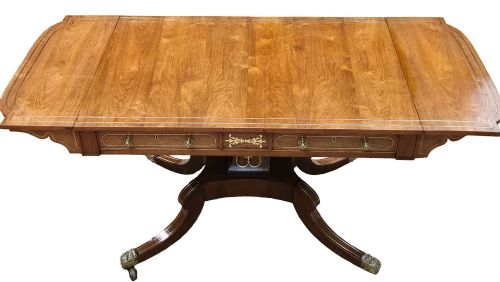
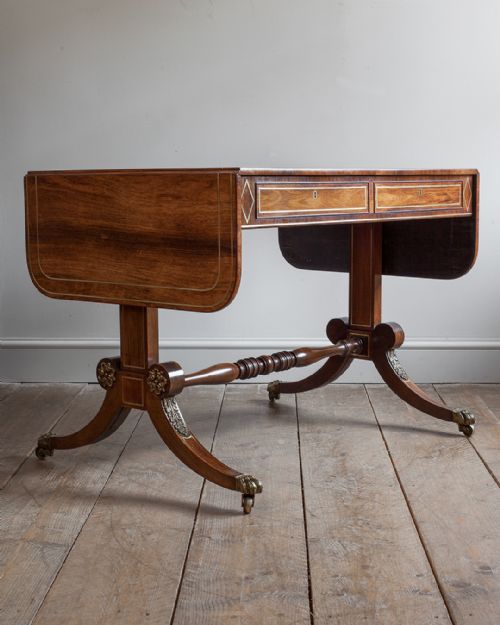


Brass Inlay Sofa Table
A brass inlay sofa table brings geometric precision to dark timbers, offering a stable writing surface flanked by drop leaves.
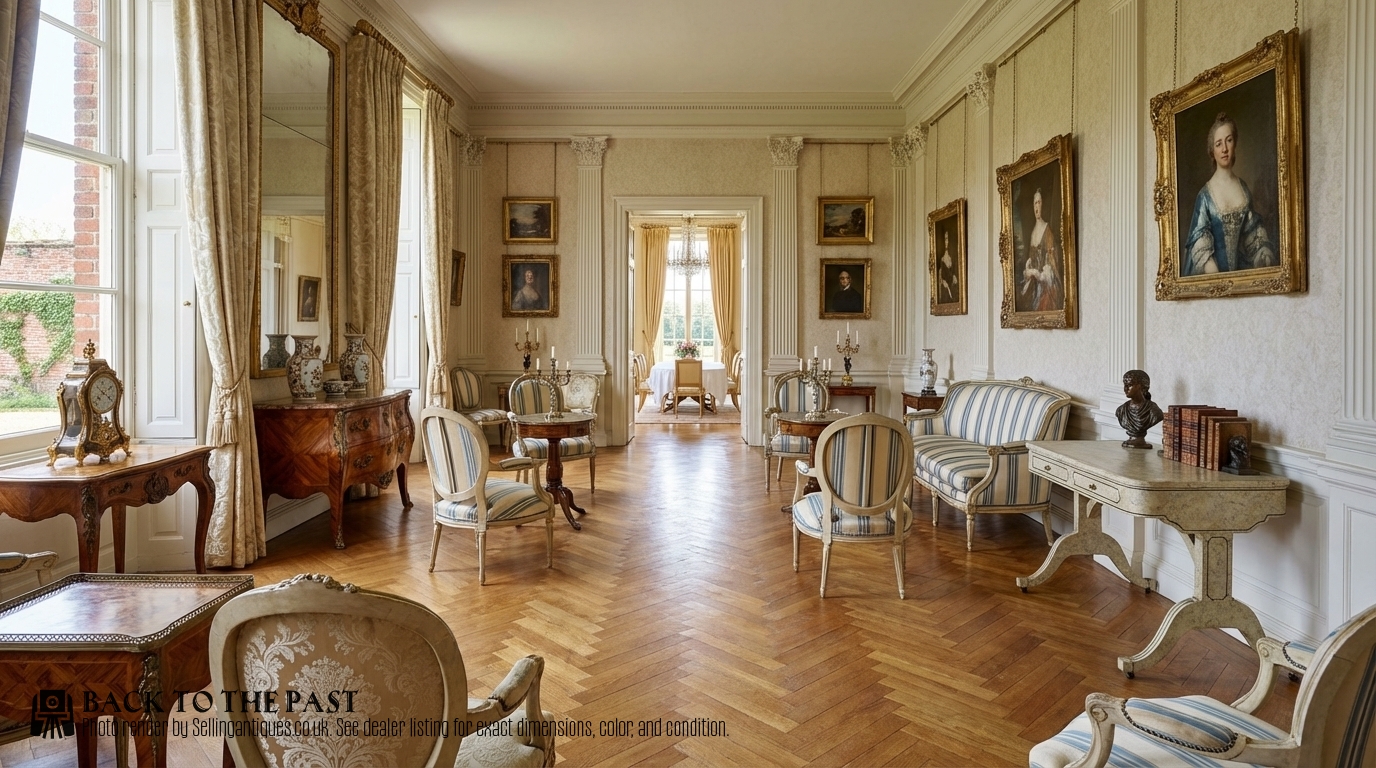
Brass Inlay Sofa Table
A brass inlay sofa table sits low and long, designed originally to stand behind a sofa in the centre of a room rather than against a wall. The form includes twin drop leaves supported by hinged flaps and two small drawers set into the frieze.
Most examples found here date from the Regency period and the nineteenth century, constructed in rich timbers like rosewood and mahogany. Makers combined these dark woods with bright metallic lines to catch the candlelight of formal entertaining rooms.
Materials and construction
Cabinetmakers channelled solid rosewood, mahogany, and satinwood to receive thin strips of brass, securing the metal flush with the surrounding grain. Boxwood, ebony, and general wood inlay frequently complemented the metallic work to build complex borders and geometric roundels.
Drop leaves required precise knuckle joints and brass hinges to drop flat without sagging under weight. Tables often stand on pillar supports or trestle ends resting on platform bases fitted with brass castors.
Listings feature brass inlay sofa tables primarily from the Regency and Georgian periods, constructed in rosewood, mahogany, and satinwood.
Assessing craftsmanship
Quality rests in the crispness of the brass channel work and the visual rhythm of the wood grain chosen for the top. Superior pieces maintain tight joins where the brass meets the timber, showing no lifting along the inlaid borders.
The sophistication of the undercarriage defines the upper tier of pieces, where turned columns or reeded pedestal supports display considered proportions. Secondary woods inside the drawer linings and the neatness of the dovetailing reveal the care taken by the original workshop.
John McLean·George Bullock
The Brass Inlay Sofa Table Glossary
- Sofa table
- A long rectangular table with drop leaves on either end, designed during the Georgian and Regency periods to sit behind a sofa.
- Frieze
- The horizontal band beneath the tabletop that typically houses small drawers for writing materials or sewing items.
- Drop leaf
- A hinged flap on the side of a table that lifts to extend the top surface when extra room is needed.
- Palisander
- A dense, dark timber resembling rosewood, often utilised in nineteenth-century cabinetmaking for its heavy grain and rich tone.
Brass Inlay Sofa Table: Frequently Asked Questions
What is a brass inlay sofa table used for?
These tables served historically as versatile pieces for needlework, reading, and letter writing in principal rooms. Their drop leaves allowed them to expand for temporary tasks or fold compactly against a sofa back.
Today they function effectively as console tables, desks, or freestanding accent tables in sitting rooms and hallways. Their finished backs make them suitable for placement in the middle of a room.
How do I identify a Regency period piece?
Regency pieces often display classical motifs, dark rosewood timbers, and precise cut brass inlay arranged in leafy scrolls or geometric lines. They frequently feature pillar supports standing on platform bases with brass paw castors.
Cabinetmakers of this era favoured strong contrast between pale brass lines and dark tropical hardwoods. Construction methods include hand-cut dovetails in the drawer boxes and solid mahogany secondary framing.
Can I use these tables for writing daily?
The surfaces accommodate light writing and laptop use, provided the drop leaves are properly supported by their wooden arms. Drawer spaces suit paper and small desk accessories rather than heavy storage.
Care should be taken with antique finishes when placing hot drinks or unsealed inkwells directly onto the timber or brass work. Using leather pads helps preserve the polished surface during regular tasks.
How should I care for rosewood and brass?
Rosewood benefits from occasional application of quality wax to nourish the grain and maintain a soft sheen. Avoid placing the wood near direct heat sources or strong sunlight to prevent warping and fading.
Brass inlay requires gentle dusting with a soft cloth rather than aggressive metal polishes that might stain the surrounding timber. Keeping humidity stable in the room protects both the metal and the adhesive holding the inlay in place.