
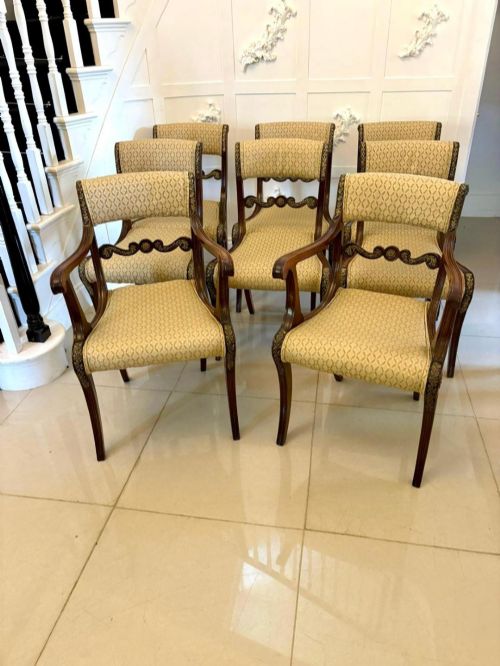

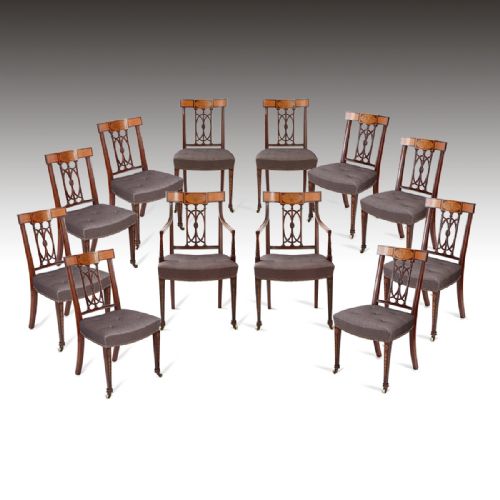
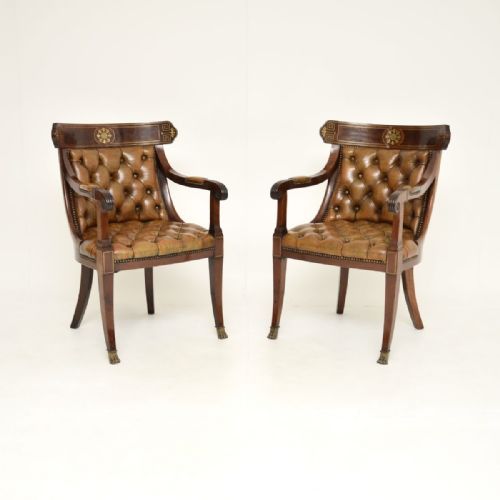


Brass Inlay Mahogany Chairs
Brass inlay mahogany chairs bring linear precision and warm timber tones to a room, uniting Regency and Georgian craftsmanship.
Brass Inlay Mahogany Chairs
The timber foundation relies primarily on mahogany, alongside occasional examples utilising rosewood or satinwood. Brass is systematically let into the wood surface to form delicate lines, geometric motifs, or classical ornamentation.
Forms range from simple side chairs to expansive sets of eight or twelve dining chairs, elbow chairs, and library armchairs. The physical evidence demonstrates that these seating pieces serve both formal dining and occasional domestic functions.
How they were made
Cabinetmakers constructed the primary frame in solid mahogany, rosewood, or satinwood, shaping the structural components to suit dining, elbow, or hall seating. Selected timbers provide a dense foundation capable of holding precision woodwork.
Craftsmen channelled the timber surface to receive thin brass stringing or shaped brass inlays, securing the metal flush with the wood grain. This meticulous process requires exact hand-tooling to prevent timber splitting along the decorative path.
Upholstery completed the functional design on many forms, incorporating leather, fabric, and velvet fixed over padding. The combination of inlaid metal, rich wood, and textile elements defines the construction of these pieces.
A piano stool from the era allows you to practice your scales while sitting on inlaid brass.
What varies in quality
The refinement of the brass inlay work distinguishes standard utility seating from exhibition pieces, where complex metal designs are integrated cleanly into the timber. Precision in cutting the channel and fitting the brass dictates the visual harmony of the surface.
Timber selection and grain figure govern the aesthetic impact of the mahogany, rosewood, or satinwood foundation. Superior examples display carefully chosen wood figures that complement the metallic detailing without competing for attention.
Structural integrity and the survival of original components, such as leather or fabric upholstery and secondary timbers, separate well-preserved examples from heavily restored pieces. The consistency across multi-piece dining sets further dictates the standing of the group.
The Brass Inlay Mahogany Chairs Glossary
- Regency
- A British design period spanning the early nineteenth century defined by classical restraint and archaeological influence. Pieces from this era frequently incorporate brass stringing and dark tropical timbers.
- Mahogany
- A durable tropical hardwood prized for its deep reddish-brown colour and stable grain. It serves as the primary structural and visual medium for these chairs.
- Inlay
- A decorative technique where contrasting materials such as brass or lighter woods are embedded into a recessed channel flush with the surface. This method creates crisp linear patterns across the chair back and rails.
- Elbow chair
- A seating form equipped with armrests, also referred to as an armchair or elbow open chair. These pieces often functioned as carvers at the head of a dining table.
- Rosewood
- A dense, heavily figured timber displaying dark brown and black grain patterns. It appears in specific listings alongside mahogany as a primary cabinet wood.
Brass Inlay Mahogany Chairs: Frequently Asked Questions
Are these chairs comfortable for daily use?
Many examples feature upholstered seats in leather, fabric, or velvet designed to provide substantial support during dining or desk work.
Armchairs and elbow chairs offer additional leverage and resting points, though nineteenth-century seating generally encourages an upright posture compared to modern lounge furniture.
How do I care for the brass inlay?
Keep the timber and metal away from direct heat sources and excessive moisture to prevent the wood from shrinking and loosening the brass elements.
Gentle dusting with a dry cloth maintains the surface without abrasive polishes that might discolour the surrounding mahogany or rosewood.
Can I mix different sets at a dining table?
Sets vary in size from pairs to larger groupings of six, eight, or twelve matching chairs designed for formal dining.
Mixing distinct Regency or Georgian styles requires careful attention to seat height, timber tone, and arm configuration to maintain visual balance around the room.
How do I identify a Regency period chair?
Regency pieces often display characteristic classical motifs, sabre legs, or sweeping top rails combined with contrasting brass inlay work.
Construction details such as traditional joinery and nineteenth-century timber stock help confirm the era alongside stylistic markers.
What is the difference between a side chair and a hall chair?
Side chairs lack arms and were traditionally utilised around a dining table or placed informally against perimeter walls.
Hall chairs generally feature solid wood seats and architectural backs intended for transient use in entrance spaces rather than prolonged sitting.