


Brass Crystal Regulator Clock
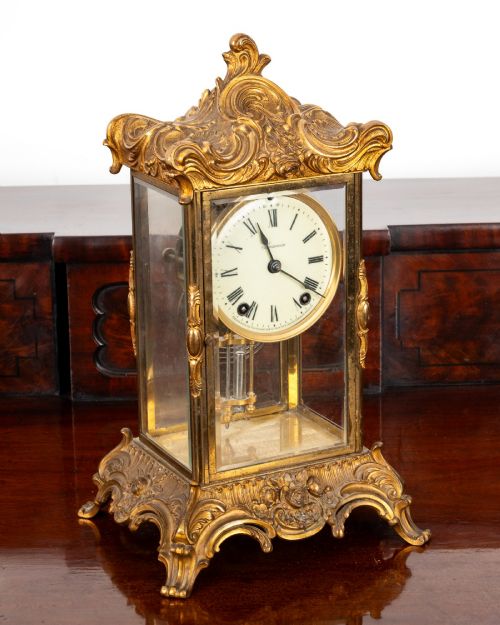
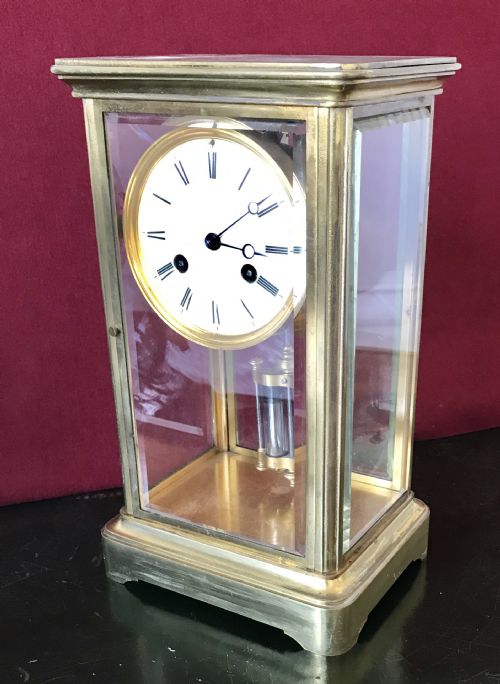
A brass crystal regulator clock brings light and mechanical precision together, housed in bevelled glass panels that reveal the pendulum at work.

Brass Crystal Regulator Clock
When you search for a brass crystal regulator clock, you encounter precision timepieces housed in glazed metal cases designed to showcase the movement from all sides. These pieces span the late nineteenth century and the early twentieth century, with French examples dominating the selection.
The objects appear primarily as mantel clocks and four-glass clocks, often featuring enamel dials and decorative painted panels. Makers such as Samuel Marti et Cie and L Epee produced notable versions during periods including the Victorian era and the Belle Epoque.
Styles range from straightforward Louis XVI designs to Rococo Revival interpretations. The most common form on this page is the French crystal regulator with bevelled glass plates and polished brass or gilt bronze framing.
Materials and construction methods
Cases combine heavy brass, gilt bronze, or ormolu with thick bevelled glass panes held together in rigid metal frameworks. This construction allows unrestricted light to enter the movement chamber while protecting the delicate gear train from dust.
Mechanical movements utilise heavy brass plates and intricate gear trains, often paired with compensated or mercury-style pendulums designed to maintain accurate time across temperature shifts.
Some clocks feature delicate pink or green side panels that cast coloured light directly onto the swinging pendulum.
Distinctions in quality and finish
Superior examples display crisp casting work in the gilt bronze or ormolu mounts, with sharp detailing in scrollwork and floral motifs. Lesser pieces show softer lines and simpler brass pressings with minimal ornamentation.
The quality of the glass case matters significantly, with top-tier clocks utilising thick, bevelled panes that fit flush into the metal rebate without gaps. Thinner, flat glass without bevelling points to a more utilitarian standard of production.
Signed movements by established makers like Samuel Marti or L Epee hold greater consistency in mechanical execution than anonymous movement blanks. The integration of hand-painted enamel decoration on the dial and side panels also separates standard production from finer luxury pieces.
Samuel Marti et Cie·L Epee France·Ansonia New York
The Brass Crystal Regulator Clock Glossary
- Crystal regulator
- A mantel clock housed in a glass-panelled case that permits a full view of the interior movement and pendulum. These designs originated in France during the nineteenth century.
- Bevelled glass
- Glass with edges cut and polished at an angle to catch the light and fit neatly into metal frames. This feature signals attention to detail in the case construction.
- Ormolu
- Finely ground high-carat gold mercury-gilded onto a bronze object. It provides a durable, warm metallic finish found on finer clock mounts.
- Paste stones
- Faceted lead glass gems set into metal bezels to simulate diamonds. They add decorative sparkle around clock dials.
- Enamel
- A glassy substance fused to metal through firing to create smooth, durable clock faces. White enamel provides a clean background for painted numerals.
Brass Crystal Regulator Clock: Frequently Asked Questions
What is a crystal regulator clock?
A crystal regulator clock is a mantel timepiece enclosed by glass panels on four sides, allowing the internal gear train and swinging pendulum to remain visible during operation.
Most examples date from the late nineteenth century and feature heavy brass or gilt bronze frames designed to showcase French mechanical ingenuity.
How do I wind the clock?
These clocks use a dedicated winding key inserted into small apertures on the enamel dial to tension the internal springs. Care must be taken not to overwind the mechanism.
Pendulum regulation is typically adjusted via a small nut at the bottom of the pendulum bob to make the clock run faster or slower.
Where should I place it?
Place the clock on a stable, level surface such as a mantelpiece, sideboard, or desk where vibrations are minimal. A level foundation ensures the pendulum swings evenly and keeps accurate time.
Keep the clock away from direct sunlight and damp environments to protect the enamel dial and metal surfaces.
How do I identify the maker?
Makers' names and medallions are frequently stamped directly onto the brass backplate of the internal clock movement. Additional foundry marks may appear cast into the bronze base beneath the dial.
Examining the style of the enamel dial and the shape of the brass case can also point toward specific French or American workshops.