


Brass Call Bell
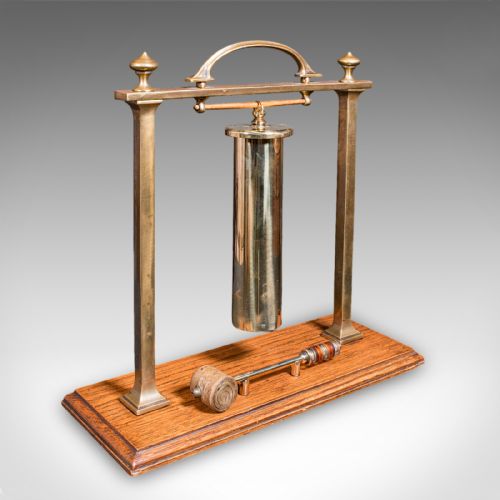
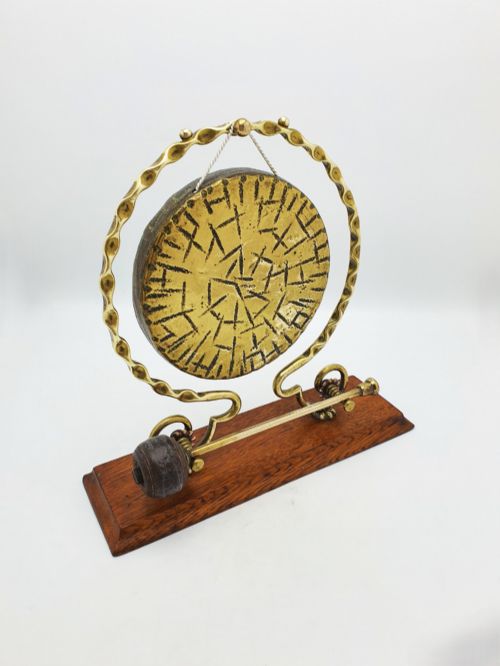
These brass call bell pieces summon service across a room with a single sharp ring, forged in cast brass and mounted on oak bases.
Brass Call Bell
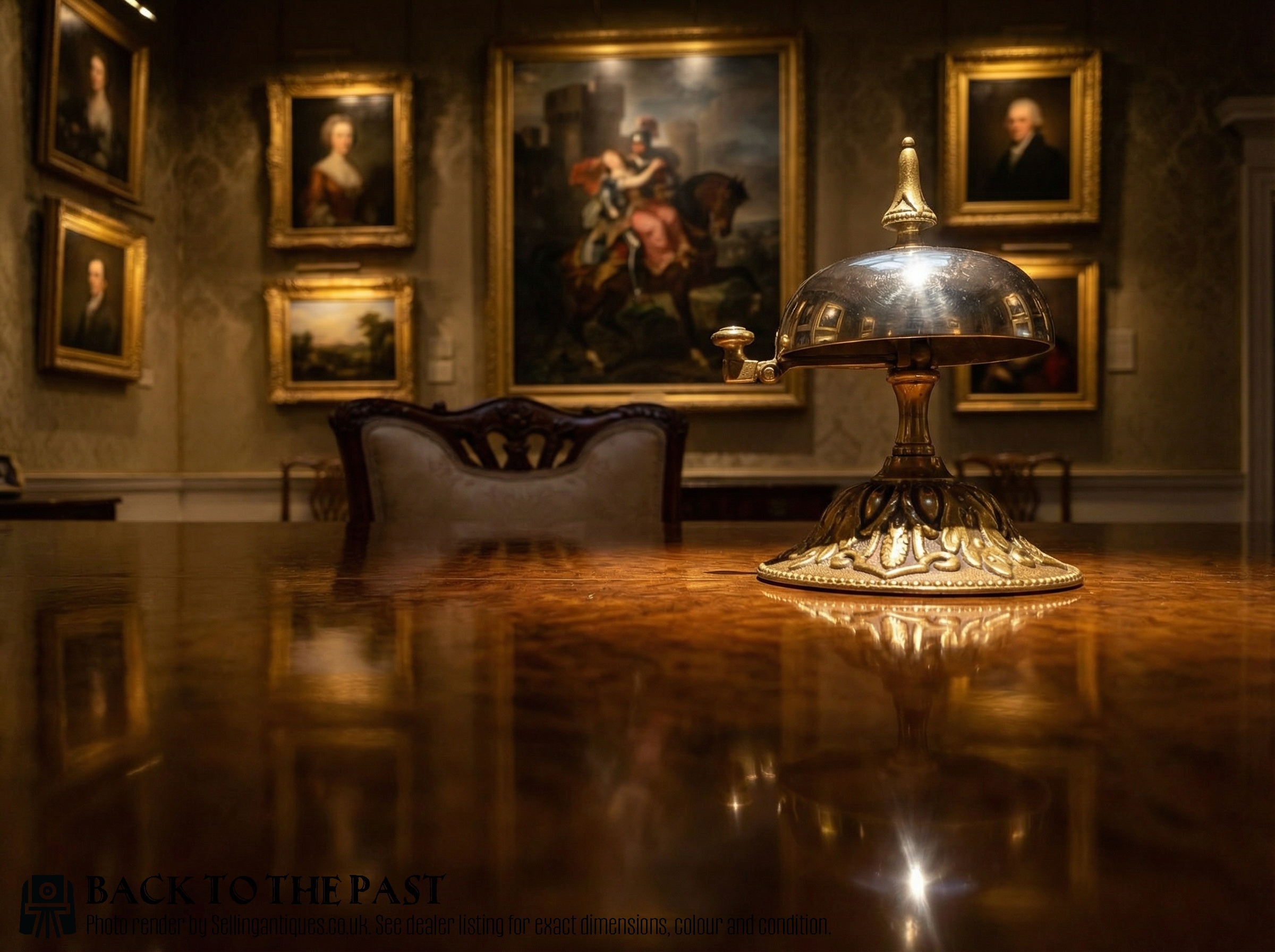
A brass call bell serves to summon attention in domestic and public spaces, appearing in forms from handheld school masters' chimes to heavy counter bells mounted for reception use. Buyers searching for a brass call bell encounter table models, desk buttons, and large freestanding dinner gongs supported by wooden frames.
The pieces on this page span the Georgian, Victorian, and Edwardian periods, alongside later twentieth century iterations. Simpler hand-held patterns sit alongside ornate French Rococo Revival designs and Anglo-Indian variations incorporating bronze and horn.
Many survivors trace their origins to country houses, railway stations, and merchant counters where daily administrative life demanded an audible signal. Domestic examples often take the form of tea gongs suspended from oak or teak frames accompanied by a handheld striker.
Construction and Materials
Foundry work relies primarily on sand-cast brass and bronze, finished with varying degrees of hand-polishing and patination. Cast iron and steel components provide structural weight in bases and internal spring mechanisms.
Wooden mounts utilise seasoned oak, teak, and occasionally turned horn to anchor the metal components. Hand-embroidered silk, beads, and cord feature in suspended bell pulls that connect to remote ringing mechanisms.
Brass Call Bell Retail Price Guide 2026
Typical asking prices for brass call bell among the pieces listed under this phrase on Sellingantiques today, from the lower quarter to the upper quarter. They describe what is for sale here now, not the wider market.
Determining Quality
Quality rests upon the crispness of the casting work and the resonance of the metal alloy itself. Finer specimens display deeply chased detailing on ornate bases, whereas utilitarian models prioritise thick walls for durability.
The integrity of internal spring mechanisms and clappers determines whether a piece maintains its clear acoustic tone after generations of use. Original patination and untouched wooden mounts elevate a piece above later replacements or over-polished examples.
The Brass Call Bell Glossary
- Counter Bell
- A stationary bell designed to sit upon a shop desk or hotel reception counter, usually featuring a plunger or push-button mechanism. These allowed customers to summon staff without leaving the storefront.
- Dinner Gong
- A suspended metal disc or bowl struck with a mallet to announce meals in country houses. They range from tabletop models to large floor-standing frames.
- Hand Bell
- A portable bell featuring a turned wooden or cast metal handle, historically used by schoolmasters, town criers, and household staff. The sound carried across large rooms and outdoor courtyards.
- Bell Pull
- A decorative strap of fabric or leather connected to a wire system running through a house to ring a distant bell. They are frequently worked in needlepoint, beadwork, or silk.
- Cast Brass
- Molten alloy poured into sand moulds to create complex three-dimensional forms. This method leaves subtle surface textures distinct from modern machine stamping.
Brass Call Bell: Frequently Asked Questions
How do counter bells work?
Most counter bells employ an internal spring-loaded hammer that strikes the interior dome when the top button is depressed. The housing remains stationary while the internal mechanism creates the acoustic resonance.
Heavier Victorian commercial models use robust steel springs designed to withstand constant daily use in shops and railway stations without losing tension.
Were dinner gongs used indoors?
Dinner gongs stood in hallways, drawing rooms, or dining spaces to alert residents that meals were served. The deep tone carried effectively through large country houses.
They were typically mounted on wooden frames made of oak or mahogany, complete with a dedicated wooden or metal striker hung from the side.
How do I date a brass bell?
Dating relies on stylistic clues, manufacturing marks, and the types of screws or fixings used on the base. Georgian and early Victorian pieces often show sand-casting irregularities and hand-turned wooden elements.
Later Edwardian and twentieth-century examples display more standardised industrial manufacturing techniques and machine-threaded components.
What is the difference between bronze and brass?
Brass is an alloy of copper and zinc, while bronze combines copper with tin. Bronze generally yields a warmer, deeper resonance and a darker natural patination over time.
Both metals appear frequently across these listings, sometimes combined within a single piece for decorative contrast.
Can I polish my antique bell?
Polishing removes the historic surface oxidation known as patination, which many collectors prefer to leave intact. Metal polish should be used sparingly, if at all, to preserve the character gained over a century or more.
Gentle dusting with a soft cloth is usually sufficient for routine maintenance of both the metal dome and wooden bases.