




Boxwood Netsuke Carving
A boxwood netsuke carving is a tactile miniature toggle from Japan, offering collectors intricate detail and centuries of master craftsmanship in the palm of the hand.
Boxwood Netsuke Carving
A boxwood netsuke carving represents a traditional Japanese toggle, traditionally used to anchor small pouches or containers to a kimono sash. These miniature sculptures take many charming forms, depicting animals, figures and natural clusters.
The pieces you encounter span the nineteenth century, including both the Edo and Meiji periods. You will find subjects ranging from frogs and toads to wise men and boys on rams.
Makers often signed their work, leaving signatures such as Tomochika and Masayuki for collectors to study. Alongside netsuke, you may also discover related wood okimono figures.
Materials and carving techniques
These miniature works are fashioned primarily from dense boxwood and various carved woods. Certain examples incorporate inlaid horn to provide contrast and texture to the natural timber.
Carvers utilised skilled hand techniques to achieve highly detailed and naturalistic forms. The wood is often subtly stained to highlight the intricate contours of the subject.
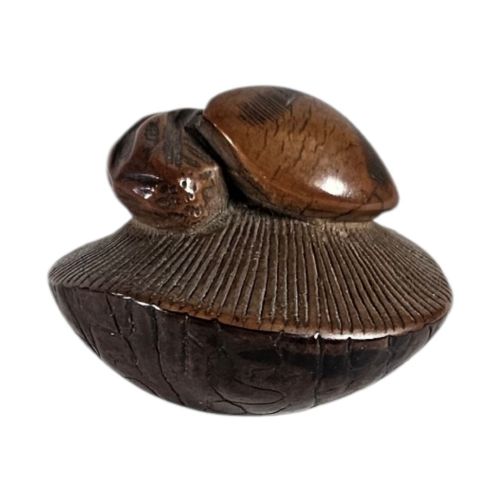
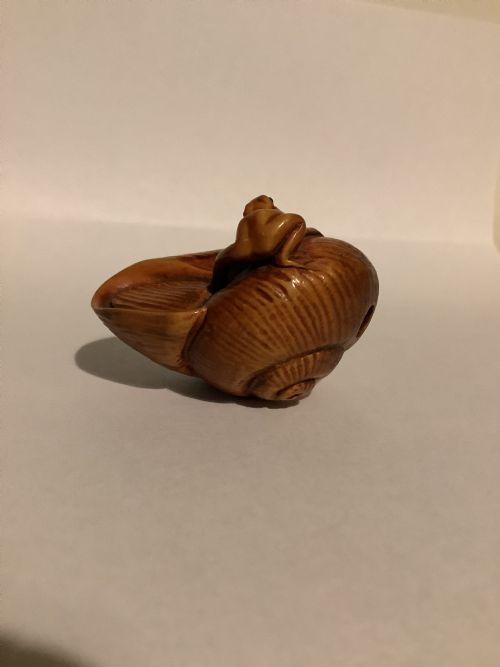
A tiny snail creeping across a mushroom offers a slow-moving creature immortalised in hard boxwood for centuries.
Distinguishing quality in miniature carvings
Quality rests upon the naturalism and depth of the carving. Master carvers captured movement and expression with remarkable precision, whereas lesser works remain stiff and uninspired.
The presence of a clear signature by a recognised artisan elevates a piece considerably. Finer examples also exhibit a superior tactile quality from handling over many generations.
Tomochika·Masayuki
The Boxwood Netsuke Carving Glossary
- Netsuke
- A small carved toggle used in traditional Japanese dress to secure small hanging pouches. These objects combine practical fastening with intricate sculptural art.
- Okimono
- A Japanese decorative figurine designed for display on a shelf or in a tokonoma alcove rather than for fastening to a sash.
- Edo Period
- The historical Japanese era lasting from sixteen hundred and three to eighteen hundred and sixty-eight. This period fostered rich traditions in miniature wood carving.
- Meiji Period
- The era of Japanese history spanning from eighteen hundred and sixty-eight to nineteen hundred and twelve. Carvings from this time often display extraordinary naturalistic detail.
- Boxwood
- A dense, pale wood prized by carvers for its fine grain. It allows for microscopic detail without splintering.
Boxwood Netsuke Carving: Frequently Asked Questions
What is a boxwood netsuke carving used for?
These pieces served as practical toggles in traditional Japanese dress, securing small pouches or medicine boxes to the sash.
Today, collectors appreciate them as tactile miniature sculptures that fit comfortably in the palm of the hand.
How do I date a wood netsuke?
Dating relies on stylistic clues, historical context, and the transition between the Edo and Meiji periods.
Nineteenth-century examples often display specific naturalistic carving conventions and occasionally bear period signatures.
What is the difference between a netsuke and an okimono?
A netsuke is strictly a functional toggle with cord holes designed for fastening to clothing.
An okimono is a decorative figurine created solely for display on a tabletop or cabinet.
Why is boxwood used for these carvings?
Boxwood possesses a remarkably tight and uniform grain that resists splitting under intricate knife work.
This density allows carvers to render microscopic details and smooth textures that age gracefully with handling.