


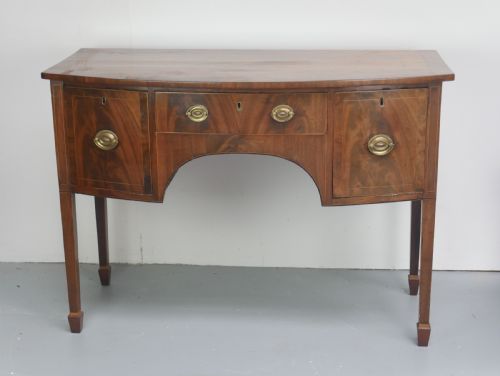


Bowfront Serving Table
A bowfront serving table brings generous proportions and curved fronts together, offering a practical surface for dining rooms.
Bowfront Serving Table
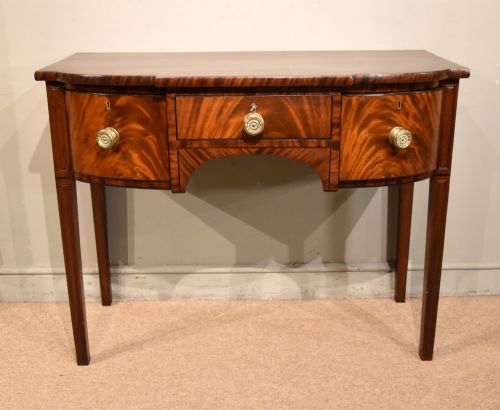
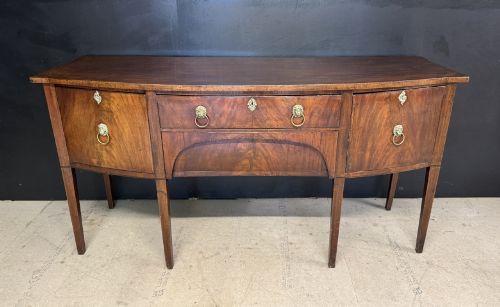
A bowfront serving table is a substantial dining room furnishing designed for surface display and storage, appearing frequently across this selection in forms commonly catalogued as sideboards, side tables, or servers. These items emerge principally from the Georgian, George III, and Regency periods, alongside later nineteenth century revivals.
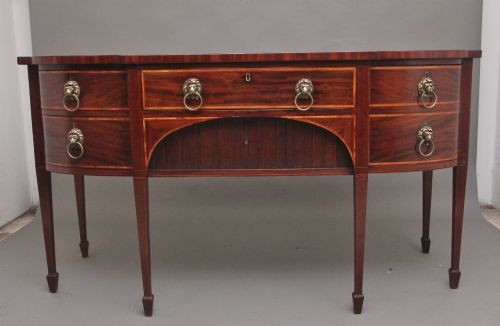
The dominant material format seen here is mahogany, often highlighted with contrasting boxwood and satinwood inlay. Makers constructed these items with bowed or curved frontages intended to soften the geometry of formal dining spaces while providing wide tops for service.
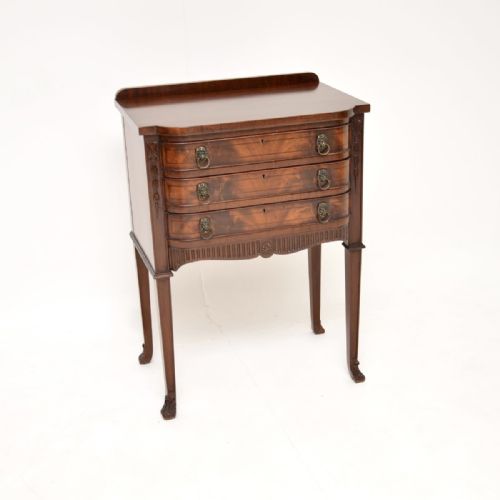
Smaller proportions appear alongside larger examples, offering versatile options for domestic interiors without sacrificing the characteristic curved profile. Buyers encounter both vernacular items and pieces following specific stylistic designs from eighteenth and nineteenth century workshops.
How they were made
Cabinet makers built these pieces primarily using solid mahogany and flame mahogany veneers, constructing carcases supported by secondary timbers such as oak. The characteristic curved front required careful timber selection and steam bending or segmental construction to achieve the smooth sweep of the bow.
Surface decoration relied on fine stringing and banding using contrasting timbers like boxwood and satinwood, inlaid directly into the primary mahogany surfaces. Drawer construction often employed hand-cut dovetails, while structural detailing incorporated ebony stringing and brass hardware.
Listings feature mahogany across multiple periods, spanning Georgian, Regency, and Edwardian eras alongside later revival styles.
What varies in quality
Quality in a bowfront serving table rests on the grain selection of the mahogany and the precision of the contrasting inlay work. Superior examples display carefully matched flame mahogany veneers that follow the curve of the bow without distortion.
The crispness of the secondary timber work and the integrity of the original drawer linings indicate higher standards of cabinet making. Refined proportions and restrained stringing distinguish better executed pieces from simpler vernacular productions.
George Hepplewhite·George Oakley
The Bowfront Serving Table Glossary
- Bowfront
- A convex curved front contour typical of these serving tables and sideboards. This shape softens the profile of large case furniture.
- Flame mahogany
- A highly figured timber grain resembling flickering flames, prized for drawer fronts and tabletops. Cabinet makers used veneers of this wood to create dramatic visual movement.
- Stringing
- Thin inlaid lines of contrasting wood used to edge panels and drawer fronts. Boxwood and ebony were common choices for this delicate decorative work.
- Satinwood
- A pale, lustrous exotic timber utilised for contrasting inlay and crossbanding. It provides a bright visual counterpoint to dark mahogany.
- Dovetail
- A traditional interlocking joint used in drawer construction to ensure durable corners. Hand-cut versions indicate earlier periods of manufacture.
Bowfront Serving Table: Frequently Asked Questions
What is a bowfront serving table used for?
These tables served primarily in dining rooms for holding dishes, silverware, and serving platters during meals.
They also functioned as decorative sidepieces for display within formal reception rooms and halls.
How do I distinguish Georgian from Regency pieces?
Georgian and George III items often display restrained classical proportions with fine boxwood stringing and subtle bracket feet.
Regency examples tend to incorporate bolder mahogany grains, architectural influences, and distinct brass mounts or ring handles.
Are these tables suitable for modern dining rooms?
The slender curved profile allows these serving tables to fit comfortably against walls without dominating floor space.
Their wide tops provide practical surfaces for modern entertaining while adding historical character to a room.
What timber is most common?
Mahogany is the predominant wood found across these listings, appearing in both solid form and as figured veneers.
Accompanying timbers include oak for drawer linings alongside boxwood and satinwood for decorative inlay work.