
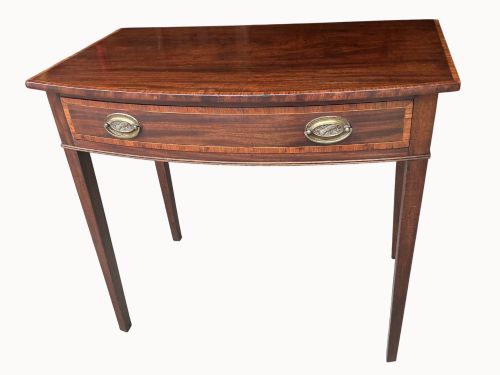
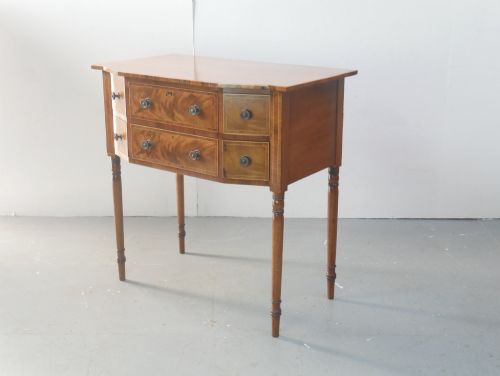
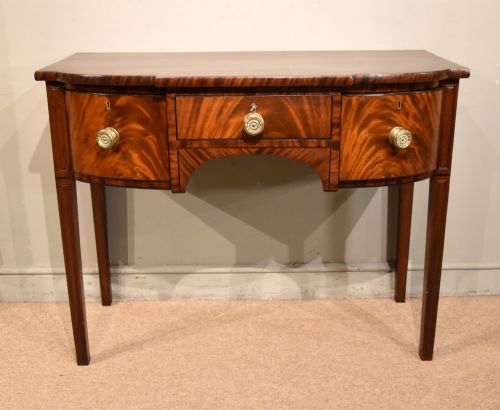
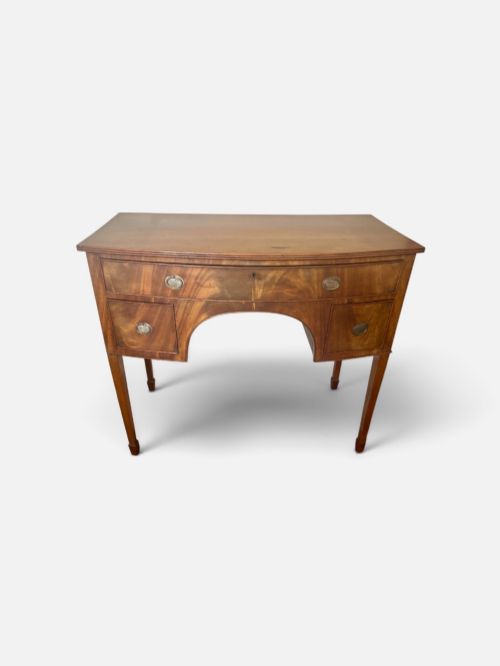




Bowfront Hall Table
A bowfront hall table brings a graceful, curved profile to narrow spaces, combining practical surface area with understated period elegance.
Bowfront Hall Table
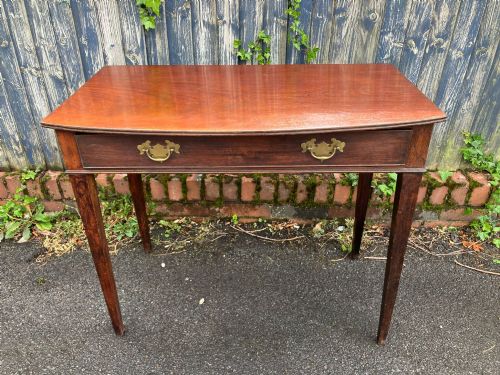
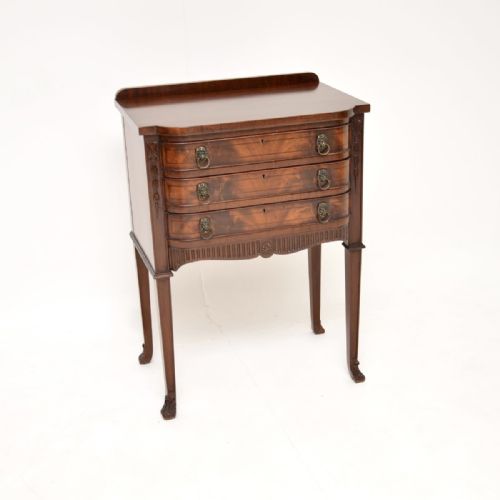
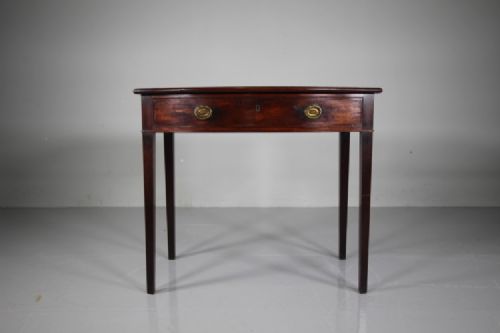
A bowfront hall table offers a convex curved front that softens the lines of a narrow passage or entranceway, making it a functional choice for smaller rooms. These pieces appear primarily in mahogany, often accompanied by related forms such as side tables, sideboards, and console tables.
Buyers seeking a bowfront hall table will encounter both authentic 18th and 19th-century originals and later interpretations from the Edwardian and interwar periods. The proportions are typically shallow, designed to sit flush against a wall without obstructing foot traffic.
Judging Quality and Craftsmanship
Quality rests in the handling of the curved front and the selection of timber veneers. Superior examples display book-matched flame mahogany with precise boxwood stringing that follows the gentle sweep of the bow without distortion.
Proportion and structural integrity define the upper tier of these pieces. Finer tables maintain crisp edge detailing on the legs and drawer frames, whereas lesser examples show heavier, less refined timber selection and simpler construction.
The listings span from the 18th century through the Georgian and Regency periods, extending into Edwardian and 1930s revival pieces.
The Bowfront Hall Table Glossary
- Bowfront
- A furniture front that curves outward in a convex shape. This profile softens the rectangular geometry of hallway furniture.
- Flame mahogany
- A veneer cut from the fork of the mahogany tree where the branch meets the trunk. It creates a distinctive, flickering flame pattern across the surface.
- Stringing
- A narrow strip of contrasting wood inlaid into the surface of a piece. It outlines drawers and tabletops in Sheraton and Regency design.
- Console table
- A table designed to be fixed against a wall, often supported by brackets or legs. Many examples in this category share the bowfront profile.
- Sheraton style
- A neoclassical furniture style popular in the late 18th and early 19th centuries. It emphasises straight tapered legs, contrasting veneers, and classical restraint.
Bowfront Hall Table: Frequently Asked Questions
Where should I place a bowfront hall table?
These tables suit narrow entrance halls, corridors, and landings where floor space is limited. Their shallow depth allows them to sit against a wall while providing a surface for lamps or correspondence.
They also function effectively in dining rooms as small servers or in bedrooms as dressing tables, depending on the specific height and drawer configuration.
How do I distinguish a Georgian original from a later revival piece?
Examination of the timber, secondary woods, and construction methods reveals the period of manufacture. Georgian and Regency pieces typically show period-specific hand-cut joinery and mature mahogany patina.
Revival pieces from the Edwardian era or the 1920s and 1930s often incorporate machine-cut elements and different internal woods, despite adhering to Georgian or Sheraton design vocabulary.
What is the difference between a hall table and a console table?
Historically, console tables were often secured to the wall with decorative brackets, whereas hall tables stood independently on four legs. In modern usage, the terms frequently overlap, particularly among pieces featuring the bowed front.
Both forms share a narrow profile designed for placement against a wall in domestic circulation spaces.
How do I care for a mahogany bowfront table?
Maintenance requires keeping the piece away from direct heat sources and strong sunlight to protect the mahogany veneer and polish. Regular dusting with a soft, dry cloth preserves the finish.
Application of traditional wax polish at infrequent intervals helps nourish the timber without building up a heavy residue.