
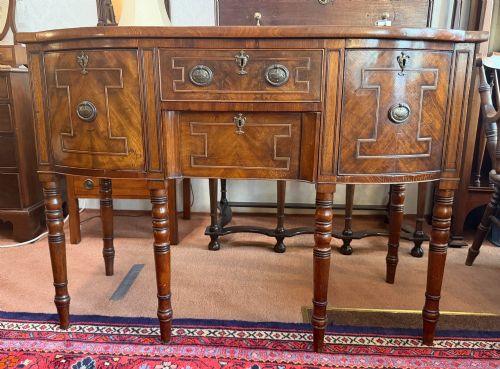
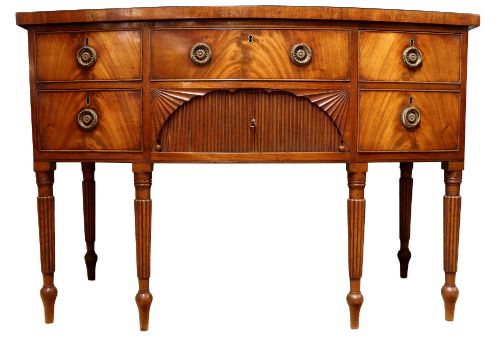
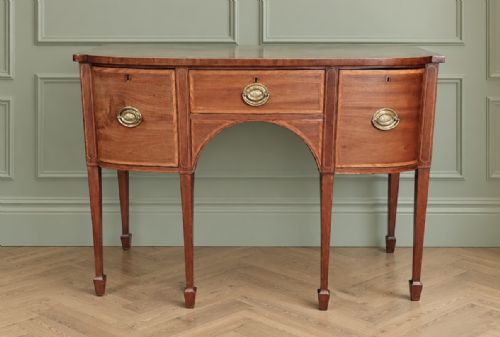
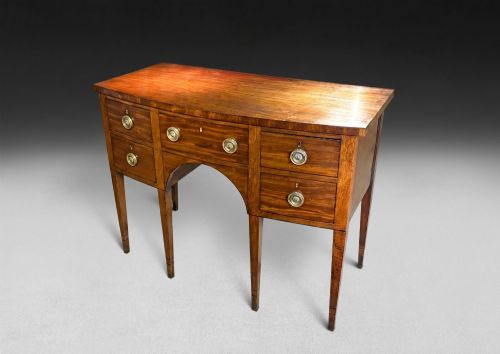
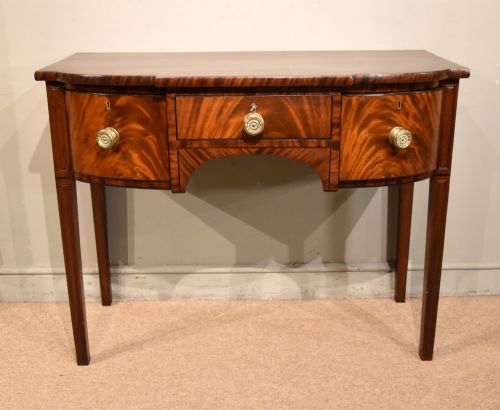
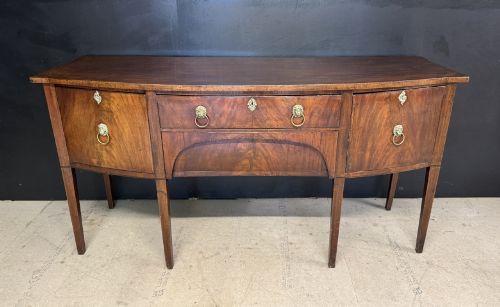
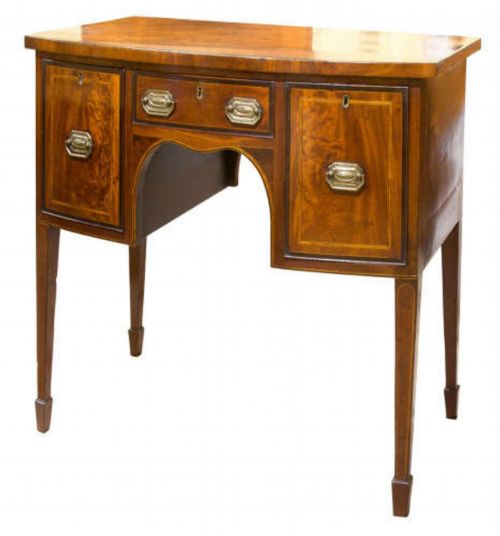
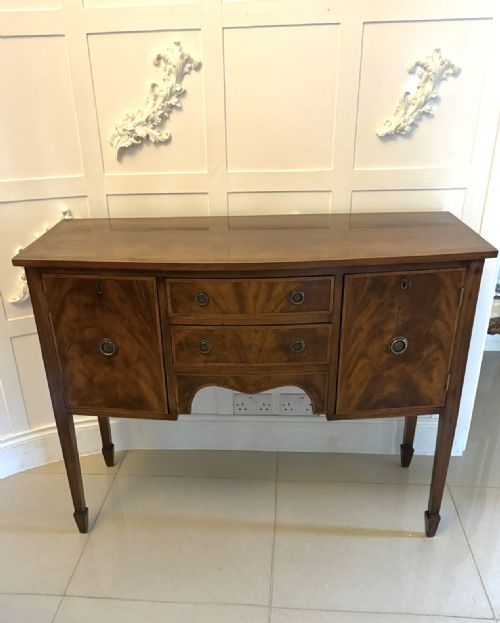

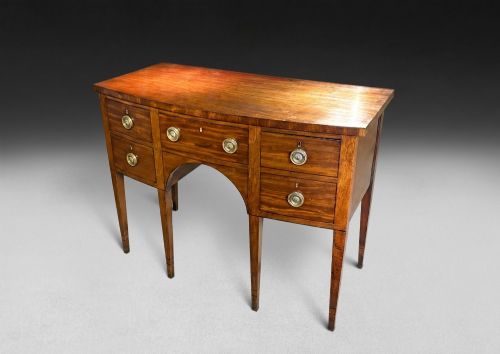
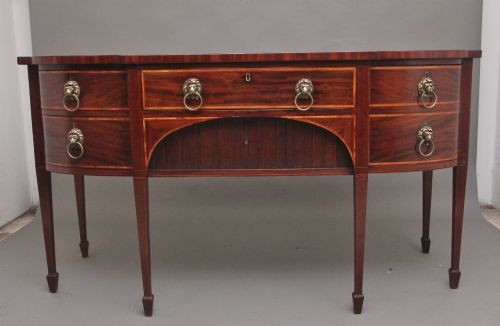

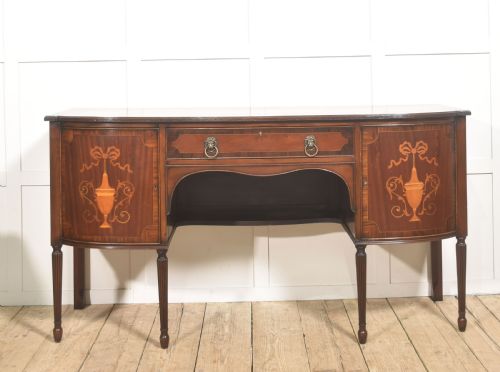


Bowfront Credenza Table
A bowfront credenza table delivers curved elegance and substantial storage, anchoring a dining room with classical proportion and rich timber grain.
Bowfront Credenza Table
A bowfront credenza table combines the curved protruding front characteristic of the bowfront form with the storage capacity of a traditional sideboard. When exploring this selection, buyers encounter pieces primarily originating from the Georgian, Regency and Edwardian periods, alongside later revival interpretations.
The dominant material format on this page is solid and veneered mahogany, frequently detailed with contrasting boxwood and satinwood inlay. These items serve historically as dining room servers and sideboards, designed to display silver and store service linen.
Most examples span the eighteenth and nineteenth centuries, featuring configurations from compact small sideboards to larger six-legged formats. The silhouettes range from restrained George III designs to decorative Sheraton Revival and Edwardian cabinet pieces.
What varies in quality
The degree of refinement in timber selection marks the primary distinction across these pieces, ranging from plain mahogany boards to highly figured flame veneers. Master cabinet makers deployed symmetrical grain patterns that accentuate the convex curve of the bowfront.
Subtlety of inlay work and precision in joinery further separate standard production from exceptional examples. Finer items exhibit crisp boxwood stringing, well-fitted drawers with hand-cut dovetails, and balanced proportions across the entire frame.
The listings on this page span the Georgian, Regency, Edwardian, and William IV periods, constructed primarily in mahogany with boxwood and satinwood inlay.
The Bowfront Credenza Table Glossary
- Bowfront
- A furniture front that curves outward in a convex arc. This shape softens the rectangular profile of dining room furniture.
- Crossbanding
- A strip of veneer applied to the border of a furniture surface so the grain runs perpendicular to the main wood. It provides a neat visual frame to tabletops and drawer fronts.
- Stringing
- Thin inlaid lines of contrasting timber used to outline panels and drawers. Boxwood is frequently utilised for this linear detail.
- Flame mahogany
- A distinct veneer figure resembling flickering flames, cut from the branch forks of the mahogany tree. It appears on the most decorative surfaces of period cabinetry.
- Sheraton
- A neoclassical furniture style dating to the late eighteenth century, known for slender tapered legs and delicate inlay. Pieces in this style emphasise geometric lightness.
Bowfront Credenza Table: Frequently Asked Questions
What is a bowfront credenza table used for?
These pieces function primarily as serving surfaces and storage cabinets in dining rooms. Historically, they held heavy platters, silverware, and linens during large meals.
Today, they serve equally well in hallways or living spaces to display decorative objects while concealing household items inside deep drawers and cupboards.
How do I identify a Georgian bowfront sideboard?
Georgian examples typically feature solid mahogany construction, hand-cut dovetail joints, and understated brass hardware. Look for proportion, tactile timber finishes, and period-appropriate cabinet work dating from the eighteenth or early nineteenth century.
Later Edwardian revival pieces often display lighter satinwood banding and machine-processed internal components that distinguish them from earlier workshop production.
What wood was used to build these tables?
Mahogany forms the primary structural and visual timber across the majority of these listings. Cabinet makers paired this dense tropical wood with contrasting details in satinwood and boxwood.
Internal framing and drawer secondary woods commonly include oak or pine, depending on the workshop origin and regional British traditions.
Where were these sideboards made?
Most pieces originate from British workshops spanning the Georgian, Regency, and Edwardian eras. Regional variations include Scottish production alongside standard English cabinet making centres.
Design influences frequently follow prominent pattern books by makers like George Hepplewhite and Thomas Sheraton.