




Georgian Mahogany Servery
A georgian mahogany servery provides the grand dining arrangement you need, offering deep timber tones and stately proportions for serious entertaining.
Georgian Mahogany Servery
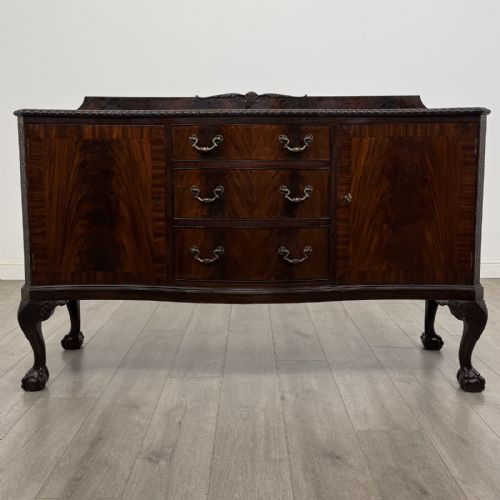
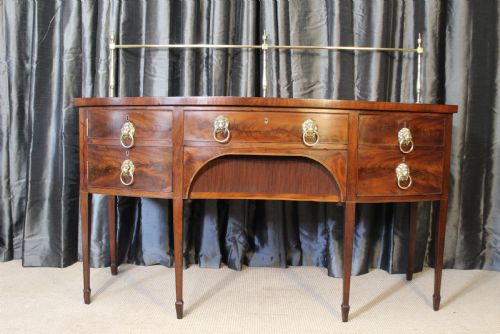
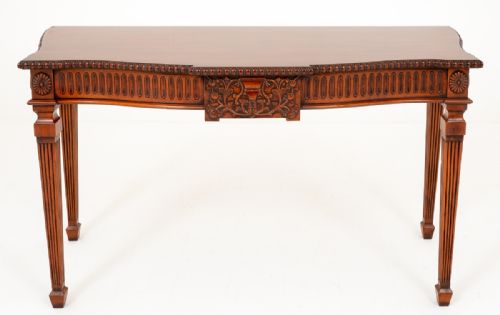
When searching for a georgian mahogany servery, you encounter substantial dining room furniture designed to hold serving dishes, silver, and glassware during grand meals. The examples on this page primarily consist of sideboards, console and serving tables, and sideboards and buffets built to manage the practical needs of the dining room.
You are most likely to meet bowfront sideboards and rectangular console serving tables among these listings, spanning the eighteenth and nineteenth centuries alongside later revival interpretations. These forms give you long surfaces and deep drawer capacities suited to both period dining spaces and contemporary homes.
The periods and styles seen here range from genuine eighteenth-century pieces and the Regency era through to later twentieth-century reproductions such as Sheraton Revival and Georgian Style. Each iteration preserves the functional silhouette required for serving, whether standing on four legs or the more expansive six-legged configurations.
Materials and construction
Makers built these pieces primarily from solid mahogany and mahogany veneers selected for rich grain patterns and deep colour. Workshops utilised cabinet-making techniques that integrated sturdy timber frames with smooth-running drawers.
Decoration relied on contrasting timbers rather than heavy carving, incorporating satinwood, boxwood inlay, and wood inlay to create delicate borders and geometric panels. Brass hardware, including handles and occasionally galleries, provided functional structure and bright metallic contrast against the dark wood.
The listings span from the Georgian period through Regency designs to twentieth-century revivals, utilising mahogany alongside brass, boxwood, and satinwood.
Assessing quality and craftsmanship
Quality in these pieces rests upon the selection of timber and the precision of the cabinet-maker's joinery. Superior examples display carefully matched grain across the drawer fronts and disciplined execution of inlaid stringing.
The integrity of the structural frame and the original condition of the timber define the upper tier of the range. Pieces retaining their original brasses and unblemished polish demonstrate greater fidelity to their period of origin.
H Mower & Stephenson
The Georgian Mahogany Servery Glossary
- Bowfront
- A curved front section that bulges outward in a convex sweep. This shape softens the rigidity of a room and provides additional interior depth.
- Inlay
- A technique where contrasting materials are inserted into recessed cavities on the wood surface. Boxwood and satinwood frequently serve this purpose to outline drawer edges.
- Console table
- A table designed to stand against a wall, frequently supported by legs at the front and secured to the wall at the back. These served as serving surfaces in formal dining rooms.
- Gallery
- A raised railing or rim placed along the top edge of a piece. In dining furniture, this prevented serving dishes or glassware from sliding off the surface.
Georgian Mahogany Servery: Frequently Asked Questions
How do I use a servery today?
These pieces function as ideal sideboards in dining rooms or long console tables in hallways. Their surface area accommodates lamps, decorative objects, and serving trays.
Deep drawers and cupboards provide practical storage for table linen, cutlery, and glassware, keeping dining spaces organised.
What is the difference between a sideboard and a console?
Sideboards traditionally feature banks of drawers and cupboards enclosed within a single timber carcase. They prioritise concealed storage alongside surface space.
Console and serving tables often present a more open framework with legs supporting a single top. They focus primarily on surface utility rather than bulk storage.
How do I date a mahogany piece?
Dating relies on observing construction methods, timber choice, and decorative styles. Eighteenth-century pieces often display hand-cut dovetails and solid secondary timbers.
Revival pieces from the twentieth century utilise machine-sawn elements and distinct finishing techniques that reveal their later manufacture.
Does inlay indicate a specific period?
String inlay in boxwood and satinwood became characteristic of late eighteenth-century and Regency design. It reflected the neoclassical taste for lighter, more refined surfaces.
Later revival movements also adopted these decorative motifs, meaning inlay must be assessed alongside overall construction.