


Bonheur De Jour Desk
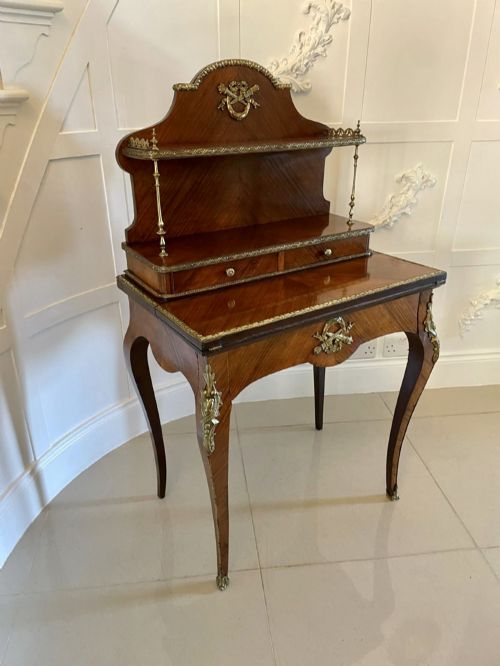
When you examine a bonheur de jour desk, you meet a refined ladies' writing table designed with upper tiers, shelves, or small cabinets.
Bonheur De Jour Desk
A bonheur de jour desk is a light ladies' writing table that emerged during the eighteenth century and saw significant revival periods throughout the nineteenth century. These pieces combine a compact writing surface with an upper superstructure containing drawers, pigeonholes, or small cupboards, and they function primarily as ornamental correspondence desks. You will encounter them most frequently in Victorian British interpretations and French revival styles.
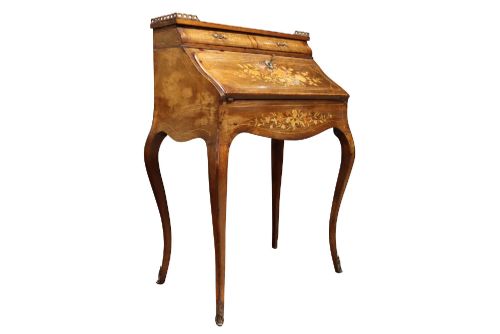
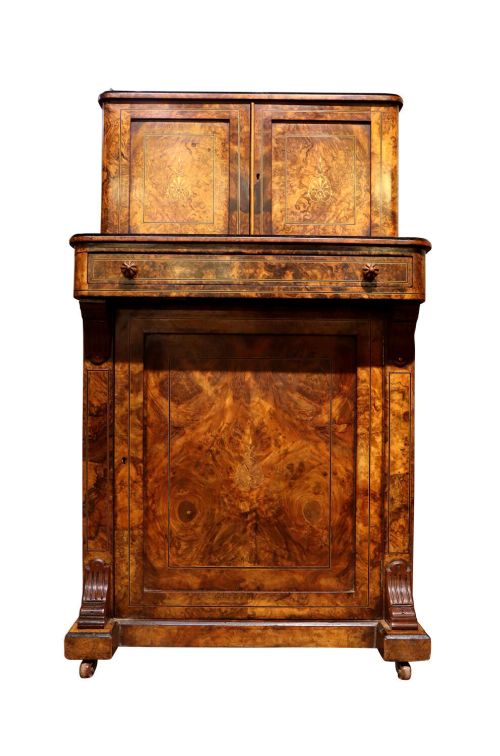
The materials span from figured native woods like walnut and mahogany to exotic veneers including kingwood, satinwood, and burr walnut. Many examples incorporate decorative elements such as ormolu mounts, brass inlay, marquetry, and inset ceramic plaques. The forms range from simple freestanding tables to elaborate bureau de dame designs with fitted compartments.
Makers working within these traditions produced pieces that reflect Georgian elegance alongside Victorian and Edwardian craftsmanship. The listings demonstrate a heavy concentration of nineteenth-century French and English workshop output, often adhering to Louis XV revival aesthetics.
How they were made
Cabinetmakers constructed these desks using solid structural carcases faced with decorative veneers such as burr walnut, kingwood, mahogany, and satinwood. Marquetry patterns were cut and inlaid into the timber surfaces, creating floral or geometric motifs across the tops and fall fronts.
Gilded bronze ormolu mounts, brass stringing, and glass panels were applied to accent the framework, while specialised components like ceramic Sevres plaques were integrated into the upper superstructures. French workshops often employed bombé forms and curved legs, requiring advanced timber bending and shaping techniques.
Listings feature walnut, mahogany, satinwood, and kingwood timbers paired with brass and ormolu mounts across Victorian and 19th century periods.
What varies in quality
The standard of craftsmanship shows clearly in the selection of timber veneers and the precision of the marquetry inlay. Superior examples display symmetrical burr walnut figures or detailed pictorial wood inlays that align seamlessly across drawers and doors.
Mounts and hardware differentiate workshop output, with heavy cast ormolu and hand-chased brass mounts indicating higher production tiers compared to stamped or plated metal. The integration of hand-painted porcelain plaques and fitted interior compartments further marks the distinction between standard commercial pieces and exhibition-grade work.
Edwards and Roberts·Paul Sormani·Druce and Co
The Bonheur De Jour Desk Glossary
- Bonheur de jour
- A small ladies' writing desk featuring a raised superstructure of shelves and drawers above a writing surface. The term translates from French as day's delight.
- Marquetry
- Decorative veneer work forming pictures or patterns using various woods applied to a carcase. Craftsmen cut contrasting timbers to fit precisely into planned designs.
- Ormolu
- Gilded bronze mounts applied to furniture for decorative effect during the eighteenth and nineteenth centuries. The technique involves coating cast bronze with a gold amalgam.
- Bureau de dame
- A lady's writing desk, often synonymous with a bonheur de jour, featuring a sloped writing flap or flat table top. These items typically include internal pigeonholes for stationery.
- Cheveret
- A small mobile writing table equipped with a removable bookstand or shelf unit on top. This form appeared during the eighteenth century alongside early bonheur de jour designs.
Bonheur De Jour Desk: Frequently Asked Questions
What is a bonheur de jour desk used for?
These desks served as elegant writing tables for ladies to write letters, manage correspondence, and store small personal items. The upper tiers held inkwells, stationery, and small display objects.
They stood in private sitting rooms and boudoirs rather than formal libraries, functioning as both practical writing furniture and decorative display pieces.
How do you tell a French piece from an English one?
French examples often display pronounced Louis XV revival curves, extensive ormolu mounts, and elaborate floral marquetry. They frequently incorporate shaped aprons and bombé front lower sections.
English interpretations tend to favour straight lines, satinwood or burr walnut veneers, and Sheraton revival influences, showing more restrained decorative mountings.
Are these desks suitable for modern writing use?
The writing surfaces are compact and positioned lower than standard modern desks, reflecting nineteenth-century furniture proportions. They accommodate laptop use or light paperwork rather than heavy office administration.
Because of their delicate superstructures and antique veneers, they require careful placement away from direct heat sources and strong sunlight.
How do you distinguish nineteenth-century pieces from later reproductions?
Nineteenth-century construction methods involve hand-cut dovetails, timber shrinkage patterns, and traditional cabinetmaker finishes like shellac polish. Materials show natural ageing in the veneers and brass patination.
Later twentieth-century copies often utilise uniform modern timbers internally, machine-cut joints, and modern adhesives that lack the depth of period construction.