
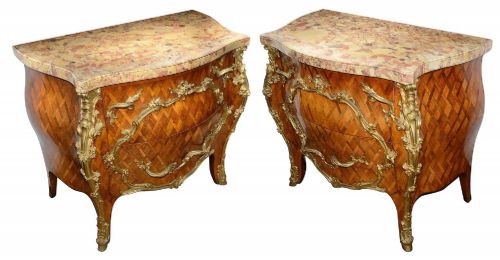


Bombe Side Cabinet
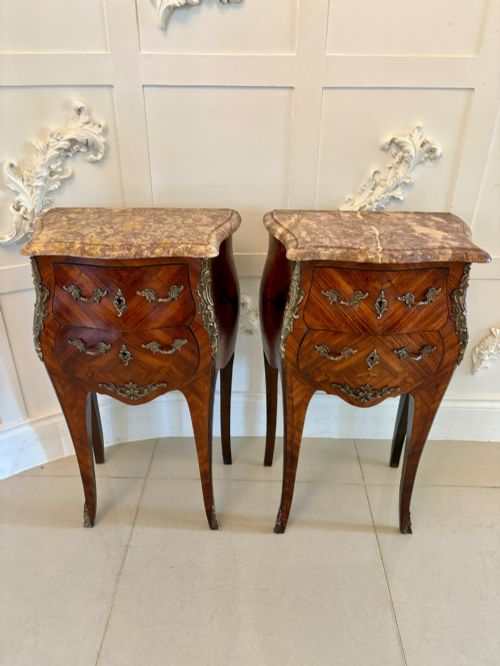
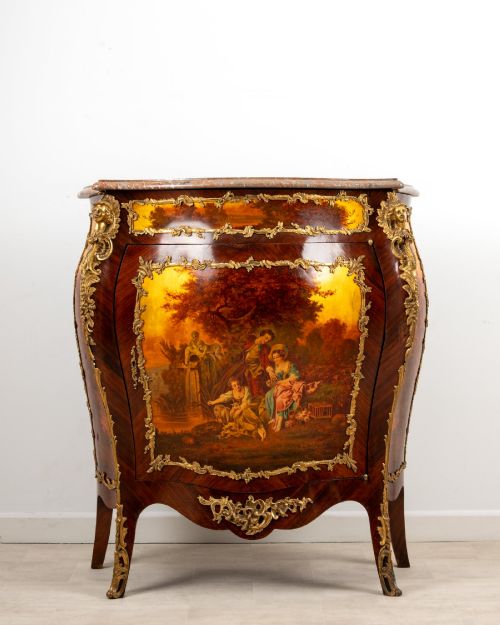
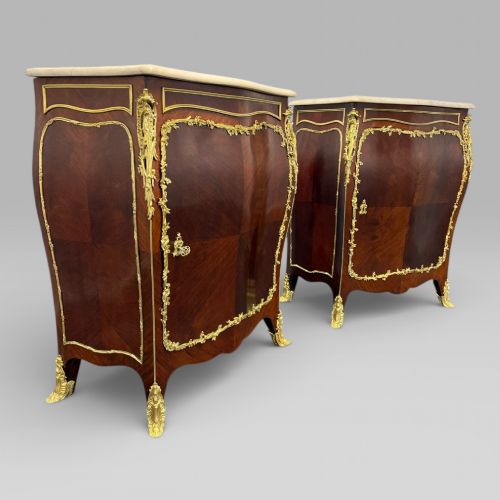
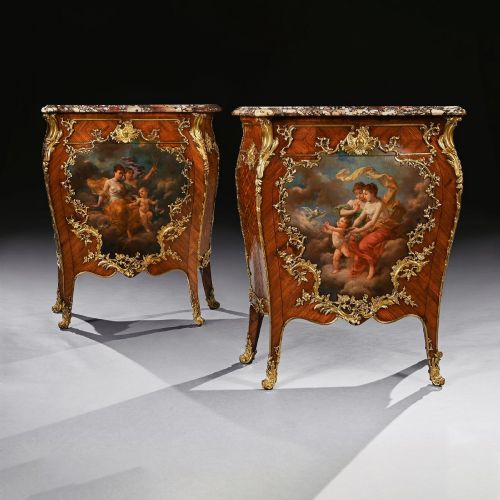
These bombe side cabinet examples bring sweeping curves and rich veneers into a room, offering both display space and practical storage.
Bombe Side Cabinet
A bombe side cabinet search reveals pieces with convex and concave serpentine outlines, heavily inspired by French Rococo revival and Louis XV designs. These forms appear most frequently as commodes, bedside tables, and small cabinets originating from the nineteenth and early twentieth centuries.
Buyers often encounter paired sets alongside individual items, constructed as side cabinets, petite commodes, or bedside night chests. The typical form rests on slender cabriole legs, occasionally incorporating a stand or marble surface to complete the silhouette.
How They Were Made
Cabinet makers constructed these pieces using dense timber carcases overlaid with kingwood, walnut, rosewood, tulipwood, or marquetry patterns. Vernis Martin lacquer finishes also appear across the surfaces, providing a glossy painted depth.
Mounts in ormolu, gilt bronze, and brass accent the corners, handles, and apron outlines to highlight the swelling contours. Heavy marble slabs frequently cap the top surface, shaped precisely to follow the curves of the wood.
Listings feature woods including kingwood, walnut, rosewood, and tulipwood, paired with marble tops and gilt bronze mounts.
What Varies in Quality
The distinction between tiers rests upon the precision of the veneer work and the casting of the metal mounts. Finer examples display fluid, hand-chased gilt bronze mounts that integrate seamlessly with the timber contours.
Structural integrity of the sweeping curves and the richness of the marquetry or lacquer work define the upper echelon of these cabinets. Lesser items feature simpler mounts and plainer timber selections without complex grain matching.
E. Kahn·Zweiner
The Bombe Side Cabinet Glossary
- Bombe
- A swelling, outward-curving shape characteristic of furniture from the Rococo revival periods. This contour requires skilled carpentry to achieve the rounded profile on all sides.
- Ormolu
- Gilt bronze ornamentation applied to furniture mounts and feet. The technique involves coating bronze with a finely ground mercury and gold amalgam before heating.
- Vernis Martin
- A simulated Japanese lacquer developed by the Martin brothers in eighteenth-century France. Cabinet makers utilised this translucent varnish technique on European furniture.
- Marquetry
- The art of applying decorative veneer pieces to a structure to form intricate designs. Craftsmen arrange different coloured woods to create pictorial or geometric patterns.
- Serpentine
- A furniture front or top curving inward centrally and outward at the ends. This line works alongside the swelling profile of the carcase.
Bombe Side Cabinet: Frequently Asked Questions
What rooms suit a bombe side cabinet?
These cabinets suit drawing rooms, bedrooms, or hallways where their curved silhouettes soften straight architectural lines. They function effectively as bedside tables or accent pieces.
Their compact proportions allow them to fit into smaller spaces while still providing surface area and enclosed storage within drawers or cupboards.
How do I identify Louis XV style?
Louis XV style pieces are defined by asymmetrical ornamentation, C-scrolls, and pronounced cabriole legs. The overall aesthetic avoids straight lines in favour of organic, flowing curves.
On these cabinets, the style appears through the swelling serpentine carcase and elaborate gilt bronze mounts following the naturalistic contours.
What is the difference between a commode and a side cabinet?
A commode typically designates a low chest of drawers, whereas a side cabinet may include cupboard doors or open shelving alongside drawer space. Both terms overlap frequently in nineteenth-century French furniture terminology.
In practice, smaller versions often serve as bedside tables while larger examples function as freestanding focal points in a reception room.
How should I care for marble and gilt bronze?
Marble tops require gentle cleaning with warm water and neutral soap to prevent staining from acidic substances. Abrasive cleaners damage the polished stone surface.
Gilt bronze mounts need only soft dusting, as aggressive polishing wears away the gold layer beneath, exposing the base metal.