


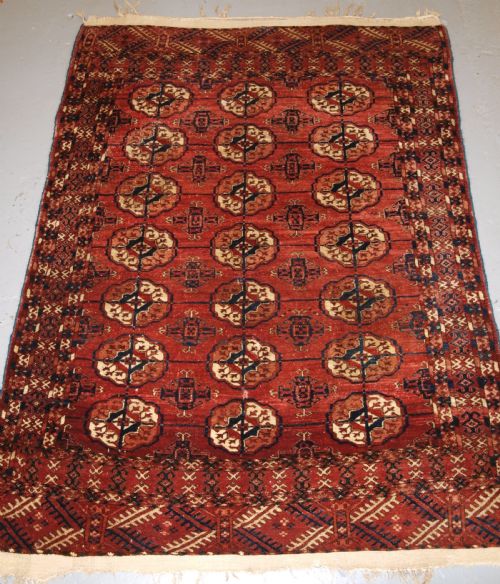
Bokhara Pattern Rug
A bokhara pattern rug brings deep red tones and geometric tribal patterns into a room, rooted in Central Asian weaving traditions.
Bokhara Pattern Rug
A bokhara pattern rug is typically a Turkmen or Afghan tribal weaving, often associated with the Tekke or Ersari tribes and the wider heritage of Central Asia. These pieces display traditional gul motifs, which are repeating octagonal medallions arranged across the field in disciplined rows.
Buyers will most frequently encounter nineteenth-century and early twentieth-century examples on this page, spanning dowry rugs, village carpets, and smaller tribal floor coverings. They anchor a space with rich burgundy and gold colourways that have settled into deep, muted tones over generations of use.
How they were made
These floor coverings are built on a foundation of natural cotton or wool, employing hand-knotted pile construction that provides dense durability for daily wear. The weavers utilised resilient wool fibres, yielding a handle that ranges from heavy duty to exceptionally soft depending on the specific tribal origin and purpose.
Dyes were derived from traditional organic sources to achieve the characteristic deep reds, burgundies, and contrasting dark accents that define the aesthetic. The structural borders often incorporate secondary geometric motifs that frame the primary field of guls.
What varies in quality
Quality in a bokhara pattern rug rests upon the fineness of the knotting and the crispness of the geometric drawing within the gul medallions. Finer tribal work yields a tighter pile and a more pliable handle, which allows the intricate borders and central motifs to maintain sharp definition.
The integrity of the wool and the depth of the dye saturation further distinguish the examples. Pieces with soft, resilient wool and balanced colour distribution hold their presence across the floor far better than heavily worn or rigid counterparts.
The Bokhara Pattern Rug Glossary
- Gul
- The primary octagonal medallion motif repeated across the field of a Turkmen weaving. This design element serves as the defining visual signature of the style.
- Tekke
- A major Turkmen tribe renowned for precise, finely knotted carpets featuring orderly rows of guls. Their work sets a distinct standard within Central Asian tribal weaving.
- Ersari
- A Turkmen tribal group known for producing carpets with larger scale designs and alternative coloration. Their rugs often display broader geometric interpretations.
- Dowry rug
- A specialised weaving created as part of a bride's traditional marriage portion. These pieces frequently receive finer wool and extra attention to detail.
- Main carpet
- A large-format floor covering intended for principal domestic use within a nomadic or village tent. They require substantial structural durability.
Bokhara Pattern Rug: Frequently Asked Questions
How do I date a bokhara pattern rug?
Dating relies on examining the wool consistency, the natural dye palette, and the specific structural characteristics of the foundation. Earlier nineteenth-century pieces tend to show softer handles and more complex organic dye variations.
Later twentieth-century examples often exhibit heavier cotton foundations and more uniform synthetic or semi-synthetic colouration. Comparing the drawing style of the gul motifs against established tribal typologies also helps narrow the period.
Where were these rugs originally made?
These textiles originate from Central Asia, produced by nomadic and village tribes such as the Tekke and Ersari across regions that include modern Turkmenistan and Afghanistan.
They were woven for domestic use, ceremonial dowries, and regional trade before entering the Western antique market. Each tribal group maintained distinct variations in border design and medallion spacing.
How do I care for an antique rug?
Gentle vacuuming without a rotating power brush helps remove embedded grit without straining the hand-knotted wool pile. Professional cleaning tailored to antique textiles is essential when deep maintenance is required.
Keeping the piece away from prolonged direct sunlight prevents the deep burgundy and red tones from fading unevenly. A quality underlay also reduces friction between the foundation and the floor.
What is a gul design?
A gul is a repeating octagonal or medallion-like motif that forms the structural heart of a Turkmen carpet. These shapes are arranged in strict rows down the central field.
Different tribes utilised specific variations of the gul to signal lineage and cultural identity. The complexity and precision of these motifs indicate the weaver's skill.