
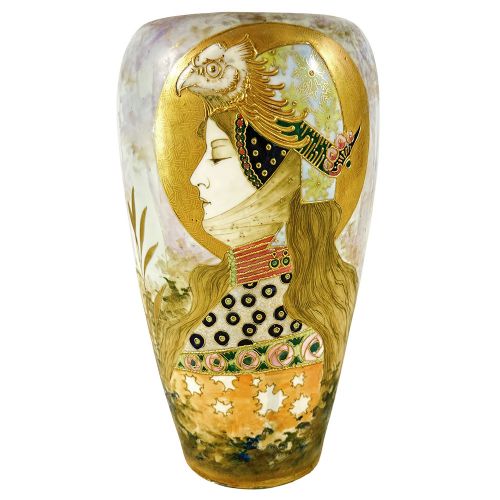


Bohemian Ceramic Maiden
These bohemian ceramic maiden figures bring flowing Art Nouveau grace and Victorian romance straight into your room.
Bohemian Ceramic Maiden
When you search for a bohemian ceramic maiden, you are looking at figural sculptures, centrepieces, and vases shaped like women, nymphs, and water carriers. These pieces date from the nineteenth century, the Edwardian era, and the early twentieth century, capturing the sweeping lines of the Art Nouveau movement and Victorian Orientalism.
The version you are most likely to meet on this page is a porcelain or earthenware figure produced by factories such as Royal Dux or Ernst Wahliss. They often take the form of graceful young women leaning on shells, holding jugs, or carrying baskets.
How they were made
Makers shaped these pieces from porcelain and earthenware, moulding graceful female forms into vases, centrepieces, and large decorative sculptures. Artisans then applied glazes and hand-painted details to bring out the textures of drapery, hair, and natural elements like water shells.
Many examples received delicate touches of enamel, gold leaf, and gilding to highlight the contours of the figures. Skilled modellers such as H. Schubert and Nicholas Kannhauser designed these elaborate forms for factories like Reissner, Stellmacher and Kessel.
Listings span the nineteenth century, the Edwardian era, and the nineteen-twenties, uniting earthenware and porcelain under Art Nouveau and Victorian Orientalism.
What varies in quality
Quality rests in the crispness of the modelling and the sensitivity of the hand-painted finish across the hair, face, and drapery. The finest pieces display precise detailing in the fingers, folds of fabric, and natural accessories.
The application of gilding and enamel work also marks the difference between standard production and exceptional studio output. Monolithic proportions and monumental scale elevate the presence of the figures within a room.
Nicholas Kannhauser·Reissner Stellmacher and Kessel·Royal Dux Bohemia·H Schubert·Ernst Wahliss
The Bohemian Ceramic Maiden Glossary
- Art Nouveau
- A style of decorative art characterised by flowing, organic lines and floral motifs. It dominates the design of these nineteenth and early twentieth century figures.
- Vide poche
- A small shallow container for holding loose items emptied from pockets. Several bohemian ceramic maiden designs incorporate this form alongside figural sculpture.
- Centrepiece
- A large decorative object placed in the middle of a table. These listings include substantial porcelain shell centrepieces featuring maiden figures.
- Spill vase
- A small container designed to hold wooden spills used for lighting fires or candles. Ernst Wahliss produced earthenware examples in this category.
- Gilding
- The application of gold leaf or gold powder to a surface. It is used here to accent the garments and accessories of the figures.
Bohemian Ceramic Maiden: Frequently Asked Questions
What is a bohemian ceramic maiden?
These pieces are nineteenth and early twentieth century porcelain and earthenware figures depicting graceful women, water carriers, and nymphs. They frequently incorporate functional elements like vases, vide poche bowls, and large shell centrepieces.
Rooted in the Art Nouveau style and Victorian Orientalism, they showcase organic curves and detailed hand-painting by notable makers of the period.
How were these figures used originally?
Wealthy Victorian and Edwardian households displayed these large ceramic maidens as decorative sculptures on mantelpieces, sideboards, and drawing-room tables. Centrepieces and vases also served practical functions during formal dining and interior decoration.
Their striking forms were intended to catch the eye and demonstrate artistic taste in domestic spaces.
How do I date a bohemian ceramic maiden?
Dating relies on stylistic markers such as the flowing asymmetry of Art Nouveau design, alongside period materials and manufacturer marks. Pieces span the late nineteenth century, the Edwardian period, and the early nineteen-twenties.
Examining the complexity of the hand-painted enamel and the presence of factory stamps helps narrow the decade of production.
How do I care for antique ceramic figures?
Keep these porcelain and earthenware sculptures out of direct sunlight to protect delicate hand-painted enamel and gold leaf detailing. Dust them gently with a soft, dry cloth rather than using liquid cleaners that might harm the glazed surfaces.
Place them on stable, level surfaces away from heavy traffic areas to prevent accidental knocks to fragile elements like raised arms or shell edges.