


Blue White Landscape China
Blue white landscape china brings pastoral scenes and cobalt imagery into daily interiors, uniting centuries of ceramic artistry across English and Chinese traditions.
Blue White Landscape China
When you search for blue white landscape china, you encounter a diverse array of ceramic objects decorated with cobalt pigment under a clear glaze. These pieces range from decorative plates and serving platters to desk accessories, teapots, and vegetable tureens.
The selection on this page spans several distinct eras, including the seventeenth, eighteenth, and nineteenth centuries. You will find both Chinese export porcelain and English pottery creations from the Victorian and Georgian periods.
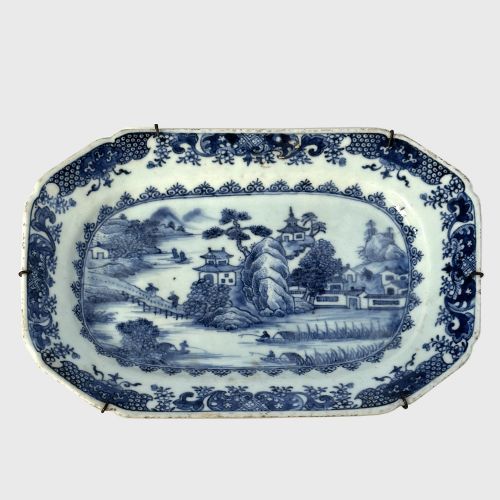
Certain items reflect specific historical epochs such as the Kangxi period and the Qing dynasty, alongside English transfer-printed wares bearing romantic patterns. Each object captures a landscape narrative rendered entirely in shades of blue.
How these pieces were made
The manufacturing process relies heavily on hard-paste porcelain, earthenware, and ironstone china, shaped into utilitarian and decorative vessels. Artisans applied cobalt pigment directly onto the clay body before covering the surface with a transparent glaze.
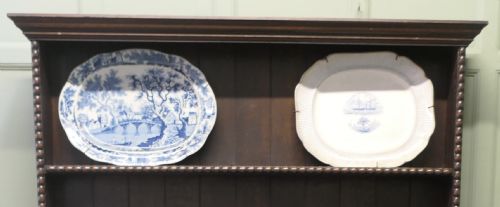
Firing at high temperatures fused the cobalt underglaze into the ceramic matrix, producing a durable finish that resists fading. Later English production incorporated transfer printing techniques to replicate intricate landscape scenery onto earthenware plates and platters.
Listings feature periods ranging from the seventeenth-century Kangxi era through to Victorian Staffordshire production.
What varies in quality
Quality diverges between early hand-painted porcelain and later industrial transfer-printed earthenware. The clarity of the cobalt pigment and the precision of the brushwork or print define the visual appeal of each landscape.
The sophistication of the ceramic body itself, whether translucent hard-paste porcelain or heavier ironstone, establishes the structural refinement of the piece. Preservation of the original glaze and the crispness of the pastoral details dictate overall merit.
William Adams·Mintons·James Wallace & Co.·Mason's
The Blue White Landscape China Glossary
- Cobalt Underglaze
- A metallic pigment applied to raw pottery before glazing, capable of withstanding intense kiln temperatures without losing its blue colour. This technique ensures the decoration remains sealed beneath the glassy surface.
- Transfer Print
- A method where an engraved copper plate transfers a design onto tissue paper, which is then pressed onto the ceramic body. This process allowed factories to produce detailed landscape patterns efficiently.
- Hard-paste Porcelain
- A dense, vitrified ceramic composed of kaolin and petuntse fired at extremely high temperatures. It yields a ringing tone when struck and a bright, impervious body.
- Ironstone China
- A durable type of earthenware patented in the nineteenth century to imitate porcelain strength. It provides a sturdy substrate for large meat platters and serving vessels.
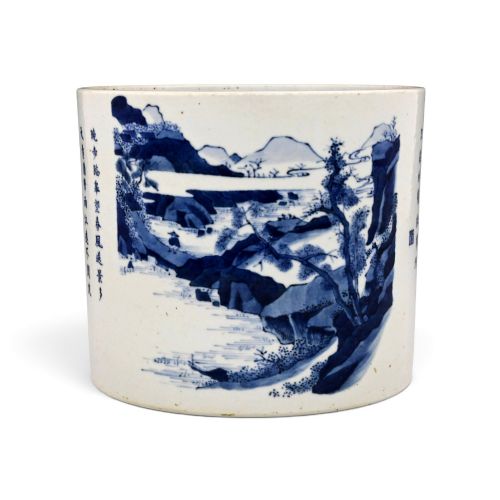
- Bitong
- A cylindrical brush pot utilised by scholars for holding writing implements in traditional studies. These carved porcelain vessels frequently display delicate landscape motifs.
Blue White Landscape China: Frequently Asked Questions
What is blue white landscape china?
These items are ceramic vessels decorated with cobalt blue pigments depicting natural scenery, rivers, and architectural vistas.
They encompass utilitarian wares like meat platters and teapots alongside decorative plates and scholar's brush pots.
How do I date these pieces?
Dating relies on identifying the ceramic body, the manufacturing technique, and any maker marks present on the base.
Early examples often feature hand-painted Chinese export porcelain, whereas nineteenth-century pieces frequently utilise English transfer printing on earthenware.
Can I use these plates daily?
Many antique platters and plates remain structurally sound for gentle everyday use or display.
Careful hand washing preserves the historic glaze and prevents damage to the nineteenth-century earthenware bodies.
What patterns are common?
Common motifs include Italianate landscapes, native scenes, and rural scenery derived from both Eastern and Western traditions.
These pastoral compositions define the visual character of nineteenth-century transfer-printed pottery.