
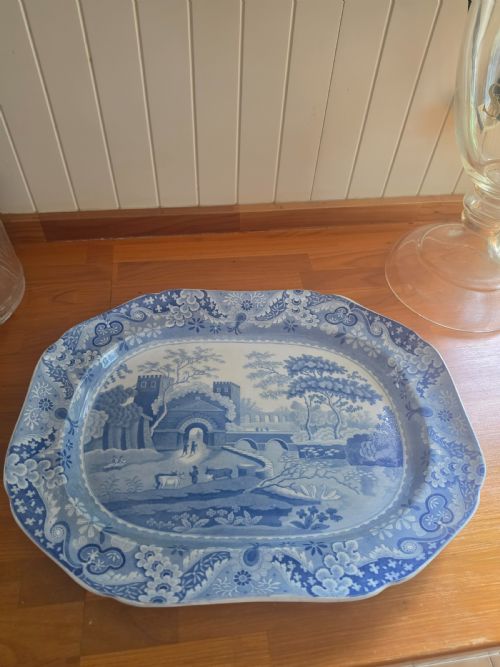
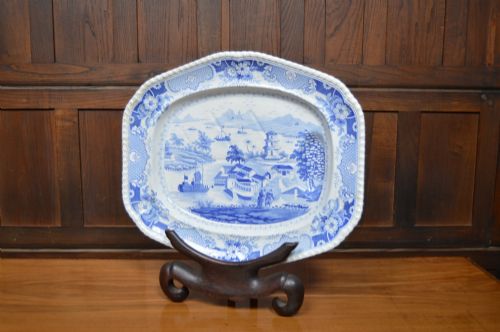
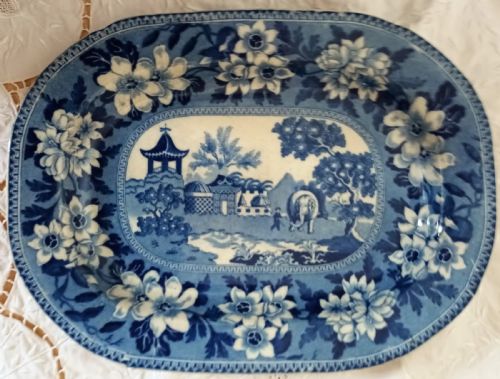
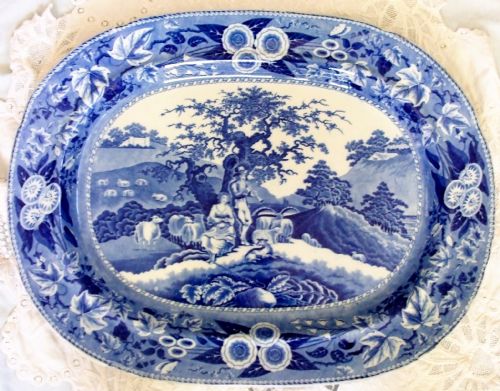


Blue Transferware Meat Dish
A blue transferware meat dish is a substantial ceramic platter designed for carving and serving joints at table.
Blue Transferware Meat Dish
A blue transferware meat dish is a large ceramic platter designed for serving joints of meat at table. These pieces emerge primarily across the Georgian, Regency, and Victorian periods from English potteries.
Originating largely from Staffordshire and notable factories, these substantial earthenware and pearlware vessels served the dining rooms of the nineteenth century with durable utility and pictorial depth.
How they were made
Potters shaped earthenware, pearlware, or ironstone bodies before applying a design engraved on a copper plate and transferred via tissue paper using cobalt pigment. Artisans then sealed the ceramic beneath a transparent lead glaze, fixing the intricate blue print during firing.
Platters often incorporate practical drainage channels, reservoirs, and gravy wells moulded directly into the clay body to manage carving juices during dining.
Water dogs and piping shepherds occasionally share dining tables with classical ruins and naval battles.
What varies in quality
Quality rests in the clarity and crispness of the transfer print, where fine lines remain sharp without blurring or pooling of the cobalt pigment beneath the glaze. Superior examples exhibit harmonious composition across expansive surfaces, deep rich colour, and well-balanced forms without distortion from the kiln.
The distinction between standard commercial output and exceptional production also shows in the weight of the ceramic body, the complexity of the moulded border work, and the prestige of the maker named on the reverse.
Spode·John Rogers and Son·Copeland and Garrett·Thomas Lakin·Don Pottery·Minton·Elkin Knight and Bridgwood·Mason·J.W.R.
The Blue Transferware Meat Dish Glossary
- Transferware
- Ceramic pottery decorated by printing a design from a copper plate onto paper and transferring it onto the unglazed or bisque surface before glazing.
- Pearlware
- A refined earthenware developed in the late eighteenth century featuring a subtle bluish glaze that pooled slightly in recesses to mimic Chinese porcelain.
- Gravy well
- A recessed depression or oval pool at one end of a serving platter designed to collect juices during meat carving.
- Chinoiserie
- A decorative style reflecting European interpretations of Chinese and East Asian artistic motifs, frequently found on nineteenth-century ceramic patterns.
- Drainer
- A removable ceramic insert pierced with holes that sits inside a platter to elevate meat above accumulated juices.
Blue Transferware Meat Dish: Frequently Asked Questions
How do I date a meat platter?
Dating relies on combining stylistic evidence, registry marks, maker names, and ceramic body types such as early pearlware versus later ironstone. Georgian pieces often display distinct floral borders and earthenware bodies, while Victorian examples introduce varied romantic series.
Examining the backstamp and the tone of the cobalt pigment helps narrow the decade of production within the nineteenth century.
Were these dishes used for cooking?
These platters were designed exclusively for serving cooked food at the table rather than for exposure to direct oven heat. Their primary function was holding large joints of meat during carving and presentation.
The inclusion of reservoirs and drainers indicates they were meant to catch juices rather than act as roasting trays.
How do I display a large platter?
Large platters can be displayed securely on sturdy plate stands or hung on walls using appropriate sized wire hangers designed for heavy ceramics. Placing them on dining sideboards or dresser shelves highlights their pictorial transfer prints.
Ensure wall fixings are rated for the considerable weight of nineteenth-century earthenware and ironstone.