


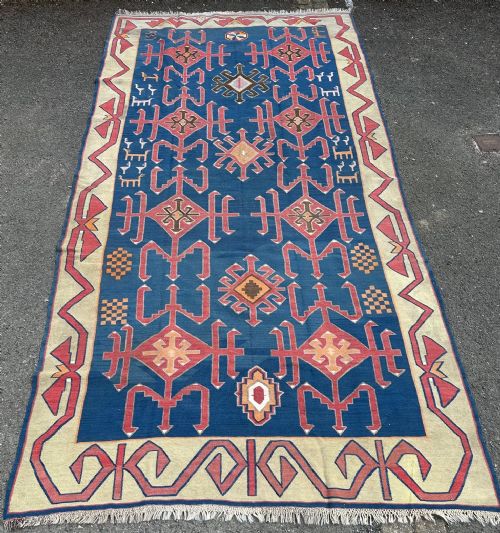


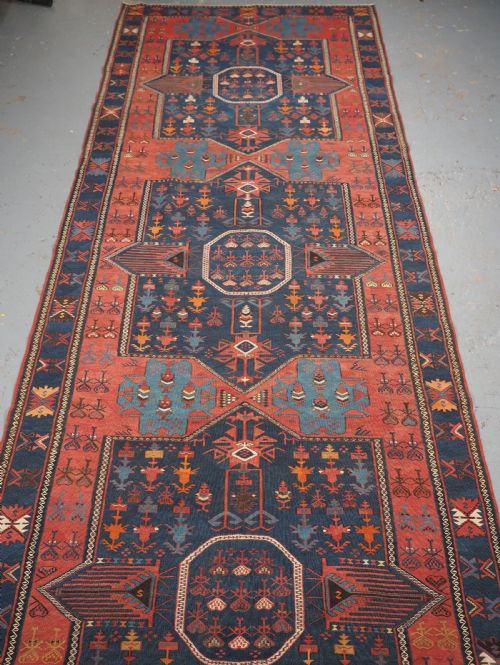


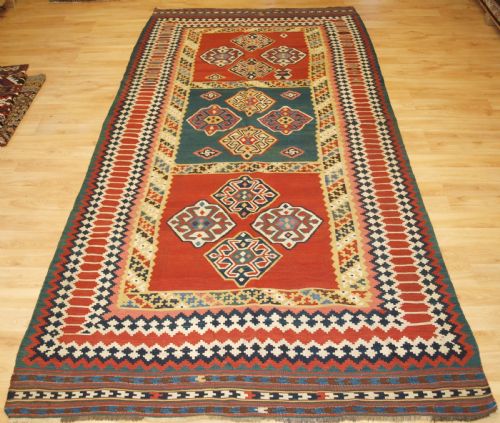
Blue Red Kilim Runner
A blue red kilim runner brings flat-woven tribal geometry and rich regional hues into a hallway or narrow space.
Blue Red Kilim Runner
A blue red kilim runner is a flat-woven textile produced by nomadic and village weavers across Persia, the Caucasus, Anatolia, and Central Asia. These narrow carpets served practical functions in tribal households, functioning as floor coverings, tent furnishings, or storage covers before entering the antique market. The examples found here span from the mid nineteenth century through to the mid twentieth century, encompassing tribal traditions such as Baluch, Kurdish, Qashqai, and Caucasian group work.
Buyers most frequently encounter narrow formats like the Senneh Bijar or Shahsevan long rugs, alongside multi-panel Uzbek covers and Anatolian kilims. These pieces rely on slit-weave techniques that produce sharp geometric motifs without a pile. The resulting flat surface makes them durable choices for corridors and stairs where a heavy pile rug might impede doors.
How they were made
Weavers constructed these runners using hand-spun wool for the structural warps and supplementary wefts, often paired with cotton foundations in later regional pieces. Natural dyes provided the characteristic palette, yielding deep indigos and madder reds that developed subtle abrash variations over decades of use and exposure to light. The interlocking slit-weave technique required precise tension control to prevent structural distortion along the vertical edges.
Certain groups employed Soumak wrapping techniques or joined multiple narrow strips together with decorative stitching to achieve wider formats or specific runner proportions. These methods demanded considerable manual labour and intimate knowledge of local sheep breeds and dye plants. The absence of a knotted pile meant that the visual impact depended entirely on the precise placement of coloured weft threads.
Current listings feature runners utilising hand-spun wool and natural dyes across periods spanning from eighteen-eighty to nineteen-forty.
What varies in quality
Quality in these flat-weaves rests on the tightness of the weave and the crispness of the geometric drawing executed by the weaver. Finer examples display high knot or weft counts per square decimetre, allowing complex patterns like eye dazzlers or compartment designs to remain sharp and legible. Weaker pieces often show uneven widths, clumsy colour transitions, or wool that has become brittle through improper washing.
The sophistication of the natural dye palette distinguishes standard utility pieces from masterworks. Superior runners exhibit complex secondary tones derived from roots and insects, whereas lesser examples rely on flat, uniform colour applications. The integrity of the original selvedges and the stability of the foundation wool also determine the enduring structural merit of each textile.
The Blue Red Kilim Runner Glossary
- Kilim
- A flat-woven carpet or rug produced without a pile by tightly interweaving warp and weft threads. This technique creates a lightweight textile that is reversible and well-suited for hanging or floor use.
- Sofreh
- A flat-woven cloth traditionally used for spreading meals, kneading bread, or sitting upon during communal gatherings. These functional domestic textiles often feature striking tribal layouts.
- Soumak
- A brocading technique where coloured weft threads are wrapped around warp threads in various sequences to create a raised, textured surface resembling embroidery. It adds durability and weight to the finished textile.
- Abrash
- Variations in colour hue caused by differences in dye batches, wool lots, or the natural fading of natural dyes over time. It creates a subtle, shaded appearance across the field of the rug.
- Warp
- The stationary vertical threads stretched across a loom that form the foundational skeleton of the textile. Weft threads are passed horizontally through these structural elements.
Blue Red Kilim Runner: Frequently Asked Questions
How do I clean an antique runner?
Surface dust should be removed gently using a soft brush or light suction without a rotating beater bar. Professional textile cleaning is necessary for deeper soil removal to protect natural dye stability.
Water saturation must be managed carefully to prevent dye migration between adjacent red and blue wool sections. Flat-weaves respond best to specialist care rather than domestic washing methods.
Are these runners suitable for heavy hallways?
Flat-woven textiles lack a pile, which helps them endure high foot traffic without crushing or matting fibres. A quality underlay provides cushioning and prevents slipping on smooth floors.
Rotating the runner periodically distributes wear evenly along its length, particularly in narrow corridors where footsteps concentrate centrally.
How can I tell tribal origins apart?
Distinctive geometric vocabularies, structural materials, and end-finish techniques point toward specific weaving groups. Caucasian pieces often display sharp hexagonal medallions, while Persian tribal work utilises softer curvilinear influences.
Examining the side cord construction and secondary colours helps clarify whether a piece originates from Anatolia, the Caucasus, or Central Asia.
What does multi-strip construction mean?
Certain regional formats required weavers to produce two or more narrow bands on portable looms before stitching them together edge to edge. This method enabled nomads to create substantial coverings despite narrow loom dimensions.
Visible join seams are a normal characteristic of large Uzbek or Afghan covers rather than a sign of structural damage.