





Blue Ocean Watercolour Painting
A blue ocean watercolour painting brings the movement and salt air of the nineteenth and twentieth centuries directly into a room through pigment on paper.
Blue Ocean Watercolour Painting
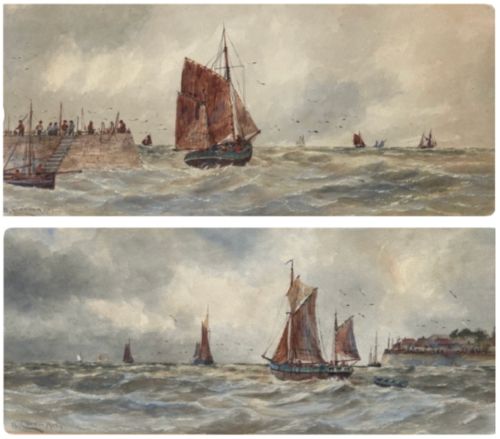
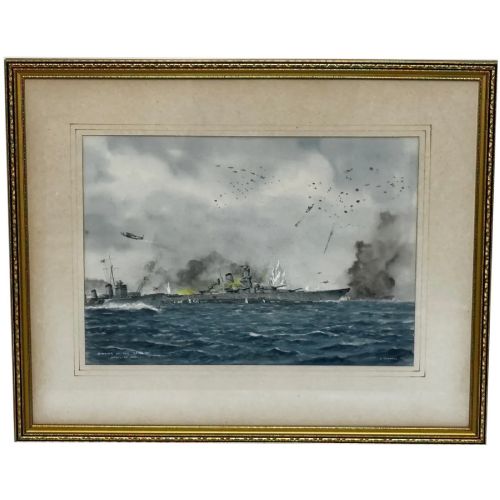
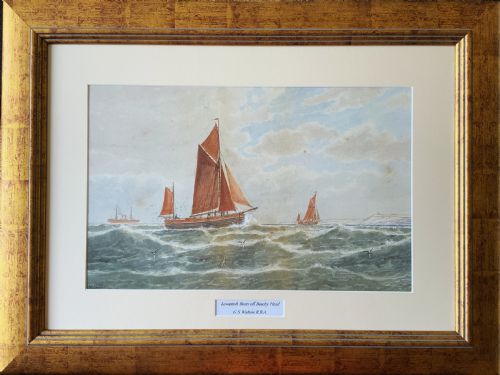
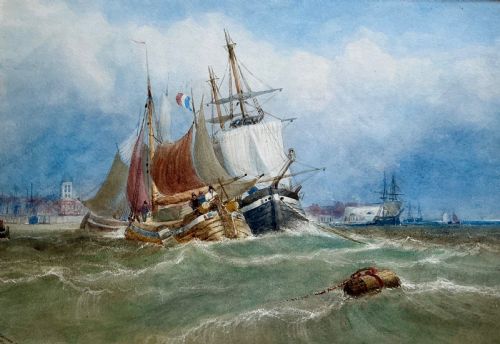
A blue ocean watercolour painting captures maritime scenes, coastal harbours, and deep-sea vessels across the nineteenth and twentieth centuries. These works range from late Victorian depictions of Cornish fishing villages to Edwardian coastal studies and mid-century naval subjects.
Buyers encounter works executed on paper, often preserved behind glass within wooden, ebonised, or gilt frames. The subject matter typically centres on fishing boats, sailing barques, lighthouses, and choppy seas around the British coast and international waters.
The aesthetic shifts from detailed Victorian marine art and traditional English seascapes toward the looser brushwork associated with British impressionism in the early twentieth century. Mid-century examples introduce specific vessels and naval engagements rendered in watercolour pigment.
Materials and technique
Artists applied watercolour pigment directly onto paper, utilising the white ground of the sheet to create luminosity in the breaking waves and sky. Washed layers establish the transparent depths of the sea, while finer brushwork defines rigging, hulls, and distant shorelines.
Framing materials commonly include wood, gilt wood, and gold leaf, which serve to protect the delicate paper surface from atmospheric moisture. Ebonised frames appear frequently on works from the early twentieth century, contrasting with the lighter tones of the maritime palette.
Several artists captured the exact moment a fishing fleet returned to harbour with nets full of herring.
Evaluating quality and handling
Quality rests upon the artist's command of water and pigment to convey the weight of water and the motion of air. Stronger pieces demonstrate confident control over transparency, capturing light on the sea surface without heavy reworking.
The handling of atmospheric perspective separates accomplished maritime works from routine coastal views. Superior paintings integrate the sky, sea, and vessel into a coherent chromatic harmony, particularly in depictions of heavy weather and coastal harbours.
William Cannon·John E. Aitken·Eric Tufnell·William Banks Fortescue·George Stanfield Walters·Henry Barlow Carter·Charles William Adderton·Frank H. Mason·Sir William Russell Flint·Samuel Owen·Kate E Booth·Frederick Stuart Richardson·Percy Brooke·John McDougal·Frank Wood·Joseph Newington Carter·S. J. Lamorna Birch·Samuel Edward Kelly·Edmund Gouldsmith·J Syer·Fred Stead·James Aitken·Thomas Bush Hardy·J. W. Carey
The Blue Ocean Watercolour Painting Glossary
- Watercolour pigment
- The finely ground colouring agent suspended in a water-soluble binder, applied to paper to achieve transparent washes.
- Ebonised frame
- Wood treated with a dark stain or finish to imitate ebony, commonly used to frame works from the late nineteenth and early twentieth centuries.
- Gilt wood
- Timber framing coated with a thin layer of gold leaf or metallic paint, adding a reflective border to the paper artwork.
- Marine art
- Artistic representation of maritime subjects, including ships, coastal scenes, and naval engagements, executed in various media.
- British impressionism
- A painting style adopted by British artists focusing on light, atmosphere, and looser brushwork rather than rigid academic detail.
Blue Ocean Watercolour Painting: Frequently Asked Questions
How should I hang a watercolour painting?
Keep watercolour works away from direct sunlight to prevent the pigments and paper from fading over time.
Ensure the room maintains stable humidity levels to protect both the paper support and the wooden frame.
What subjects appear in these paintings?
The works depict fishing boats, lighthouses, coastal harbours, and large sailing vessels navigating choppy seas.
Scenes range from British coastal spots like St Ives and Scarborough to international waters and naval subjects.
How do I identify the period of a work?
Signatures, framing styles, and the specific attire or vessel types depicted offer strong clues to the date of execution.
Victorian pieces often feature meticulous detail, whereas twentieth-century examples lean towards looser impressionistic brushwork.
Are these paintings usually framed?
Most works arrive framed, often behind glass in original wooden, ebonised, or gilt wood surrounds.
Glass protection is essential for watercolours on paper to prevent surface dust and moisture damage.