

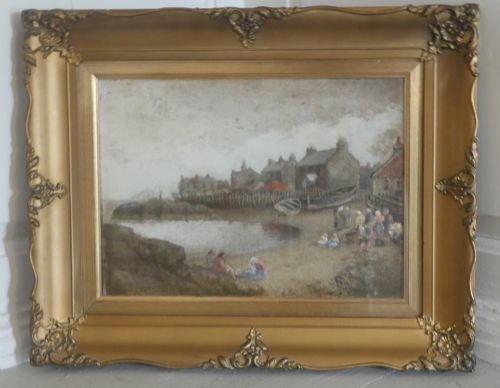

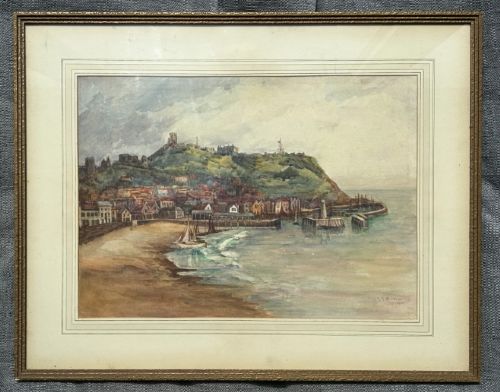


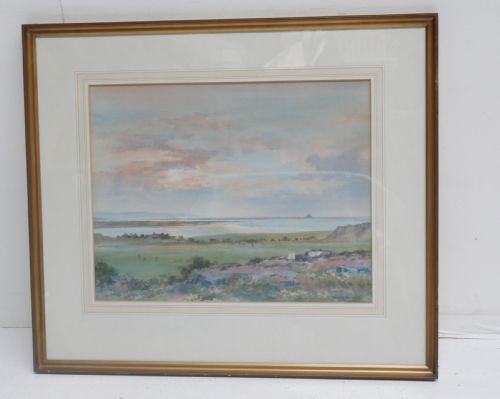


Vintage Seaside Artwork
Vintage seaside artwork brings coastal views, harbour scenes and sandy shores from past centuries directly into modern rooms.
Vintage Seaside Artwork
Vintage seaside artwork captures coastal life, fishing harbours and sandy beaches through the eyes of artists working from the nineteenth century into the mid-twentieth century. These pieces record specific locations, from Cornish fishing villages to chalk cliffs and Victorian pleasure piers, using traditional topographical and impressionist approaches.
The selections available here rely heavily on works executed in watercolour on paper and oil on canvas or board. Buyers find both intimate depictions of children playing by the shore and expansive views of shipping in coastal waters.
How they were made
Artists painted these coastal subjects using oil on canvas, oil on board, and watercolour on paper, framed in wood or gilt wood to protect the surface. Many watercolours capture the changing light of the shore quickly on paper, whilst oil paintings utilise thicker layers on canvas or board to build depth and texture.
Makers mounted paper works behind glass or framed oil pieces directly within wooden mouldings, employing traditional framing techniques that suit the period of the painting.
Listings feature works from the nineteenth century, 1900, 1910, 1920, 1930, 1940, 1950 and 1960 periods.
What varies in quality
Quality rests on the artist's ability to render the specific quality of coastal light and atmosphere, distinguishing accomplished plein air observation from formulaic studio work. The handling of water, sky and figures determines whether a harbour scene holds lasting artistic interest.
Condition also separates examples, as paper works suffer from foxing and fading whilst canvases can show old repairs or craquelure, though well-preserved media retain their original impact.
Clifford Hanney·Edward Mills·William Banks Fortescue·F A Roylance·Lionel Horsnell·John Bedloe Goddard·Norman Lloyd·William J B Jenkins·William Raymond Dommersen·Sir William Russell Flint·Frank Wood·H E Tidmarsh·Alfred Henry Vickers·Percy Brooke·Jack R Mould·James George Bingley·John Sanderson Wells·Robert Macaulay Stevenson·John Abernethy Lynas-Gray·William Greaves·James Watson·Edwin Bagshaw·Yves Brayer·George Marks·Alfred Egerton Cooper
The Vintage Seaside Artwork Glossary
- Watercolour painting
- A work created using water-soluble pigments on paper, often favoured for capturing fleeting coastal weather and bright marine light.
- Oil on canvas
- Pigments bound in a drying oil applied to a stretched fabric support, allowing rich texture and durable preservation.
- Topographical art
- Work that depicts specific real-world locations with geographical accuracy, common in nineteenth-century views of named bays and piers.
- Impressionism
- A style focused on accurate depiction of light in its changing qualities, seen in mid-century and earlier coastal beach scenes.
- Gilt wood
- Wood coated with gold leaf or a gold-coloured finish, frequently used for traditional picture frames.
Vintage Seaside Artwork: Frequently Asked Questions
What periods do these coastal paintings cover?
The works span from the late nineteenth century through the Edwardian era into the mid-twentieth century, including Victorian pieces and post-impressionist examples.
This broad range allows collectors to find both precise topographical records and looser, modern interpretations of British and French shores.
Where were these seaside scenes usually painted?
Artists painted across named coastal locations, capturing harbours, fishing ports, piers and cliffs in regions such as Yorkshire, Dorset, Devon and Cornwall.
Many works record specific spots like St Ives, Whitby, Scarborough and various French coastal towns during summer visits.
How should I frame and display a watercolour?
Watercolours require mounting behind glass to protect the paper from moisture, atmospheric pollutants and physical damage.
Positioning them away from direct sunlight preserves the delicate pigments used by artists to render coastal skies and water.
How do I distinguish between oil and watercolour?
Oil paintings feature a textured surface on canvas or wooden board, often showing visible brushstrokes and a heavier paint layer.
Watercolours present a flatter appearance on paper, relying on transparent washes where the white of the paper shows through.