

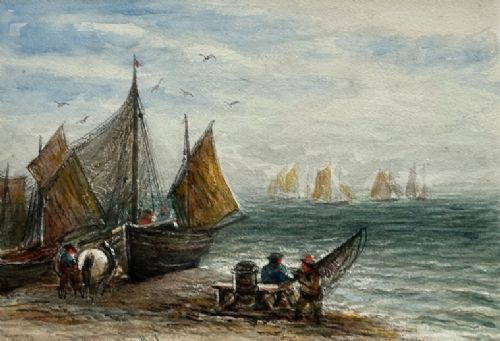



Watercolour Beach Scene
These watercolour beach scene paintings capture the movement of coastal life on paper, bringing salt air and shoreline light directly into a room.

Watercolour Beach Scene
A watercolour beach scene depicts coastal views, fishing harbours, and tidal shores through pigment applied directly to paper. You will most frequently encounter nineteenth century Victorian works alongside early twentieth century British examples showing ports, boats, and figures along the coast.
The subjects range from bustling Yorkshire and Cornish fishing villages to quiet Scottish estuaries and foreign shores. These works document maritime life, capturing low tides, beached boats, and fisherfolk at work under changing skies.
Materials and technique
Artists painted primarily with watercolour pigment suspended in water, brushed onto heavy paper sheets to achieve translucent washes and fine details. Many examples rely on the white of the unpainted paper itself to create the glare of sunlight on sand and foam.
Framing often involves wood, gilt wood, gold leaf, or ebonised surrounds, frequently protected behind glass to shield the delicate water-soluble pigments from moisture and fading.
Watercolour Beach Scene Retail Price Guide 2026
Typical asking prices for watercolour beach scene among the pieces listed under this phrase on Sellingantiques today, from the lower quarter to the upper quarter. They describe what is for sale here now, not the wider market.
Fisherfolk hauling nets on windy shores share space with quiet Scottish estuaries and sunlit foreign harbours.
What separates the best from the rest
Quality rests on the sureness of the brushwork and the artist's command of atmospheric light and weather. The strongest examples display confident washes that render sea spray, wet sand, and shifting cloud formations with immediate clarity.
The framing and preservation also play a significant part, as works retained behind clean glass with minimal fading or foxing preserve the artist's original palette and tonal contrast.
James Orrock·William Banks Fortescue·George Hamilton Constantine·Sir William Russell Flint·Frederick William Hattersley·Kate E Booth·Ernest F Hill·Madeline Hughes·GM de L Aubiniere·Yves Brayer·Markey Robinson·Thomas Bush Hardy·Joseph Pighills
The Watercolour Beach Scene Glossary
- Watercolour pigment
- Finely ground colour particles mixed with a water-soluble binder, applied in thin washes to paper. This medium allows for luminous effects through the transparent layering of colour.
- Foxing
- Brown spots caused by chemical reactions in old paper over time. It appears frequently in nineteenth century works stored in damp conditions.
- Ebonised frame
- Wood treated to imitate ebony, providing a dark, contrasting border around the painting. These frames are common on Victorian and early twentieth century works.
- Gilt wood
- Wood carved and coated with a thin layer of gold leaf or metallic paint. It frames many traditional British and European watercolours from this period.
Watercolour Beach Scene: Frequently Asked Questions
How should I hang a watercolour beach scene?
Keep these works away from direct sunlight to prevent the watercolour pigments from fading over time. UV-filtering glass provides an extra layer of protection for nineteenth century paper.
Ensure they hang on interior walls where humidity and temperature remain relatively stable to protect both the paper and the original frame.
How do I identify a Victorian beach painting?
Victorian examples often feature detailed maritime activities, such as spreading fishing nets or hauling boats ashore, rendered in naturalistic tones. The paper and framing materials typically match nineteenth century production methods.
Signatures, artist inscriptions, and framing styles frequently help anchor these pieces within the Victorian period.
Are these paintings always framed under glass?
Watercolour on paper requires glass protection because the pigment sits on the surface without a protective varnish layer. Dust and moisture damage unprotected paper very easily.
Original frames with old glass often accompany these pieces, adding to their historical character.
What subjects appear besides British beaches?
While British coastal scenes from locations like St Ives and Whitby dominate, the selection includes foreign shores such as Dutch ports and Arabic coastal views. Artists travelled widely to paint Mediterranean and continental harbours.
These international works share the same watercolour techniques used by British artists of the era.